

Politicised science on the Great Barrier Reef? It's been that way for more than a century
- Written by: Rohan James Lloyd, Adjunct Lecturer, James Cook University
The controversy surrounding the A$444 million given to the Great Barrier Reef Foundation by the federal government shows how politicised science has become on the Great Barrier Reef.
One reef scientist, who declined to be named, was quoted saying that the grant was “obviously” political, and accused the federal government of seeking to deny the opposition the chance to make the Great Barrier Reef an election issue.
But the politicisation of reef science, and particularly the Great Barrier Reef itself, is not new. It has a long history, stretching back to the time when the British empire was at its most powerful.
Read more: Is it too cheap to visit the 'priceless' Great Barrier Reef?
In the nineteenth century, scientists studying the Great Barrier Reef were driven by the political winds and whims of British colonialists. For the most part, these scientists aided the mission of exploration and settlement. With every exploratory voyage, the value of the Great Barrier Reef as an arm of the empire grew, as scientists began to weave their insights into the reef’s biology and geology with evocations of its potential resources and suitability for settlement. Scientists such as Joseph Beete Jukes were particularly important in illuminating the Great Barrier Reef’s scientific mysteries and economic possibilities.
Around the time of federation in 1901, however, the politics of reef science took on a heightened nationalistic and provincial tone. Scientists asserted that the Great Barrier Reef’s value to Queensland and the nation lay specifically in its exploitable resources, and argued that it was the government’s responsibility to develop them.
As the science was in its infancy, reef scientists imagined that their field would inevitably develop in concert with the establishment of reef-based industries such as fishing and coral rubble mining.
Read more: Death on the Great Barrier Reef: how dead coral went from economic resource to conservation symbol
In the early twentieth century, scientists suggested that a research station needed to be established along the Queensland coast. The idea was championed by natural historian Edmund Banfield, who wrote that it would “demonstrate how best the riches of the Great Barrier Reef might be exploited”.
Many scientists of the day believed that the government had failed to sufficiently develop the Great Barrier Reef, and feared that its dormant resources were at risk of plunder by our northern Asian neighbours. Reef science became caught up in the prevailing discourse of an empty and undeveloped northern Australia.
In response, Queensland-based scientists established the Great Barrier Reef Committee in 1922. The committee saw itself as having two roles: “pure” scientific research on the reef’s biology and geology; and the identification of commercial products that the reef could provide.
In 1928 the committee, backed by the British, Australian and Queensland governments, organised a research expedition to Low Isles, off the coast of Port Douglas.
The year-long expedition, led by British-born marine scientist Charles Maurice Yonge, aimed to find evidence of the reef’s economic potential. But the research, while significant to coral-reef science, offered little advice for the Queensland government despite its significant financial investment.
Nonetheless, the Great Barrier Reef Committee continued to leverage the state government’s interest in developing northern Queensland, and in 1950 it secured a lease on Heron Island. The committee was also given funding to build a research station on the island, after promising that it would reveal commercial products and boost tourism.
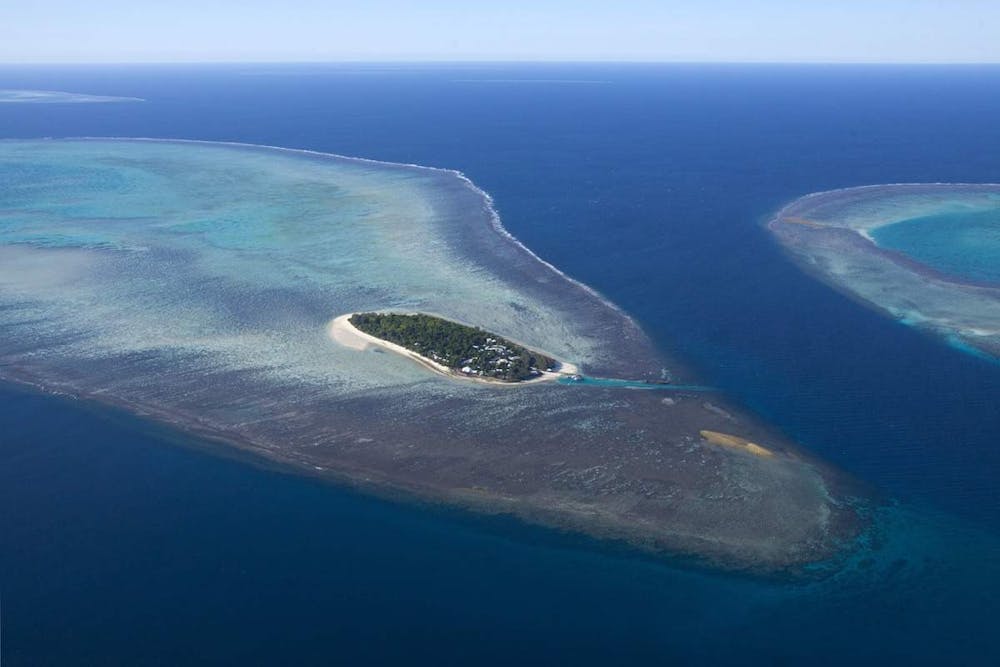 Heron Island, where the research station is still operating, now run by the University of Queensland.
UQ/Wikimedia Commons, CC BY-SA
Heron Island, where the research station is still operating, now run by the University of Queensland.
UQ/Wikimedia Commons, CC BY-SA
The Heron Island research station was built at a time when only a few Australian universities offered full courses in marine biology. Reef science had always been dominated by geology, as researchers sought to understand how coral reefs were formed.
After the second world war, aided by more sophisticated drilling equipment, and governments eager to locate local oil reserves, scientists such as the Queensland geologist Dorothy Hill began studying the Great Barrier Reef’s mineral and petroleum reserves, and recommended several sites for further exploration.
Between 1959 and 1967 three exploration wells were drilled along the reef, but none showed signs of oil or gas. In the same period, the Queensland government granted 37 prospecting and exploration permits, 23 of them in the vicinity of the Great Barrier Reef.
Geologists’ role in this exploration meant that they were viewed with suspicion by their marine biologist colleagues when the “Save the Reef” campaign began in 1967.
Geologists were largely seen as sympathetic to the oil industry’s interests, whereas marine biologists typically aligned themselves with the views of conservationists. At the same time, scientists found themselves taking sides in response to the first outbreak of Crown of Thorns starfish in the 1960s.
Robert Endean, the scientist who campaigned for government intervention in the outbreak, found himself marginalised by the scientific community, faced backlash from tourist operators concerned by his claims of dying reefs, and eventually lost government support for his research.
During both the Save the Reef campaign and the Crown of Thorns outbreak, scientists were publicly scrutinised for how their research, and their public comments, impacted the debate. A similar pattern has played out over the mass coral bleaching that hit the Great Barrier Reef in 2016.
Today, it seems governments are seeking to make the Great Barrier Reef appear to be protected while scientists themselves leverage the political and public fascination, with the result that the Great Barrier Reef accounts for a significant proportion of Australia’s entire marine research output.
The issues of sediment and nutrient run-off, coral bleaching, ocean acidification, Crown of Thorns starfish, coal mines, and port developments have all complicated the politics of reef science.
Read more: Not out of hot water yet: what the world thinks about the Great Barrier Reef
For half a century, the science has been overlaid with a wider discourse about the need to preserve the Great Barrier Reef. This idea, championed by scientists, politicians and civil society, shows no sign of subsiding.
Today, the amounts of money involved may well be unprecedented. But the idea of reef science coming with political strings attached is nothing new.
Authors: Rohan James Lloyd, Adjunct Lecturer, James Cook University


















