

The Lord Howe screw pine is a self-watering island giant
- Written by: Matthew Biddick, PhD Researcher, Victoria University of Wellington
If you’d like more content like this, sign up for the Beating Around the Bush newsletter for a dose of nature news every two weeks.
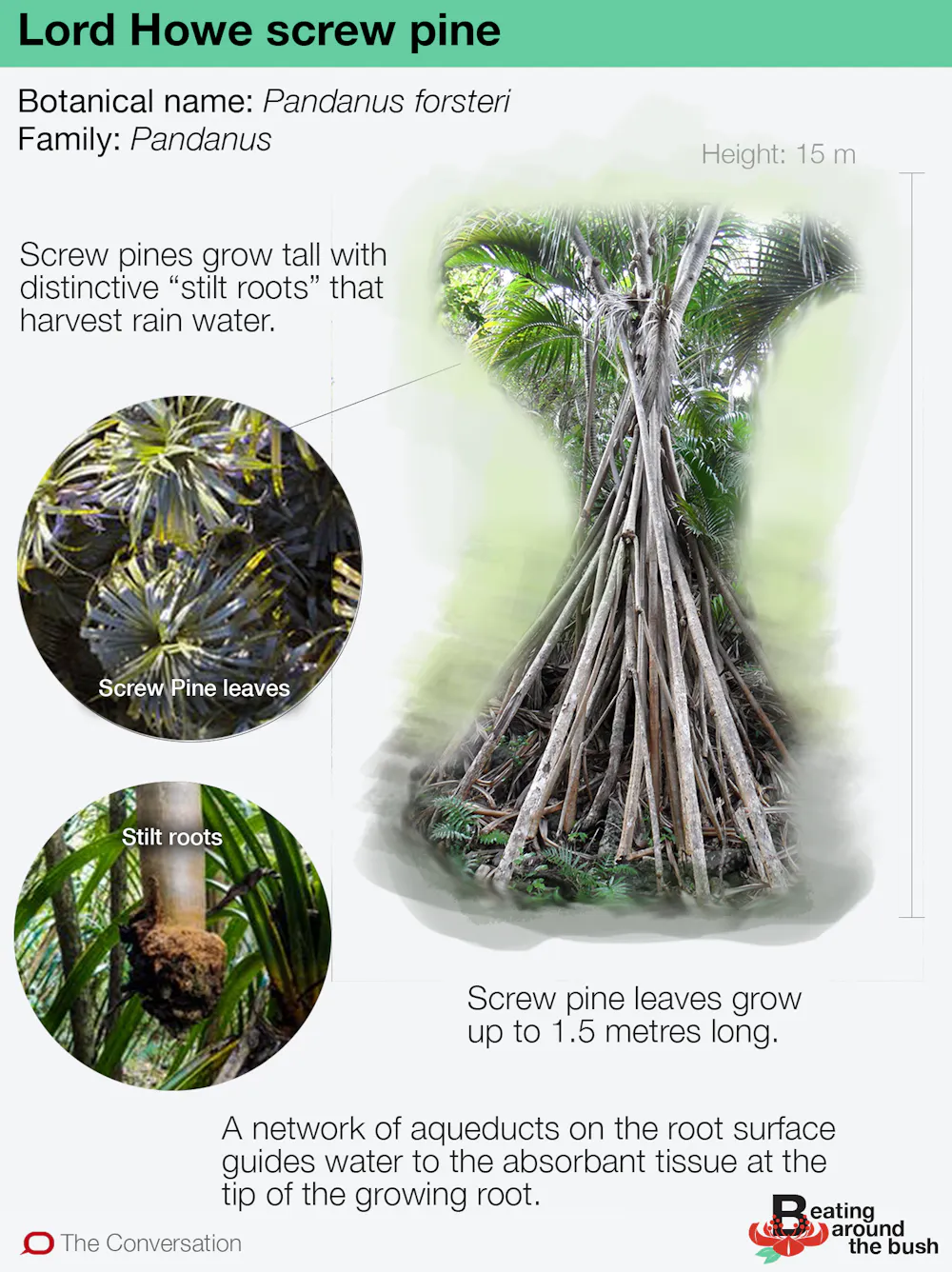
Pandanus forsteri, a species of screw pine endemic to Lord Howe Island, grows tall like no other tree on Earth. To reach the canopy, these trees have evolved a rainwater harvesting system that enables them to water themselves.
Originally from Micronesia, the palm-like P. forsteri belongs to a group of trees that have populated almost every coastal habitat of the Pacific. In fact, pandans are used by Oceanic cultures for everything from fishing and cooking to medicine and religious ceremonies.
Our research shows that pandans differ in several fundamental ways from more familiar trees, including how they capture water and grow.
Read more: Welcome to Beating Around the Bush, wherein we yell about plants
 Reaching for the canopy
Most trees lay down concentric rings of vascular tissue as they mature, thickening over time. This enables them to grow tall, yet maintain enough structural integrity to avoid toppling over. It is also arguably the most important evolutionary innovation that has enabled trees to colonise most of terrestrial Earth.
Together with palms, bamboo and yucca, pandans belong to a group known as monocots, because their seedlings produce a single embryonic leaf.
Reaching for the canopy
Most trees lay down concentric rings of vascular tissue as they mature, thickening over time. This enables them to grow tall, yet maintain enough structural integrity to avoid toppling over. It is also arguably the most important evolutionary innovation that has enabled trees to colonise most of terrestrial Earth.
Together with palms, bamboo and yucca, pandans belong to a group known as monocots, because their seedlings produce a single embryonic leaf.
 Pandans belong to a group of plants whose vascular tissue is still primitive, making it difficult to grow tall.
Ian Hutton, CC BY-SA
Their vascular tissue is not compartmentalised in the same way. It forms bundles that are positioned somewhat haphazardly within the stem. Consequently, monocots are unable to produce true secondary growth and thicken like other trees do – and reaching the canopy becomes a much more ambitious endeavour.
The canopy offers a good life. The sun is shining, seed-dispersing birds are abundant, and the herbivores of the forest floor are a distant concern. In monocots, natural selection has favoured some inventive ways of stretching to the top.
Pay-as-you-go growth
Palms overcome the limitations imposed by their physiology by spending their younger years laying down enough vascular girth to support their future stature. Think of it like putting aside money for your retirement. You may not need it now, but you will likely later depend on it.
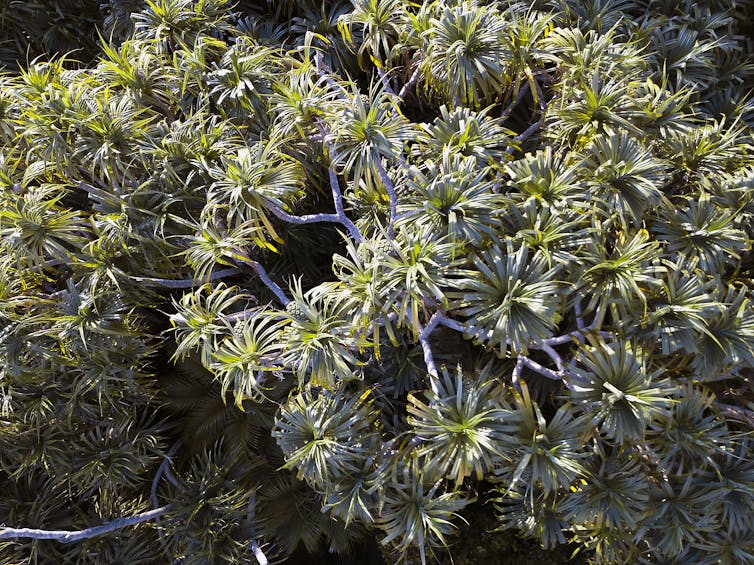
Pandans belong to a group of plants whose vascular tissue is still primitive, making it difficult to grow tall.
Ian Hutton, CC BY-SA
Their vascular tissue is not compartmentalised in the same way. It forms bundles that are positioned somewhat haphazardly within the stem. Consequently, monocots are unable to produce true secondary growth and thicken like other trees do – and reaching the canopy becomes a much more ambitious endeavour.
The canopy offers a good life. The sun is shining, seed-dispersing birds are abundant, and the herbivores of the forest floor are a distant concern. In monocots, natural selection has favoured some inventive ways of stretching to the top.
Pay-as-you-go growth
Palms overcome the limitations imposed by their physiology by spending their younger years laying down enough vascular girth to support their future stature. Think of it like putting aside money for your retirement. You may not need it now, but you will likely later depend on it.
 Stilt roots support the crown as it matures.
Kevin Burns, CC BY-SA
Once thick enough, palms shift their efforts to vertical growth. The palm’s tactic of delayed vertical growth may be slow, but it functions well enough to thrust Columbian wax palms (Ceroxylon quindiuense) – the world’s tallest monocot – 45 meters into the clouds.
Pandans, on the other hand, are less patient. Unlike palms, they prefer a sort of “pay-as-you-go” method. They produce stilt roots that extend from the trunk to the ground for support as the crown matures. The end result gives the appearance of an ice cream cone perched on a tepee of stilts. It’s an odd strategy, but it works.
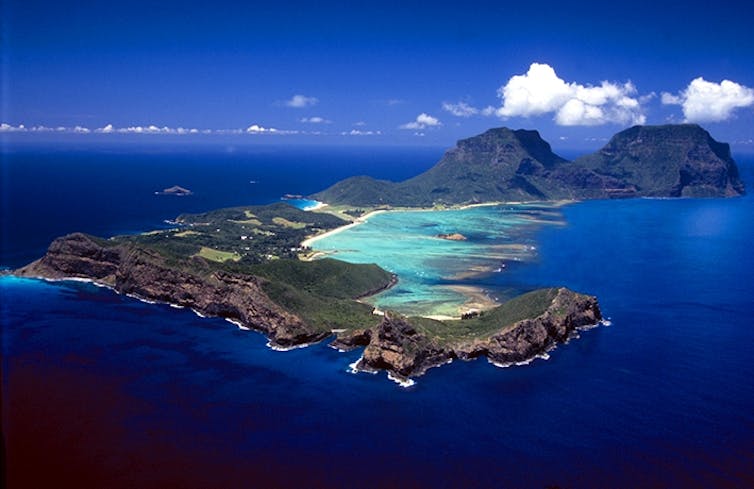
However, on Lord Howe Island, something quite remarkable has transpired. Isolated some 600 kilometres off the east coast of Australia, one species of screw pine has evolved into an island giant.
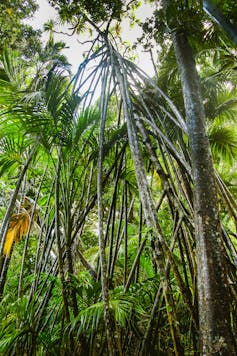
Stilt roots support the crown as it matures.
Kevin Burns, CC BY-SA
Once thick enough, palms shift their efforts to vertical growth. The palm’s tactic of delayed vertical growth may be slow, but it functions well enough to thrust Columbian wax palms (Ceroxylon quindiuense) – the world’s tallest monocot – 45 meters into the clouds.
Pandans, on the other hand, are less patient. Unlike palms, they prefer a sort of “pay-as-you-go” method. They produce stilt roots that extend from the trunk to the ground for support as the crown matures. The end result gives the appearance of an ice cream cone perched on a tepee of stilts. It’s an odd strategy, but it works.
However, on Lord Howe Island, something quite remarkable has transpired. Isolated some 600 kilometres off the east coast of Australia, one species of screw pine has evolved into an island giant.
 Lord Howe Island, some 600km off the Australian east coast, is home to countless endemic plants and animals.
Ian Hutton, CC BY-SA
Island syndrome
Most screw pines are lucky to reach four or five meters. Pandanus forsteri trees, however, regularly exceed 15 meters. These kinds of size changes are not uncommon on isolated islands. They are part of a repeated evolutionary phenomenon known as the island syndrome.
Species on isolated islands are free from the stressors of continental life, and they subsequently converge on a more optimal, ancestral form. Large continental species evolve into island dwarfs, while smaller species become comparatively gigantic. Support for the island syndrome primarily comes from animals. However, a growing body of evidence suggests island plants follow a similar evolutionary path.
Read more:
Lord of the forest: New Zealand's most sacred tree is under threat from disease, but response is slow
Lord Howe Island, some 600km off the Australian east coast, is home to countless endemic plants and animals.
Ian Hutton, CC BY-SA
Island syndrome
Most screw pines are lucky to reach four or five meters. Pandanus forsteri trees, however, regularly exceed 15 meters. These kinds of size changes are not uncommon on isolated islands. They are part of a repeated evolutionary phenomenon known as the island syndrome.
Species on isolated islands are free from the stressors of continental life, and they subsequently converge on a more optimal, ancestral form. Large continental species evolve into island dwarfs, while smaller species become comparatively gigantic. Support for the island syndrome primarily comes from animals. However, a growing body of evidence suggests island plants follow a similar evolutionary path.
Read more:
Lord of the forest: New Zealand's most sacred tree is under threat from disease, but response is slow
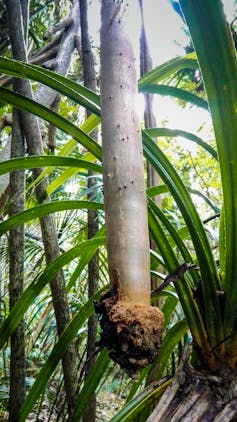 A network of aqueducts on the root surface guides water to the absorptive tissue at the tip of the growing root.
Matt Biddick, CC BY-SA
While gigantism may be favourable, it doesn’t come without risks – and for P. forsteri, they are serious. Thanks to their new-found stature, P. forsteri trees must produce enormous stilt roots to support themselves. This process that can take years. Exposed to the air, roots can form air bubbles, and an air bubble in a plant is bad in the same way it is bad in your artery. It is potentially lethal.
Nature appears to have solved this problem through the evolution of a rainwater harvesting system that enables P. forsteri to water its own stilt roots before they reach the ground.
Gutter-like leaves collect rainwater and transport it to the trunk, where it descends. The flow of water is then couriered by a network of aqueducts formed by the root surface. Finally, water is stored in a specialised organ of absorptive tissue encasing the growing root tip.
Back to the drawing board
This is dramatically different from how we traditionally think about plants. It is far from our concept of sessile beings that passively absorb everything they need from the soil, thanks to the capillary action of their vascular tissues. Never before has a plant species been shown to possess a system of traits that operate jointly to capture, transport and store water external to itself.
This species has opened our eyes to an entirely new field of scientific inquiry. It forces scientists to rethink the function of organs like leaves and roots outside of the contexts of photosynthesis and the conduction of soil water.
Do other plants harvest rainwater in this way? Why have we only just discovered this? Has our overly simplistic view of plants hindered our ability to comprehend their true complexity? Only time, and more research, will tell.
A network of aqueducts on the root surface guides water to the absorptive tissue at the tip of the growing root.
Matt Biddick, CC BY-SA
While gigantism may be favourable, it doesn’t come without risks – and for P. forsteri, they are serious. Thanks to their new-found stature, P. forsteri trees must produce enormous stilt roots to support themselves. This process that can take years. Exposed to the air, roots can form air bubbles, and an air bubble in a plant is bad in the same way it is bad in your artery. It is potentially lethal.
Nature appears to have solved this problem through the evolution of a rainwater harvesting system that enables P. forsteri to water its own stilt roots before they reach the ground.
Gutter-like leaves collect rainwater and transport it to the trunk, where it descends. The flow of water is then couriered by a network of aqueducts formed by the root surface. Finally, water is stored in a specialised organ of absorptive tissue encasing the growing root tip.
Back to the drawing board
This is dramatically different from how we traditionally think about plants. It is far from our concept of sessile beings that passively absorb everything they need from the soil, thanks to the capillary action of their vascular tissues. Never before has a plant species been shown to possess a system of traits that operate jointly to capture, transport and store water external to itself.
This species has opened our eyes to an entirely new field of scientific inquiry. It forces scientists to rethink the function of organs like leaves and roots outside of the contexts of photosynthesis and the conduction of soil water.
Do other plants harvest rainwater in this way? Why have we only just discovered this? Has our overly simplistic view of plants hindered our ability to comprehend their true complexity? Only time, and more research, will tell.
Authors: Matthew Biddick, PhD Researcher, Victoria University of Wellington
Read more http://theconversation.com/the-lord-howe-screw-pine-is-a-self-watering-island-giant-101597


















