

Business owners' control of their work-life balance is the fine line between hard work and hell
- Written by: Park Thaichon, Lecturer and Cluster Leader, Relationship Marketing for Impact Research Cluster, Griffith University
We live in a society in which people are trying to do more each day. Both work and life are worthy competitors for time. Yet the complex demands of modern society have redefined the notion of work-life balance.
Work-life balance has different meanings for different people and is often linked to individual preferences. We interviewed franchised and independent business owners in Australia to understand their work and life priorities.
Although not always aware of it, most people in small business reconcile competing work and life demands on an ad hoc basis. This is because a variety of reasons motivate small-business ownership.
Most owners, however, want control. Being one’s own boss, having the freedom to make decisions and determining one’s own rewards are key determinants of control. All are important to business owners.
Work and life priorities
Remarkably, only six of the 30 business owners we interviewed considered work-life balance important when establishing their businesses. Five who had families clearly stated that their desire and ability to allocate time to family drove their choice to be in business.
Many owners were unable to articulate where their lives were out of balance, although they expressed concern about having to skip or compromise on family and social activities. They used terms such as time poor, burdened and frustrated to describe their feelings when juggling priorities.
Some owners had not connected their state of frustration with their lack of opportunity to allocate time effectively.
One said:
Getting up to go to work because you want to. Knowing there’s a light at the end of the tunnel, knowing you’re in control of your own destiny… I kid you not, it has been three years of hell.
However, many owners admitted not having previously recognised this as a work-life balance issue.
This suggests it is highly likely that work-life balance is a concern for them although they saw it more in terms of excessive work demands rather than forgone opportunities to participate in other esteemed activities.
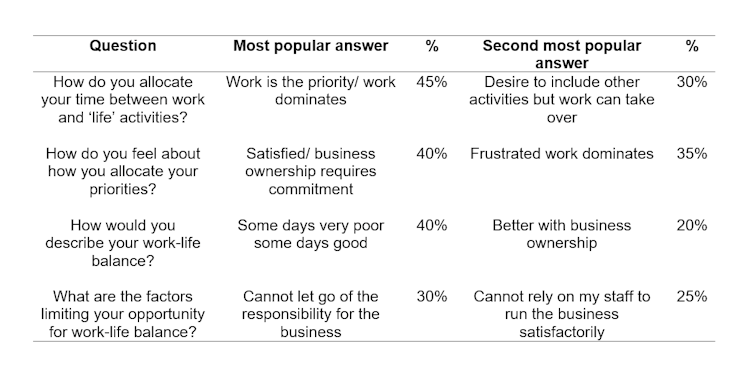
The table below reports the most common responses from business owners regarding their attitudes toward work-life balance and prioritising activities.
 Author provided
Irrespective of how work, family or community are prioritised in a work-life balance model, interviewees reported a sense of imbalance when they lose control in setting and achieving their priorities.
Interestingly, the factors the business owners identified as limiting their opportunity for work-life balance were also those that minimised their discretion when making choices, particularly in allocating their time.
This harks back to the need to feel “in control”, which a business owner articulated:
OK, if I was owning a franchise, for example … probably I would have to open from 6am until 10pm whether I am busy or not. In my business here, I open from 8am to 5.30pm and there you are. I’ve got my own right to shut the business whenever I want and I’m there for my kids at home.
Control over work versus control over life
Ownership of a small business provided most individuals with greater control over the work aspect of their lives. However, many interviewees felt overwhelmed by the multiplicity of roles or one that dominated others, thus limiting the opportunity to broaden their lives.
Some also found it difficult to acknowledge that there are trade-offs. Clearly, there is a need to feel in control of their own lives in whichever role they play.
Interviewees felt they were in control when the decisions they choose to make were based on what they wanted to achieve. This implies that work-life balance requires better consideration of the variety of roles at hand, the availability of the resources to make the preferred choices, and a better system to allocate preferences to those roles.
Business owners need to understand what they want to achieve, how these objectives are prioritised and how to allocate energy to realise these priorities.
Read more:
The more work-life balance we have the more we want: global study
Many policies designed to enhance work-life balance are employee-focused and do not apply to owners of, say, coffee shops or similar businesses. Access to flexible hours and work conditions, for example, does not apply to businesses with predetermined hours.
The use of technology at home has also subliminally extended the workday for many. As such, if location determines work-life balance, then owning one of those small businesses will not improve work-life balance.
The traditional notion of work-life balance might be inappropriate for small-business owners. The satisfaction they derive from operating their own business affects how they allocate time and work.
In particular, some owners were happy working long hours as they were benefiting and they derived a sense of achievement from self-employment. They felt a sense of control and empowerment over decisions they made about their lives rather than being subject to external forces.
The independents could only rely on family and staff. Franchisees could leverage a support structure provided by their franchisor. However, many cautioned that inappropriate support or non-delivery of promised support in the franchise system – such as being required to attend meetings at the end of a long day – often added to the pressure on franchisees.
To sum up, business owners have full responsibility for business outcomes. As a result, they find it difficult to remove themselves from the daily operations and enjoy a sense of work-life balance unless they take control of their multiple roles and have reliable support to stand in their shoes.
Author provided
Irrespective of how work, family or community are prioritised in a work-life balance model, interviewees reported a sense of imbalance when they lose control in setting and achieving their priorities.
Interestingly, the factors the business owners identified as limiting their opportunity for work-life balance were also those that minimised their discretion when making choices, particularly in allocating their time.
This harks back to the need to feel “in control”, which a business owner articulated:
OK, if I was owning a franchise, for example … probably I would have to open from 6am until 10pm whether I am busy or not. In my business here, I open from 8am to 5.30pm and there you are. I’ve got my own right to shut the business whenever I want and I’m there for my kids at home.
Control over work versus control over life
Ownership of a small business provided most individuals with greater control over the work aspect of their lives. However, many interviewees felt overwhelmed by the multiplicity of roles or one that dominated others, thus limiting the opportunity to broaden their lives.
Some also found it difficult to acknowledge that there are trade-offs. Clearly, there is a need to feel in control of their own lives in whichever role they play.
Interviewees felt they were in control when the decisions they choose to make were based on what they wanted to achieve. This implies that work-life balance requires better consideration of the variety of roles at hand, the availability of the resources to make the preferred choices, and a better system to allocate preferences to those roles.
Business owners need to understand what they want to achieve, how these objectives are prioritised and how to allocate energy to realise these priorities.
Read more:
The more work-life balance we have the more we want: global study
Many policies designed to enhance work-life balance are employee-focused and do not apply to owners of, say, coffee shops or similar businesses. Access to flexible hours and work conditions, for example, does not apply to businesses with predetermined hours.
The use of technology at home has also subliminally extended the workday for many. As such, if location determines work-life balance, then owning one of those small businesses will not improve work-life balance.
The traditional notion of work-life balance might be inappropriate for small-business owners. The satisfaction they derive from operating their own business affects how they allocate time and work.
In particular, some owners were happy working long hours as they were benefiting and they derived a sense of achievement from self-employment. They felt a sense of control and empowerment over decisions they made about their lives rather than being subject to external forces.
The independents could only rely on family and staff. Franchisees could leverage a support structure provided by their franchisor. However, many cautioned that inappropriate support or non-delivery of promised support in the franchise system – such as being required to attend meetings at the end of a long day – often added to the pressure on franchisees.
To sum up, business owners have full responsibility for business outcomes. As a result, they find it difficult to remove themselves from the daily operations and enjoy a sense of work-life balance unless they take control of their multiple roles and have reliable support to stand in their shoes.
Authors: Park Thaichon, Lecturer and Cluster Leader, Relationship Marketing for Impact Research Cluster, Griffith University


















