

How to get children to eat a rainbow of fruit and vegetables
- Written by: Yasmine Probst, Senior lecturer, School of Medicine, University of Wollongong
Worldwide, people are not eating enough fruit and vegetables. In Australia, less than 4% of us meet the Australian Dietary Guideline recommendations for vegetables by age group. Worryingly, children and teenagers are even less likely than adults to be eating enough vegetables.
Less than 1% of kids aged two to three are eating the recommended 2.5 serves of vegetables and legumes a day. Between ages four to eight, 0% of kids are meeting their minimum 4.5 serves of vegetables per day. Most children up to 13 are eating two or fewer serves per day when the aim is closer to five serves.
Fruit intake is more positive, with almost four out of five (78%) two-to-three year olds eating the recommended one serve. But this decreases as kids get older, with 59% of four-to-eight year olds consuming the recommended 1.5 serves, and 39% of nine-to-13 year olds getting two serves, which is the recommended minimum fruit intake for ages nine and above.
Children need to be familiarised with the taste of fruit and vegetables from a young age to establish healthy habits later in life. Fruit is generally easier as humans have an innate preference for sweetness. While some vegetables are sweeter, they remain a struggle for many parents. But there are things mum and dad can do to encourage youngsters to eat their veggies.
Read more: Food as medicine: why do we need to eat so many vegetables and what does a serve actually look like?
Why is colour important?
Fruits and vegetables all contain different vitamins and minerals meaning we need to eat a variety when consuming our two serves of fruit and five serves of vegetables each day.
Using the rainbow is a great starting point for food choices as it encourages variety. Even the Australian dietary guidelines refer to a rainbow. Importantly, rainbows resonate well with younger children.
Colour comes from different components in fruits and vegetables. For example, components called anthocyanins contribute to the red through to purple colour of fruits and vegetables such as plums, eggplant and red cabbage. Meanwhile, beta carotene found in carrots create the yellow to orange colour.
 Getting kids to eat their vegetables is notoriously tricky.
From shutterstock.com
Getting kids to eat their vegetables is notoriously tricky.
From shutterstock.com
The different colour associated components may also provide many health benefits such as strengthening a child’s immune system and protecting their eye sight.
Using colours that complement each other can make foods more appealing for children. Different parts of fruit and vegetables including the skins, leaves and flowers provide fun and interesting options too. This creates a teaching experience where children can learn where a food comes from and which parts can be safely eaten.
Creativity relieves boredom
Although some children may prefer to follow routines, repeating the same foods for extended periods of time can become dull for both the child and the parent and can cause deficiencies if followed in the long term.
To promote variety, children may enjoy creating colourful edible scenes such as a fairy garden or a dinosaur jungle. Natural colours from fruit or vegetable juices, such as blueberry juice, can even be used to change a food’s colour.
These creative tasks are age dependent and may need to be demonstrated by a parent. By school age children might enjoy trying these things independently with parental supervision.
New ways of presenting foods, including different shapes, colours, containers and serving utensils can encourage children to eat new foods. For example, eating a meal with chopsticks that would otherwise require a knife and fork, or being allowed to eat food with their hands, shows children a meal does not need to follow a routine.
This also offers an opportunity to showcase new foods from different cultures not previously tried. Parents can encourage exposure to different cultures by creating themed days where a cuisine is selected with the child, and food purchases are made together.
Make food interactive; include your children in the planning, purchasing and preparation of meals with age appropriate responsibilities. And don’t be afraid of the likely mess that comes with children cooking. Embrace the experience as cooking skills have lifelong benefits.
Preparing and eating meals together builds positive relationships, not only with food but with each other. Turn off the TV during meal times and talk about the day.
This space also provides parents with a platform to role model desired food behaviours to children. If you are a fussy eater, it’s likely your child will follow this behaviour.
Read more: Six ways to improve meal times with your children
Back to basics
Don’t get upset if children don’t want to try new foods the first few times – you will need to be persistent. Make those challenging foods (such as mushrooms or Brussels sprouts) available more frequently and in different ways, such as by incorporating them into mixed dishes rather than serving them on their own. Allow your child to see and touch unfamiliar fruits and vegetables.
Often new foods will need to be presented to a child on between five and ten occasions over time before they will try it. Importantly, if they taste it and don’t like it, encourage their willingness to have tried something new.
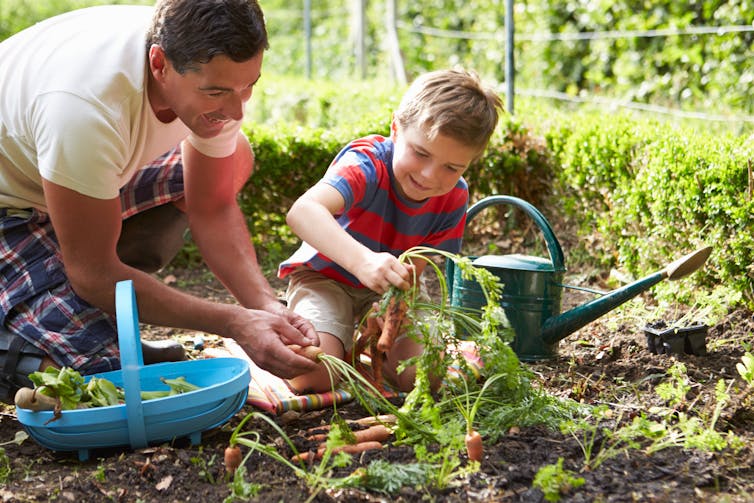 It’s useful to get kids involved in growing fruits and vegetables.
From shutterstock.com
It’s useful to get kids involved in growing fruits and vegetables.
From shutterstock.com
Growing food with kids teaches them where food comes from. Marketing messages strongly influence a child’s food preferences, and it’s important for children to learn not all foods come from packages.
Space permitting, grow ingredients in a backyard garden or in pots on the window sill so children can learn about the life cycle of food. Allow them to experience planting a seed through to harvesting it to add to a meal.
If space is limited, teach children an awareness of the seasonal implications of food and encourage eating fruit and vegetables that are in season. Start with ones they know and like and progress towards new varieties.
Authors: Yasmine Probst, Senior lecturer, School of Medicine, University of Wollongong
Read more http://theconversation.com/how-to-get-children-to-eat-a-rainbow-of-fruit-and-vegetables-97546


















