

Malcolm Fraser's political manifesto would make good reading for the Morrison government
- Written by: Tony Walker, Adjunct Professor, School of Communications, La Trobe University
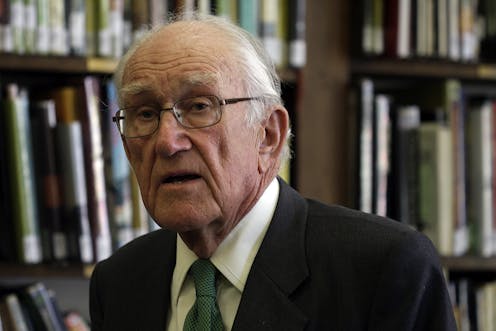
Malcolm Fraser died on March 20, 2015, just a little more than three years ago. One can only speculate what he would have made of a three-year Malcolm Turnbull interregnum, but it is a fair assumption he would have been disgusted by the behaviour of the Liberal party’s hard right and its media acolytes.
At the time of his death, Fraser had quixotically lent himself to efforts to establish a “reform” party as a centrist alternative – in the tradition of Menzies and Deakin – to the existing political parties.
So no doubt the former Liberal prime minister’s disgust would have been aggravated during last week’s leadership upheavals, in which reactionary elements came within a handful of votes of hijacking the party of Robert Menzies, and before that Alfred Deakin.
Read more: If the Liberals have any hope of rebuilding, they might take lessons from Robert Menzies
While this attempted hijacking may has been averted – for now – the danger has not passed, nor has the possibility of a split between the Liberal Party’s conservative and moderate wings.
Scott Morrison is from the conservative flank of the Liberal Party, as is his deputy Josh Frydenberg.
If the two leaders were in doubt about the task confronting them in restoring confidence in a Coalition government, this should have been dispelled by the latest Newspoll. It revealed a collapse in support for the government whose primary vote plunged four points to 33%, while Labor’s increased six points to 41%. This was the first poll since Malcolm Turnbull was deposed as prime minister.
Turnbull’s mistake, among several in the wake of his 2016 near-death political experience, was to allow himself to be persuaded that, to shore up support in the conservative heartland and outflank Pauline Hanson, he needed to shift further to the right.
In the end, he was devoured by those he had sought to appease, or as Winston Churchill might’ve advised: “An appeaser is one who feeds a crocodile hoping it will eat him last”.
This brings us back to Malcolm Fraser and the “forgotten people” of Australian politics. This is the phrase Menzies used when he established the Liberal Party in 1944 out of the embers of the United Australia Party he had led at the outset of the second world war.
Menzies’ “forgotten people” were defined as those caught between a union-dominated Labor Party and a conservative establishment. What the father of the Liberal Party had in mind was the artisan and small business class, broadly defined.
As Menzies put it in his slight memoir, Afternoon Light.
We took the name “Liberal” because we were determined to be a progressive party, willing to make experiments; in no sense reactionay, but believing in the individual, his rights and his enterprise…
It is interesting that the word “progressive” has become a weapon wielded by the right in its relentless culture wars against the left, in what has proved to be a debilitating era in Australian politics.
In this debasement of the political debate, phrases like “political correctness” and “identity politics” and “virtue signalling” have been weaponised to the point where these phrases have corrupted reasonable discussion.
Fraser’s attempt before he died to promote a centrist liberal alternative to the existing parties was aimed at representing the “forgotten people” in Australian politics.
These were not Menzies’ “forgotten people” who had found a home in John Howard’s “broad church” of latter-day Liberals, but a small “l” liberal wedge in the centre. They have long felt disenfranchised.
The so-called “sensible centre”, caught between a conservative party trending reactionary and a Labor party led by union-backed factional apparatchiks is more numerous than party operatives on either side would have you believe.
Read more: Memo Scott Morrison: don't chase the 'base'
As mentioned in a previous column the same-sex marriage vote demonstrated a much larger cohort in the centre of Australian politics than might be conceded by the political class.
While Fraser’s “reform” party never saw the light of day beyond a small circle of small “l” Melbourne liberals, members of the Liberal Party’s latter-day “broad church” could do worse than secure copies of these documents.
This is not because I believe Fraser’s reformist movement would have gained traction everywhere, but because its 24-point manifesto reflects views widely held in the liberal and moderate centre of Australian politics.
Space does not permit publication of the Fraser manifesto in its entirety, but salient points include:
calls for tougher ethical sanctions on members of parliament who breached a code of conduct along with the establishment of an anti-corruption commission
a cap on donations to political parties and a requirement these donations be disclosed in real time
the introduction of a market-based emissions trading scheme and bold targets for renewable energy
early moves to a Republic
an end to the incarceration of asylum seekers in off-shore detention centres
an independent foreign policy
a requirement for a two-thirds majority in parliament to sanction the commitment of Australia’s armed forces to war.
In this latest period, disenfranchised voters of the moderate centre vote for minor parties, including the Greens, as a protest. This is not because they feel affinity for the more doctrinaire positions of the Greens, but out of despair at the Hobson’s choice being offered by the major parties.
In their calculations about how to rebuild the Coalition’s shattered credibility, Morrison and Frydenberg should remind themselves that a lot of Australians are fed up with politics as usual.
People are antagonistic to attempts by unscrupulous politicians and their friends in the media to hijack the political debate. They are sick of being caught in the slipstream of the tiresome culture wars.
Authors: Tony Walker, Adjunct Professor, School of Communications, La Trobe University


















