

Behrouz Boochani's unsparing look at the brutality of Manus Island
- Written by: Alex Reilly, Director of the Public Law and Policy Research Unit, Adelaide Law School, University of Adelaide
It is a matter of wonder that Behrouz Boochani was able to write No Friend but the Mountains at all. He did so while in Manus prison, using text messages in Farsi on smuggled mobile phones. Egyptian and Australian academic Omid Tofighian worked closely with Boochani to translate the text into English. In a detailed introduction to the book, Tofighian explains that Boochani’s writing contributes to a Kurdish literary tradition. He describes his style as “horror surrealism”.
This is not how I experienced the book. Although the imagery Boochani shares is horrific, and the brutality of the prison environment is almost beyond belief, Boochani is bearing witness to a system of detention that is part of contemporary Australian policy, and to which he is an on-going victim. This is no piece of imagination.
In a prologue to the book, author Richard Flannagan places the book in the Western genre of “prison literature”, alongside writing by the likes of Oscar Wilde and Antonio Gramsci.
For me, the book invokes Ken Kesey’s One Flew Over the Cuckoo’s Nest for its use of insanity and humour to explore the brutality of authority, and Shahram Khosravi’s ‘Illegal’ Traveller for its meditation on state techniques for exclusion through the eyes of the excluded.
Read more: Truth to power: my time translating Behrouz Boochani’s masterpiece
The book begins with Boochani boarding a boat somewhere on Java, hoping to reach Australia. In elegant prose, he brings to life the refugee journey through detailed observations of his fellow travellers. He describes a rapid collapse of order:
Men lie in the arms of another’s wife, children lie on the bellies of strangers. It seems they have all forgotten … the energy spent establishing a gender-based order.
A storm destroys the boat with waves the size of mountains that transport him back to the mountains in his native land.
Where is this place? Why is my mother dancing?
After being rescued, a short interlude on Christmas Island begins the clinical process of dehumanising the asylum seekers. They are issued flip-flops and ill-fitting clothes, regularly strip-searched, exposed to CCTV in toilets, moved from cage to cage through layers of bureaucracy, and finally escorted (or carried) by two guards per prisoner to an plane bound for Manus Island.
From this moment, the sense of a journey ends, and the book is a meditation on survival in a prison system intent on destroying the prisoners’ will.
Australians accept detention on Nauru and Manus as a “necessary evil” to prevent an uncontrollable flow of asylum seekers to Australia by boat. Boochani dissects this necessary evil. He sits us on a white plastic chair, our feet on the wire border fence, overlooking the jungle.
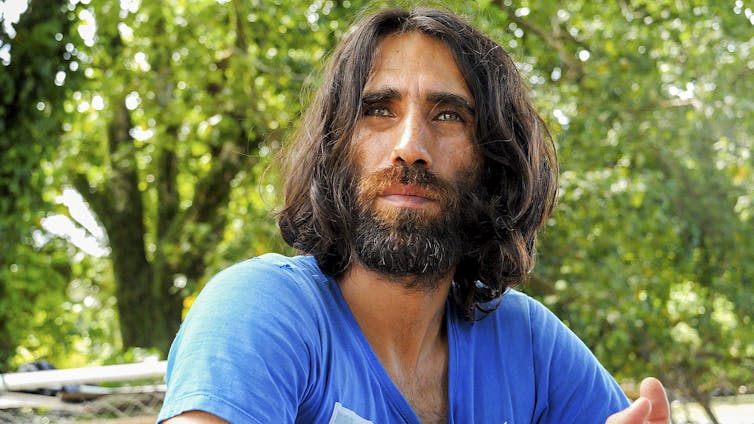 Behrouz Boochani on Manus last year.
Amnesty International handout
Behrouz Boochani on Manus last year.
Amnesty International handout
There is no silence. Only the constant grind of an old tractor generator, the whirr of fans, the noise of hundreds of prisoners crammed into a space the size of a football field, the static of the guards’ walkie-talkies signalling an incident.
Boochani takes us on a sensory tour of the Manus prison. The smells – body odour and bad breath, rotting vegetation, diesel and excrement. The rubbing against one another in the tight spaces – flesh on hairy, sweaty flesh.
The uniforms are reminiscent of dystopian regimes – nurses in orange carrying boxes of yellow pills, local guards in purple, medical staff in white, and Australian federal police in flak jackets with shields and black gloves with metal spikes.
Read more: Friday essay: the Chauka bird and morality on our Manus Island home
The heat is oppressive. The bottled water so warm it does not quench one’s thirst. The only relief is a huge shade tree in the middle of the complex.
We learn of the daily routine, the constant queuing for meals, for the toilet, for cigarettes, for the telephone. Through a detailed analysis of how these queues operate, we begin to understand the way institutional power breaks the spirit of the prisoners by pitting one against another, and using an unbending authority to remove all human compassion.
In one incident, a man cannot swap his place in the telephone queue to speak to his dying father because the regulations make no provision for it. An appeal to a higher authority brings out the Boss, backed by 12 police officers. The Boss places his hand on the shoulder of The Man with the Dying Father (as Boochani calls him) and calmly explains that the rules are the rules.
The queues mean that stronger prisoners eat well, and weaker ones starve. Bouchani marvels at the fortitude of The Cow, a brick of a man, who is prepared to sit in the heat of the sun for hours to ensure his place at the front of the meal queue.
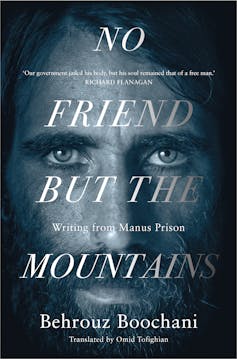 No Friend but the Mountains.
Pan Macmillan
No Friend but the Mountains.
Pan Macmillan
In the first few months of detention, there is still a sense of resistance. Maysan the Whore entertains prisoners most nights with wild dancing in innovative costumes of bed sheets, “pretending to be happy as a form of revenge”. But eventually Maysan begins to deteriorate. “We must find another way to cope with exile”, Boochani laments.
Boochani shares his own weakness, anger, frustration and despair. He does not romanticise these feelings. He simply observes.
Periodically, he tries to make sense of his experience, musing on the strategies of oppression. He describes Manus prison as a Kyriarchal system, a system of total psychological control.
The generator, which Boochani calls Mr Generator, breaks down periodically, leaving rooms unbearably hot and filled with mosquitoes. Just when the tension is unbearable, the generator resumes.
Games are not allowed. When prisoners create a makeshift backgammon board on a table using bottle lids, it is destroyed.
How can it be that soccer balls are prohibited, but cigarettes are always available?
Milk is offered as a special treat. The allocation is always half a cup. If a cup is overfilled, even slightly, it is removed and binned. Why not just redistribute the milk? The lack of logic “confines the mind of the prisoner”, Boochani writes, “leaving him just trying to cope”.
The toilets flow with excrement. They are a place for sex. A place to cut wrists with a razor. Despite risk of punishment, people prefer to piss behind bushes after dark.
Read more: Manus detention centre closure sparks safety fears for refugees
The sights and sounds outside the walls are important for retaining hope and sanity – the sound of the ocean just behind a thin strip of forest, the coconut trees, the chauka birds and crickets, the sunsets and phases of the moon, the white flowers along the sewage line.
The prisoner’s imagination is always occupied with the world beyond the fences.
Poetic streams of consciousness intersperse the narrative, and Boochani is occasionally transported back to the Kurdistan of his childhood. At these moments, the reader is with Boochani at the fence as he lets his mind run free, interpreting the confusion of his existence in this place of torture. These interludes make the book more intensely personal without descending into romanticism or self-pity.
The book ends with the description of a riot in the prison. The full brutality of authority is unleashed in response. We learn that The Gentle Giant, Reza Barati, has been killed.
No Friend but the Mountains reveals that Manus prison is designed to break the will of refugees so they see no option but to return home. It leaves no doubt that any prisoner who chooses to repatriate has been driven to do so through the brutality of the prison system, in clear breach of Australia’s non-refoulement obligation under the UNHCR’s 1951 Refugee Convention.
Every Australian should read this book and marvel at the extent of our brutality, the human cost of a “necessary evil”.
Behrouz Boochani is appearing via video link from Manus Island at the Melbourne Writers Festival on Wednesday, 29 August, and at University of Technology Sydney on Wednesday, 5 September.
No Friend but the Mountains: Writing From Manus Prison is available in bookstores and online.
Authors: Alex Reilly, Director of the Public Law and Policy Research Unit, Adelaide Law School, University of Adelaide


















