Modern Australian
The Times

Who owned this Stone Age jewellery? New forensic tools offer an unprecedented answer

  • Written by Michelle Langley, Associate Professor of Archaeology, Griffith University
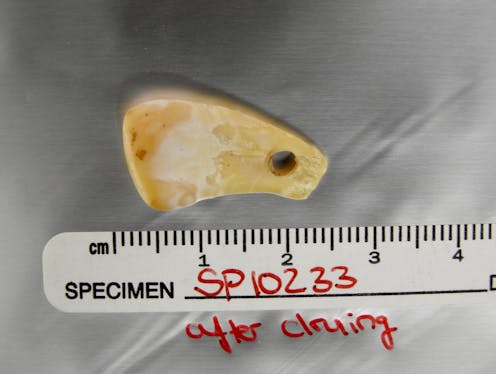
Who owned this Stone Age jewellery? New forensic tools offer an unprecedented answer

An international team of researchers has recovered DNA from the owner of a deer-tooth pendant that was buried inside a remote Siberian cave for tens of thousands of years.

In research published in Nature, Elena Essel of the Max Planck Institute for Evolutionary Anthropology in Germany and colleagues detail how they developed a new technique to extract DNA left behind on an artefact.

In much the same way police solve crimes using “touch DNA” – DNA recovered from skin cells or trace bodily fluids left behind when somebody touches an object – archaeologists will now be able to recover genetic traces of ancient humans from the artefacts they left behind.

These traces will reveal the biological sex and genetic ancestry of the individual who once held or wore a particular artefact, allowing archaeologists to link genetic and cultural evidence as they attempt to unravel the deep past.

Prehistoric artefacts and touch DNA

When archaeologists find artefacts such as tools and ornaments at a site, it’s not easy to work out who used them.

Until now, we have had to rely on finding artefacts in “direct association” with buried people. That is, we could only link an individual to an ornament if we found them buried wearing it.

Even then, this funerary association isn’t always a guide to what happened in life. The dead are buried with things their community think they should have, which may not have been theirs when they were alive.

This new method of ancient DNA extraction provides a more direct way of determining who used specific items in everyday life.
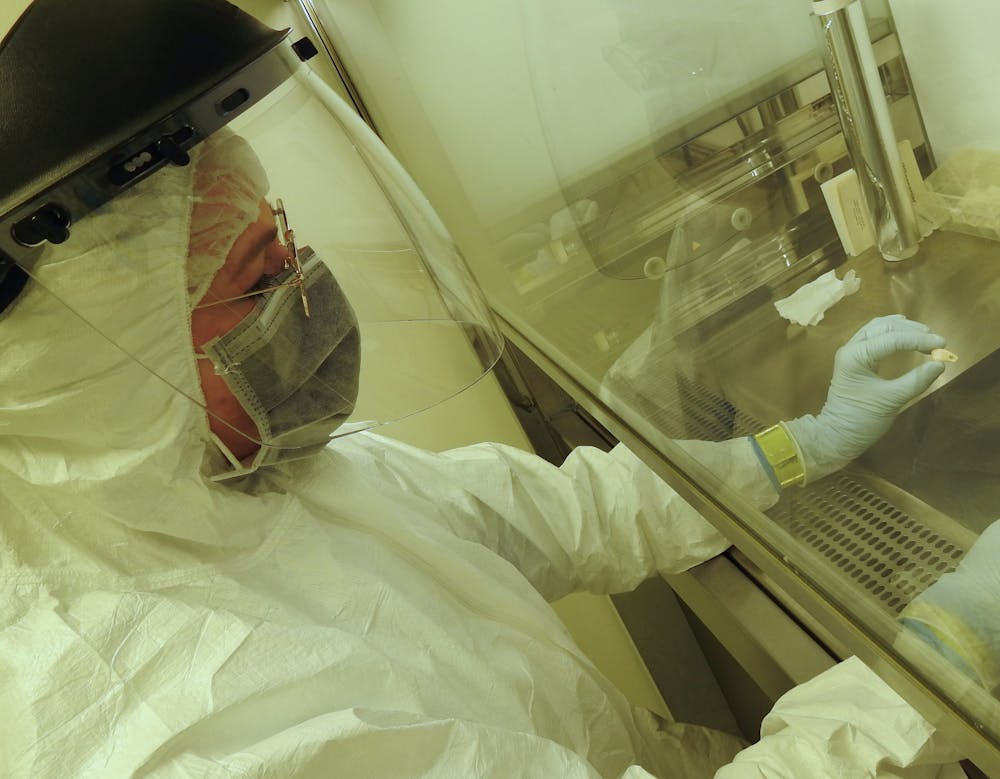
A photo of a woman in clean-room gear holding a small bone object inside a perspex box.
Elena Essel working on the pierced deer tooth discovered at Denisova Cave. Max Planck Institute for Evolutionary Anthropology

The method can only be used for artefacts made from bone or tooth as these materials are porous and can soak up human DNA from repeated contact with bodily fluids (sweat, blood, saliva). Luckily, the bones and teeth of animals (and sometimes humans) were widely used throughout the past to create everyday tools, sacred items, and personal adornment.

These osseous artefacts were held in the hand or worn against the body for extended periods, resulting in sweat and other fluids soaking into their surfaces over time. As a result, the artefact records the genetic information of the wearer.

Through experimentation with different techniques, Essel and her team found a way to recover that DNA record in a form that is intact enough to be read.

Is this yours?

Using this new method of DNA extraction, the researchers were able to extract a wealth of archaeological information from a single tooth pendant recovered from the famous archaeological site of Denisova Cave in Siberia.

The cave, tucked away in the foothills of the Altai mountains, has fascinated researchers for decades as its past inhabitants included not only Homo sapiens but also Neanderthals and another enigmatic extinct human species known as Denisovans.

A photo of the entrance to a cave in a tree-covered hill.
Over the millennia, Denisova Cave has been inhabited by Homo sapiens as well as our extinct cousins the Neanderthals and Denisovans. Richard G. Roberts

First, they were able to extract the DNA of the animal the tooth belonged to, a wapiti deer (Cervus canadensis).

They were then able to extract human DNA from the pores of the tooth and deduce that this DNA had come from a female individual whose ancestry is most similar to ancient people found further east in Siberia and with Native Americans.

They were also able to use the DNA data to estimate the date of the pendant’s creation, somewhere between 19,000 and 25,000 years ago. This date fits with previous radiocarbon dating of the layer of the cave floor sediment in which the artefact was found.

DNA found in soil, or “environmental DNA”, can also inform our understanding of who used an archaeological site such as Denisova Cave.

Without the extraction and analysis of the human DNA held in the tooth, archaeologists would have been able to tell what animal it had come from and how old it was. However, we could never have guessed the owner of this ornament. Now we can identify a specific individual.

Using the additional DNA information attached to individual artefacts, archaeologists will be able to create an understanding of past societies with a level of detail never before possible.

Read more: Dirty secrets: sediment DNA reveals a 300,000-year timeline of ancient and modern humans living in Siberia

Authors: Michelle Langley, Associate Professor of Archaeology, Griffith University

Read more https://theconversation.com/who-owned-this-stone-age-jewellery-new-forensic-tools-offer-an-unprecedented-answer-204797

Celebration of Life vs Traditional Funeral: What's the Difference?

When saying goodbye to someone you love, there is no single way to honour their life. Every family has different traditions, beliefs, and preference...

Building Approval for Roofing Projects: What Homeowners Need to Know

Roofing projects are an important part of maintaining and protecting your home. Whether you're repairing storm damage, replacing an ageing roof, or ...

Chatswood Tutoring And Its Role In Academic Achievement

Academic success often requires more than classroom attendance alone. Students face increasing expectations as they progress through school, particu...

Why Laser Hair Removal Treatments Continue Growing In Popularity

Managing unwanted hair can become time-consuming and frustrating for many people, especially when shaving, waxing, and other temporary methods requi...

Choosing the Right Devices for a Flexible Workplace

For IT leaders managing large fleets, the device layer is where workforce productivity and security policy meet. The shift towards flexible and hybrid...

How Business Advisory Services Help Companies Achieve Sustainable Growth

Every business owner aims to build a profitable and sustainable organisation. While dedication, innovation, and hard work are important, achieving l...

Why Body Contouring Has Become A Popular Cosmetic Treatment

Many people maintain healthy lifestyles through regular exercise and balanced eating habits but still struggle with stubborn areas of fat that are d...

How to Choose the Right POS Hardware for Your Business in Australia

A lot of Australian business owners spend weeks researching POS software but buy hardware almost as an afterthought. That's a mistake. The wrong har...

Why Material Handling Hose Is Critical for Industrial Efficiency

A high-performance material handling hose is an essential component in industries that transport abrasive, dry, or bulk materials on a daily basis...

How to Choose the Right Lawyer in Melbourne for Your Situation

Choosing legal support can feel difficult, especially when the stakes are personal or business-related. The right lawyer in Melbourne should underst...

Hoteliers Look to Clever Value Adds to Increase Revenue

The Australian hospitality industry is still in recovery mode after a notoriously rough patch in recent years. While there has been a post-COVID tra...

Moving to Queensland? Here’s How to Prep Your Car for the Big Move North

There’s no sign of the northern migration slowing down, with thousands of southerners fleeing from chaotic lifestyles and cooler climates for a brig...

Diesel Shortage to Impact Trades and Contractors

Strait of Hormuz blockage affecting all major parts of trades and construction Trades and construction across residential, commercial and industria...

Why Holiday Home Owners Turn to Rental Management Agents

The Allure — and the Reality — of Renting Out Your Property Owning a holiday home is a dream for many Australians. Whether it's a beachside sha...

Why Finding Reliable Doctors In Bundoora Is Important For Long-Term Health

Access to quality healthcare plays an important role in maintaining overall wellbeing and managing health concerns early. Trusted Doctors in Bundoor...

Understanding the Different Types of Car Services: Minor vs Major

When it comes to car maintenance, one of the most important things every vehicle owner should understand is the difference between a minor and a maj...

How Superannuation and TPD Insurance Work Together

Superannuation is an essential part of financial planning in Australia. It is designed to provide individuals with income during retirement, helping...

Tiny Towns funding granted for Mt Hotham and Mt Buller upgrades

Alpine Resorts Victoria (ARV) has welcomed funding support from the Victorian Government’s  Tiny Towns Fund, with both Mt Hotham and Mt Buller se...