

why the UN has found Myanmar’s military committed genocide against the Rohingya
- Written by: Anthony Ware, Senior Lecturer in International & Community Development, Deakin University
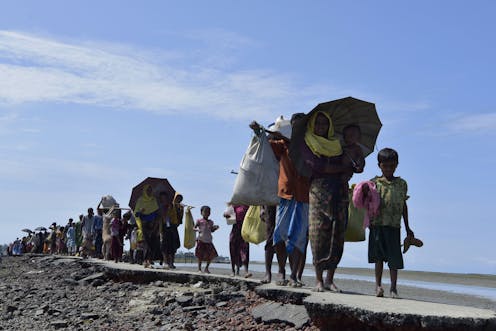
The UN Human Rights Council released a new report last Monday, which calls last year’s violence against the Rohingya “genocide”.
Released almost exactly a year after the start of devastating violence that drove 671,500 Rohingya Muslims into Bangladesh within a matter of months, the report found conclusive evidence that Myanmar’s armed forces committed war crimes and crimes against humanity. Using the strongest language to date, the report calls for the Myanmar commander-in-chief, Min Aung Hlaing, and five generals to be prosecuted.
What was the UN investigating?
The UN Human Rights Council formed a Rohingya investigating commission in March 2017, five months before the start of the violence that led to the mass flight of Rohingya refugees. The initial reason for the commission was a five-month military “area clearance operations” in Rohingya communities from October 2016 to February 2017, which resulted in widespread allegations of human rights abuses and war crimes.
The commission was set up to investigate alleged human rights violations by military, “with a view to ensuring full accountability for perpetrators and justice for victims.” The August 2017 violence occurred after the commission had already begun, but obviously gave it more to investigate.
The “area clearance operations” were triggered by attacks against security forces on October 9, 2016, by a new militant group called the Arakan Rohingya Salvation Army (ARSA). What really spurred the military into action was that the same day as the attacks, the organisation uploaded a series of 11 videos calling for international funding and fighters to join their jihad to liberate northern Rakhine State for the Rohingya – links were quickly found between the leader and the Taliban.
Apparently fearing a situation similar to the ISIS-linked Marawi crisis in the Philippines, the Myanmar army launched massive operations. But this military action failed to root out ARSA, and they responded with a second, much larger attack on August 25, 2017.
The Myanmar government quickly labelled the coordinated attacks by ARSA on over 30 security posts on a single night as “terrorism”. In response, the military quickly launched even more brutal counter-terrorist operations.
Obviously, any government must respond to violence perpetrated against its security forces. But the UN commission has been investigating alleged human rights abuses by the Myanmar army against the Rohingya people as a whole, as they tried to contain the armed threat.
What is the state of the Rohingya crisis?
The onset of brutal military action in their communities led to mass panic by Rohingya communities. Over half the Rohingya in Myanmar were so terrified they abandoned everything and fled to Bangladesh. Médecins Sans Frontières (Doctors Without Borders) quickly estimated that at least 6,700 Rohingya died in the military violence in the first month alone. Total Rohingya deaths were perhaps over 13,000 people.
By March 2018, the UNHCR counted 671,500 Rohingya who had fled Myanmar since August 25, 2017. Counting those who had fled earlier violence, the UNHCR was looking after 836,210 Rohingya refugees in camps in Bangladesh.
Given some remain outside the camps, the Bangladeshi authorities claim 1,092,136 Rohingya refugees are now sheltering in their country. Only about 500,000-600,000 Rohingya Muslims now remain in Myanmar, and their situation is very vulnerable.
With allegations of Rohingya links to terrorism, some elements are trying to isolate these Rohingya villages and drive them out. On the other hand, there are many others locals rebuilding relations with local Rohingya.
What did the report find?
The Report of the Independent International Fact-Finding Mission on Myanmar released this week found conclusive evidence that the army and security forces had indeed engaged in mass killings and gang rapes of Rohingya, with “genocidal intent”. It therefore recommended that the UN Security Council should refer the Myanmar commander-in-chief and five generals to the International Criminal Court in The Hague, or an ad hoc international criminal tribunal. The report also suggested that ARSA might be guilty of war crimes too, and should be held to account.
The report said that Nobel Peace Prize-laureate Aung San Suu Kyi and her government “contributed” to the atrocities through “acts and omissions”. This is a serious critique, and the international community must continue to demand she and her government change policy direction on the Rohingya.
The report authors strongly criticised Suu Kyi in particular, for not using her moral or political authority to stem the hate speech or apparently attempt to limit the military response. However, the passive role described in this report does not leave her open to international prosecution.
How can the crisis be brought to an end?
With serious mass atrocity crimes now documented, it is now urgent that the power of the army be reined in. The Myanmar army must be brought under civilian, parliamentary oversight, and the key perpetrators be at very least removed from position. The military have clearly demonstrated that they need formal oversight, and that their current senior leadership are unfit for command.
Myanmar has long demonstrated its ability to be belligerent to the international community, and that it is prepared to isolate itself in the face of international criticism. If this occurs now, 1.1 million Rohingya refugees in Bangladesh and up to 600,000 Rohingya in Myanmar remain in peril.
The perpetrators of mass crimes must be removed. But we must be careful that dogged pursuit of individuals for prosecution does not so undermine any hope of cooperation by the military and government, and thus further jeopardise the future and wellbeing of the Rohingya themselves.
The repatriation of Rohingya to Myanmar is urgent, before all chance of them returning to their own land is removed. But repatriation plans to date don’t sufficiently guarantee their security and human rights guarantees. The international community needs to push for this, and engage more strongly than ever with the Myanmar authorities in achieving this outcome.
Likewise, the international community must commit resources now to ensure the security and future of the 600,000 or so Rohingya remaining in Myanmar. Much work must be done on strengthening social cohesion, and facilitating the sort of social change that would prepare the local population for accepting all the refugees back too. Now is not the time for broad sanctions and isolation, but engagement for the sake of the Rohingya.
Authors: Anthony Ware, Senior Lecturer in International & Community Development, Deakin University


















