

how to provide suitable and affordable housing for ageing people
- Written by: Fatemeh Yavari, PhD candidate in Architecture, Victoria University of Wellington
With a global rise in the number of people aged 65-plus, it will be increasingly important to have appropriate housing that allows them to remain in their familiar communities and “age in place” for as long as possible.
However, as experience shows in New Zealand and other parts of the world, including Australia and the United Kingdom, housing for many people in this age group is far from appropriate.
In our research, we explore different design solutions to convert existing housing into shared living spaces for people approaching their later years.
Read more: Not enough homes being built for older people – new research
Housing in New Zealand
The majority of the housing stock in New Zealand is a three-or-more-bedroom house. Stats New Zealand found that 80% of people aged 65-plus either lived with their partner or alone. This implies that as the ageing demographic grows, houses designed to accommodate more people are increasingly occupied by one or two.
This is a waste of housing resources, especially when combined with the slow rate (around 1% per year) of homes being added to the housing stock. Furthermore, older people are often on restricted incomes. They may not be able to maintain or heat these houses as much as needed.
In response, we set out to find ways of altering larger houses to make them more suitable for ageing in place, while at the same time ensuring the conversions are energy efficient and affordable.
A new solution for ageing in place
The current market response of private retirement villages is not suitable for many older people who want to stay in their own neighbourhoods. At the same time retirement villages offer a much needed sense of community and alleviation of loneliness for some people. The idea was, therefore, to look at various design solutions that could provide a sense of companionship.
One is co-housing. Although most existing co-housing is multi-generational, senior co-housing is a new trend. Community Housing in Auckland, New Zealand’s largest city, is a great example of a new purpose-built house where five older women share. Abbeyfield’s supported housing is based on the same idea.
Subdividing an existing section and building a suitable unit, known as accessory dwelling unit or ADU, is another option. For our research, we focused on the possibility of converting existing houses with various degrees of sharing of the internal and external spaces.
Vetting designs
We investigated two New Zealand housing types: early 20th-century villas with a central corridor and 1940–60s single-storey state houses. For each house type, we produced three designs, ranging from subdivision (conversion to two smaller units), to having some shared spaces such as a guest bedroom, to private en-suite bedsitting rooms and sharing of all living spaces. To meet the accessibility needs of an ageing person, New Zealand level three Lifemark standards, a rating to show how well a home will suit a person’s needs over a lifetime, were incorporated in all designs.
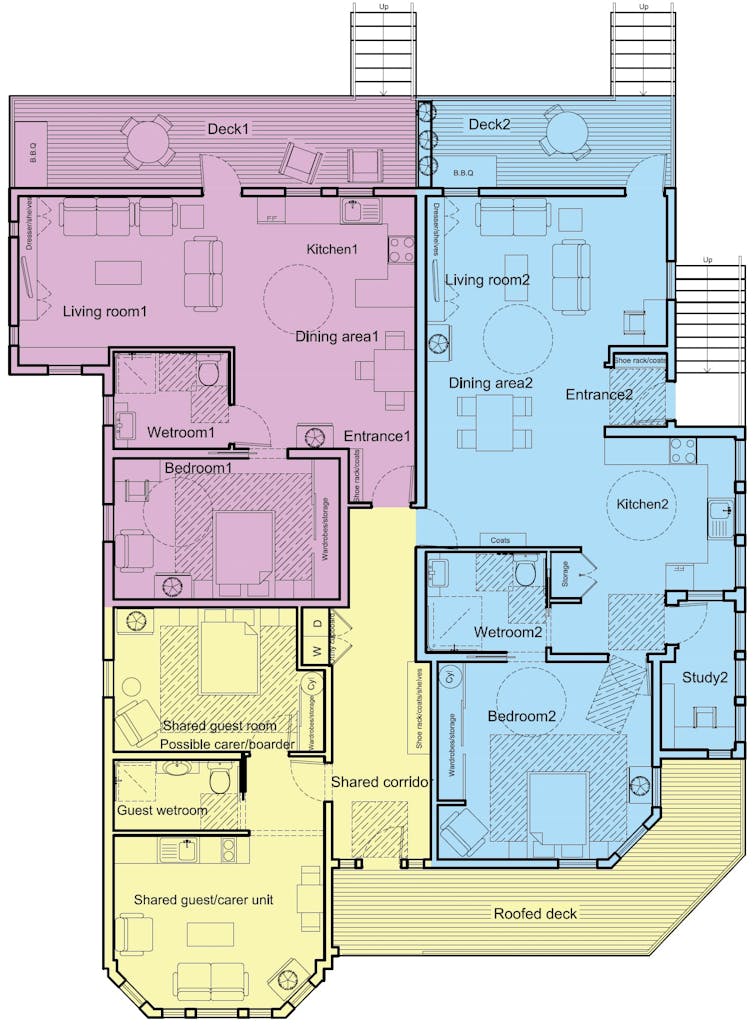 This floor plan shows how a villa can be converted into two separate units, with some shared spaces.
Fatemeh Yavari, CC BY-ND
This floor plan shows how a villa can be converted into two separate units, with some shared spaces.
Fatemeh Yavari, CC BY-ND
We examined the proposed conversions through a questionnaire-based survey, a focus group of experts on the built environment and ageing as well as two focus groups of potential clients aged 55-plus. Whereas comments from the former were focused on viability aspects of the proposed conversions, such as fire regulations and sound proofing, the latter groups were voluble about the various degrees of sharing.
Two schemes emerged as preferences: dividing a villa into private units or private units with limited shared space (entry and guest room). This indicates that, despite living in small, often single-person households, participants still wanted a sense of space in their homes. Women tended to rate both schemes higher than men, suggesting they are more ready to share.
Who people shared with was also important. Some people would be prepared to live with their children, relatives or close friends in a shared house. But they preferred the small house converted into private units over a large house with all living spaces shared. This suggests that privacy is preferred over space if both cannot be achieved.
Sharing and saving energy
Our findings show that people aged 55 to 85 have very specific housing needs when it comes to ageing in place. Therefore, engaging potential users with the design process at an early stage might be a good idea to make conversion and modification more effective.
Although converting a small state house proved unpopular, we used a life-cycle energy approach to calculate the resource implications of two such conversion schemes based on seven different occupancy scenarios. This included subdivision of a state house into either two one-bedroom units or two en-suite bedsits with shared living areas and laundry cupboard.
Four occupants in the latter option, it led to a 27% reduction in life-cycle energy per person (calculated over 50 years) compared with the original house with two occupants. But none of the other scenarios resulted in significant savings.
We discovered that although converting houses into smaller, easier-to-heat units that meet Lifemark standards seems a good idea, it does not necessarily lead to improved energy use. The potential resource saving comes from sharing rather than living in smaller units.
We also considered potential health issue and access to support services funded by District Health Boards for older people who wish to age in place to maintain their independence and quality of life. As our research shows, it is possible to convert existing houses to provide homes similar to those in purpose-built retirement villages.
Authors: Fatemeh Yavari, PhD candidate in Architecture, Victoria University of Wellington


















