

Australia's decision to again use the term 'occupied Palestinian territories' brings it into line with international law
- Written by Amy Maguire, Associate Professor in Human Rights and International Law, University of Newcastle
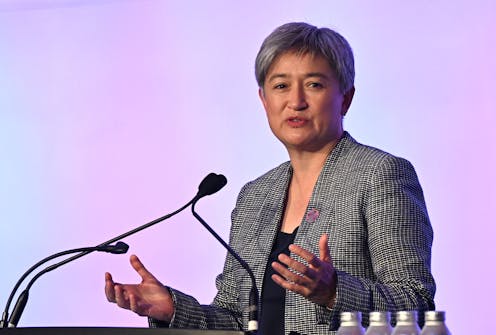
Australia’s minister for foreign affairs, Penny Wong, has announced Australia will return to use of the term “occupied Palestinian territories”.
The Australian government will use this phrase to describe the territories in the West Bank and Gaza that Israel occupied in 1967.
Australian officials have generally avoided the use of “occupied” and “occupation” in relation to Palestine since 2014.
This move by Australia is an important means of signalling condemnation of Israel’s expansion of illegal settlements on Palestinian lands. It reorients Australia towards the orthodox position on the occupation under international law.
It has been reported that some at the upcoming Labor national conference will agitate for the government to recognise Palestinian statehood.
Former Labor foreign minister Gareth Evans argues the time is right for the government to make such a move. He notes that 138 of the UN’s 193 member states have already done so.
There is no legal bar to Australia recognising Palestine as a state. Rather, it would be a political decision for the government of the day, aimed at promoting the long called-for two-state solution.
Read more: Gareth Evans: the case for recognising Palestine
The position under international law
Since the United Nations (UN) was established in 1945, the status of Palestine has been a perennial question of modern international law. The UN General Assembly and Security Council have resolved that Israel violates the prohibition on the use of force through its occupation of Palestinian territories. Palestine has held the special status of “non-member observer state” in the UN since 2012.
In 2004, the International Court of Justice (ICJ) gave an advisory opinion on the implications of Israel’s construction of a wall in the occupied Palestinian territories. The ICJ concluded the wall served to protect illegal settlements, shore up annexation of Palestinian lands and deny self-determination for the Palestinian people.
The UN’s longstanding condemnation of Israel’s occupation was reasserted in a General Assembly resolution on December 30 2022. The resolution noted Israel’s obligations, as the occupying power, to:
comply with the Geneva Conventions on the protection of civilians during war
cease violating the human rights of the Palestinian people
cease efforts to modify Palestinian territory through illegal settlements, and bring an end to the occupation
stop construction and dismantle the wall it has been constructing in the occupied territories
respect the right to self-determination of the people of Palestine and the territorial unity of the occupied territories
end the blockade of the Gaza strip and other onerous limitations on freedom of movement for people and goods.
Read more: 'I can live with either one': Palestine, Israel and the two-state solution
The General Assembly also took the significant step of requesting a new advisory opinion from the ICJ on the legal implications of Israel’s continuing occupation. In January 2023 the UN secretary-general submitted the following questions to the ICJ:
What are the legal consequences arising from the ongoing violation by Israel of the right of the Palestinian people to self-determination, from its prolonged occupation, settlement and annexation of the Palestinian territory occupied since 1967, including measures aimed at altering the demographic composition, character and status of the Holy City of Jerusalem, and from its adoption of related discriminatory legislation and measures?
How do the policies and practices of Israel […] affect the legal status of the occupation, and what are the legal consequences that arise for all States and the United Nations from this status?
The ICJ is now reviewing submissions by UN member states on these questions. It is likely some submissions will explicitly raise the question of whether Israel’s policies and practices in Palestine amount to the crime of apartheid.
What happens now?
The ICJ’s eventual advisory opinion will not be a binding decision on Israel. However, it will be an authoritative view by the world court. Based on extensive precedent in international law and practice, the ICJ will surely conclude that Israel remains in illegal occupation of Palestine.
The Australian government’s reorientation on the status of Palestine is aligned with international law and state practice. Australia, along with all UN member states, is obliged to promote respect for international law and universal human rights.
Authors: Amy Maguire, Associate Professor in Human Rights and International Law, University of Newcastle

















