

Genetically engineered bacteria can detect cancer cells in a world-first experiment
- Written by Dan Worthley, Gastroenterologist and cancer scientist, South Australian Health & Medical Research Institute
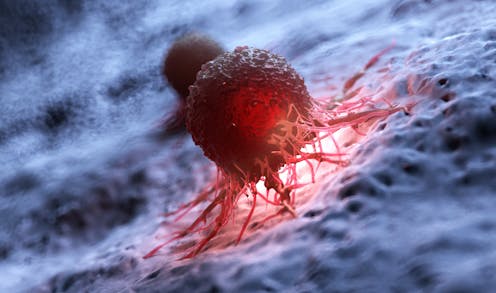
As medical technology advances, many diseases could be detected, prevented and cured with cells, rather than pills.
This branch of medicine is called cellular or cell therapy. It’s already used in clinical practice in some situations, such as patients receiving faecal microbial transplants (“poo transplants”) when they have a severe gastrointestinal infection, or a bone marrow transplant for treating blood cancer.
Using synthetic biology, we can also engineer new and improved cells that could help us manage various diseases. In a new study published today in Science, my colleagues and I describe how we engineered bacteria to successfully detect cancer cells.
Leveraging competent bacteria
Our project started with a presentation by synthetic biologist Rob Cooper during our colleague Jeff Hasty’s weekly lab meeting at the University of California San Diego. Rob was studying genes and gene transfer in bacteria.
Genes are the fundamental unit of genetic inheritance. It’s the stuff that gives you your mother’s smile or your father’s eye colour.
Gene transfer (or inheritance) is the process by which genes are passed from one cell to another. They may be inherited vertically – when one cell replicates its DNA and divides into two separate cells. This is what happens in reproduction, and how children inherit DNA from their parents.
Genes may also, however, be inherited horizontally – when DNA is passed between unrelated cells, outside of parent-to-offspring inheritance.
Horizontal gene transfer is quite common in the microbial world. Certain bacteria can salvage genes from cell-free DNA found in their immediate environment. This free-floating DNA is released when cells die. When bacteria hoover up cell-free DNA into their cells, it’s called natural competence.
So, competent bacteria can sample their nearby environment and, in doing so, acquire genes that may provide them with an advantage.
After Rob’s talk, we engaged in some frenzied speculation. If bacteria can take up DNA, and cancer is defined genetically by a change in its DNA, then, theoretically, bacteria could be engineered to detect cancer.
Colorectal cancer seemed a logical proof of concept as the bowel is not just full of microbes, but is also full of tumour DNA when it’s struck by cancer.
Read more: One test to diagnose them all: researchers exploit cancers' unique DNA signature
We put the bacterium through its paces
Acinetobacter baylyi, a naturally competent bacterium, was chosen to be the experimental biosensor – a disease-detecting cell.
Our team modified the A. baylyi genome to contain long sequences of DNA to mirror the DNA found in a human cancer gene we were interested in capturing. These “complementary” DNA sequences functioned as sticky landing pads – when specific tumour DNA was taken up by the bacteria, it was more likely to integrate into the bacterial genome.
It was important to integrate – hold in place – the tumour DNA. In doing so, we could activate other integrated genes, in this case an antibiotic resistance gene, as a signal for the cancer being detected.
The signal would work as follows: if bacteria could be grown on antibiotic-laden culture plates, their antibiotic resistance gene was active. Therefore they had detected the cancer.
We conducted a series of experiments in which our new bacterial biosensors and tumour cells were brought together in increasingly complex systems.
Initially, we simply marinated the biosensor with purified tumour DNA. That is, we presented our biosensor with the exact DNA it was built to detect – and it worked. Next, we grew the biosensor alongside living tumour cells. Again, it detected the tumour DNA.
Ultimately, we delivered the biosensor into live mice that either did or did not have tumours. In a mouse model of colorectal cancer, we inject mouse colorectal cancer cells into the colon, using mouse colonoscopy.
Over several weeks, the mice that were injected with cancer cells develop tumours, while the mice that were not injected serve as the healthy comparison group. Our biosensor perfectly discriminated between mice with and without colorectal cancer.
CATCH’s promising start – but more testing is needed
After these encouraging results, we engineered the bacteria even further. The biosensor can now tell apart single base pair changes within the tumour DNA, allowing for finely tuned precision in how it detects and targets the genes. We have named this technology CATCH: cellular assay for targeted, CRISPR-discriminated horizontal gene transfer.
Read more: What is CRISPR, the gene editing technology that won the Chemistry Nobel prize?
CATCH holds great promise. This technology uses cell-free DNA as a new input for synthetic biological circuits, and thus for the detection of a range of different diseases, particularly infections and cancers.
However, it is not yet ready to be used in the clinic. We’re actively working on the next steps – to increase the efficiency of DNA detection, to more critically evaluate the performance of this biosensor compared to other diagnostic tests, and, of course, to ensure patient and environmental safety.
The most exciting aspect of cellular healthcare, however, is not in the mere detection of disease. A laboratory can do that.
But what a laboratory cannot do is pair the detection of disease (a diagnosis) with the cells actually responding to the disease with an appropriate treatment.
This means biosensors can be programmed so that a disease signal – in this case, a specific sequence of cell-free DNA – could trigger a specific biological therapy, directly at the spot where the disease is detected in real time.
Acknowledgements: I am grateful to be part of this incredible team including Professor Jeff Hasty, Dr Rob Cooper, Associate Professor Susan Woods and Dr Josephine Wright.
Authors: Dan Worthley, Gastroenterologist and cancer scientist, South Australian Health & Medical Research Institute

















