

Australia’s extraordinary alpine insects are being marooned on mountaintops as the world warms
- Written by Kate Umbers, Senior Lecturer in Zoology, Western Sydney University
We may not pay invertebrates much thought, but they’re the workhorses of all ecosystems. Insects and other invertebrates do essential jobs such as pollinating plants, improving soils and controlling pests. They’re also food for many larger animals, which moves nutrients up the food chain.
Invertebrates are vulnerable to rising global temperatures. In response to climate change, many are moving to cooler areas, be that across land towards the poles, or upward in elevation.
But not all invertebrates have that option. In Australia, invertebrates already living at the highest possible elevation – on mountain summits – have nowhere higher to go. So how will they cope? And how can we help them?
Answering these questions is important. Invertebrates underpin Earth’s ecosystems – so if their numbers decline, the ecological damage will be felt far and wide.
A life at the top
The invertebrates of the Australian Alps are beautiful and diverse. As in all ecosystems, they make up the largest proportion of our alpine animal species.
Most of our alpine invertebrates are found nowhere else If we don’t look after them they’re gone forever. And each species extinction is like losing a rivet in an aeroplane wing; eventually whole ecosystems will crash.
Warmer temperatures can affect invertebrates in many ways. For example, pollinating insects that collect nectar may hatch before plants flower – creating issues for both the insects and the plants. Species that rely on wet or damp conditions may find their habitat dried out. Less harsh, cold conditions may also bring new predators and competitors into their habitats.
Overseas, where mountain ranges are typically much higher, animals have been moving up in elevation to survive. But Australia’s mountains are small – less than half the height of many key mountain ranges overseas. This leaves little room to move higher.
Alpine invertebrates tend to live in small, isolated populations on mountain tops. This limits their genetic diversity and therefore the potential that offspring can survive and adapt to changing conditions.
What’s more, many invertebrates don’t have wings, so can’t fly away to a more hospitable place. And being trapped on mountain tops also makes them vulnerable to devastating local threats such as unusually severe or extensive bushfires.
Extraordinary bogong moths
Some species might seem to be moving higher up the Australian Alps. For example, it seems bogong moths inhabit low elevation caves less frequently than they once did. But this probably just shows the species’ habitat is shrinking upward.
Each year, bogong moths undertake an extraordinary nocturnal migration. From their starting point many hundreds of kilometres away, they use the stars and Earth’s magnetic field to navigate to the Australian Alps in search of cool caves and rock crevices. There, they rest and take refuge from the summer heat, before returning to their winter pastures.
In 2021, bogong moths were listed as endangered because the availability of their summer habitat is declining.
Bogong moths bring an incredibly important influx of nutrients to the alps. They provide food for many animals, including the adorable, critically endangered mountain pygmy possum, as well as many types of birds.
The Taungurung people refer to the bogong moth as “Deberra”. The annual concentration of Deberra in the alps is culturally significant to the Taungurung and other traditional custodians.
Deberra have a high fat content and were harvested by Taungurung and other groups for eating. During the harvest, large gatherings of many Aboriginal nations were held and cultural business was conducted.
So Deberra offers not only a rich source of food, but also connection with deeply significant cultural landscapes. They are an important element in the cyclical movement of people and exchange of knowledge within and between Indigenous nations.
For Traditional Owners, Deberra is, like all things, part of the interrelated web of Country. When Deberra travels, human and non-human entities follow. It supports energy flows of many kinds.
The decline of Deberra is a sign that Country is sick. Sick Country tells us the land is not being managed well.
Read more: Next time you see a butterfly, treasure the memory: scientists raise alarm on these 26 species
Colour-changing skyhoppers
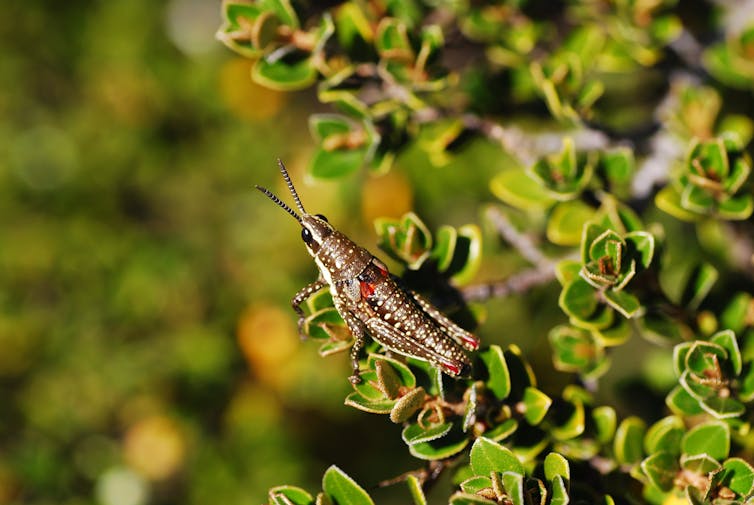
The adults of many alpine invertebrate species live for just a single summer, lay their eggs, then die. They include skyhoppers, a group of alpine grasshoppers unique to Australia, many species of which are threatened.
Skyhoppers rely on a thick snow layer to protect their eggs in winter. But Australia’s snow cover is becoming increasingly unreliable as the planet warms.
Thermocolour skyhoppers, listed as endangered, are unique among grasshoppers in that they change colour from black to turquoise when their body temperature exceeds 25℃.
Until recently, five skyhopper species were known to science. But when researchers walked the entire 655-kilometre Australian Alps walking track, they discovered 15 species of skyhopper exist – each separated by the rugged mountain landscape.
The true biodiversity of the alps is unknown. What we do know is that it is heavily fragmented. What may look like one species across the alps is likely to be many species each occupying small areas. This means they’re even more vulnerable than currently recognised.
Helping them hang on
Much of the Australian Alps region is contained in national parks, but this alone is not adequate protection for our alpine biodiversity.
Greenhouse gas emissions to date have put our alpine biodiversity on a knife’s edge. Australian and international governments must swiftly undertake far more ambitious climate action to cool the alps.
And more effort is needed to give our alpine ecosystems the best chance of coping with climate change. This includes allowing Traditional Owners to connect to and manage Country and removing threats such as feral species, disease and habitat destruction.
Authors: Kate Umbers, Senior Lecturer in Zoology, Western Sydney University

















