

why the V-22 Osprey aircraft won’t be grounded despite dozens of crashes and 54 fatalities
- Written by Peter Layton, Visiting Fellow, Griffith Asia Institute, Griffith University
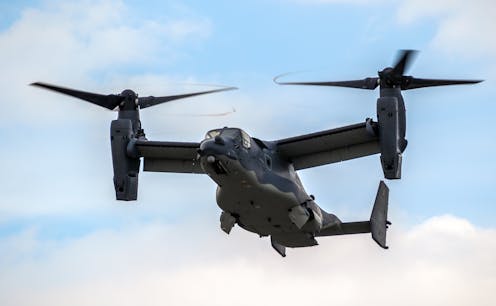
At the weekend a V-22 Osprey aircraft crashed on Melville Island north of Darwin. Of the 23 US Marine Corps personnel onboard, three died, five were taken to Darwin hospital in a serious condition, and some others had more minor injuries.
The craft was part of the Marine Rotational Force - Darwin, a unit of up to 2,500 US marines that has been based in the Northern Territory from April to October each year since 2012. This is the most serious accident in that 11-year period.
The Osprey is a relatively new type of aircraft, with a patchy track record for safety. But the advantages it offers for the military – and perhaps for civilians – mean we will only be seeing more of it in the future.
What is the V-22 Osprey?
The Osprey has long been controversial, initially for its high cost and long development time, and in recent years for safety concerns.
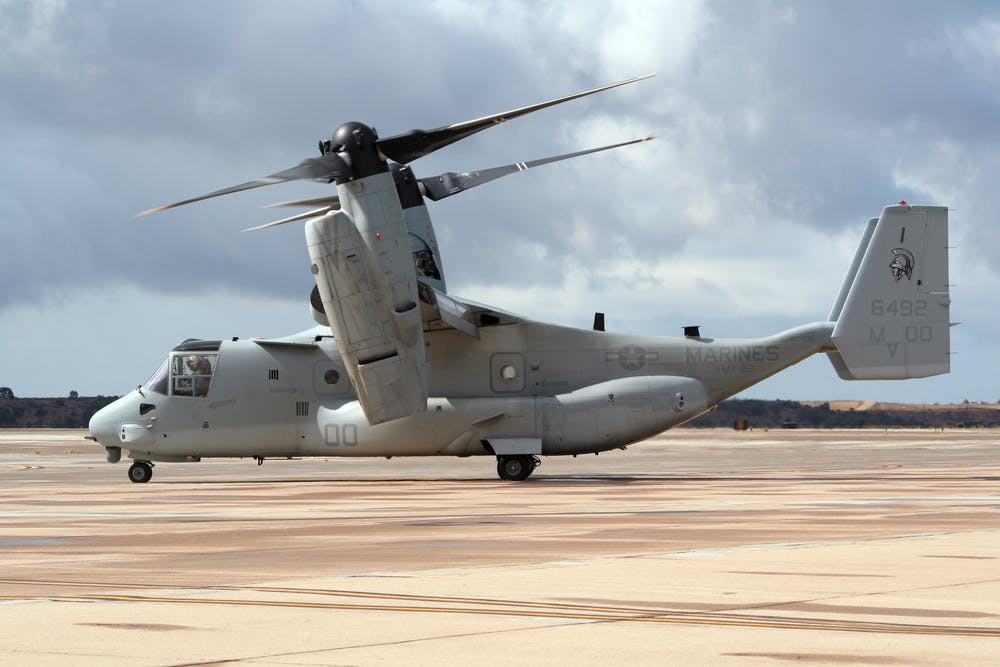
These issues reflect the revolutionary design of the craft: it is a kind of plane–helicopter hybrid called a tiltrotor, which means the wing tilts upward for takeoff and landing and back down again for level flight. If this sounds complex, it is.
The Osprey is at the leading edge of aviation technology, with nothing else in operational service like it. The aircraft was built to replace helicopters and is used by the US Air Force, Navy and Marine Corps, and the Japanese Ground Self-Defense Force.
Why is the Osprey so useful?
The Marine Corps is by far the largest user, being attracted to the aircraft’s much longer range, much higher speed and good carrying capacity compared to conventional helicopters.
The Marine Corps is famous for landing soldiers across beaches during combat but in the modern era this is difficult. Potential adversaries now have excellent beach defences, and bringing ships close enough to shore to land soldiers via traditional naval landing craft or conventional helicopters is becoming unrealistic.
The Osprey solves this by allowing amphibious ships to remain hundreds of kilometres at sea and launch assaults onto the beach “from over the horizon”. A landing can now surprise an enemy, while the Osprey’s range allows many more possible landing sites to be accessed.
The Marines first brought the Osprey into service in 2007, and it has been central to the adoption of a whole new way of war. They have dispensed with heavy mechanised forces like tanks in favour of rapid manoeuvres, light vehicles, long-range missile technology and island hopping.
This approach of so-called Expeditionary Advanced Base Operations (EABO) is the Marine Corps answer to China’s growing assertiveness in East Asia and to keeping the Corps relevant in the modern era. The Marines in Darwin now practise EABO.
Why is the Osprey’s safety record so patchy?
That’s the upside. The downside of being leading-edge technology is having little historical experience of similar aircraft to fall back on.
Every Osprey flight is a learning event for the pilots, the maintenance personnel and the aircraft’s manufacturer.
For example, the US Air Force grounded their Ospreys for two weeks last year over worries about gearbox matters. This has been an ongoing problem that seems to get worse the more an aircraft is flown and the gearbox used; technical fixes are in the works.
The central concern today is flying safety and here the Osprey has a mixed record. The aircraft had four crashes and 30 deaths during its initial development.
Since entering operational service in 2007 there have been an additional ten crashes and 24 deaths.
Two of these ten were on combat operations where the cause was uncertain. The others were due to pilot error or technical problems.
A fatal crash off Rockhampton in 2017 can be seen in a terrifying video that also shows operating the Osprey is a complicated business.
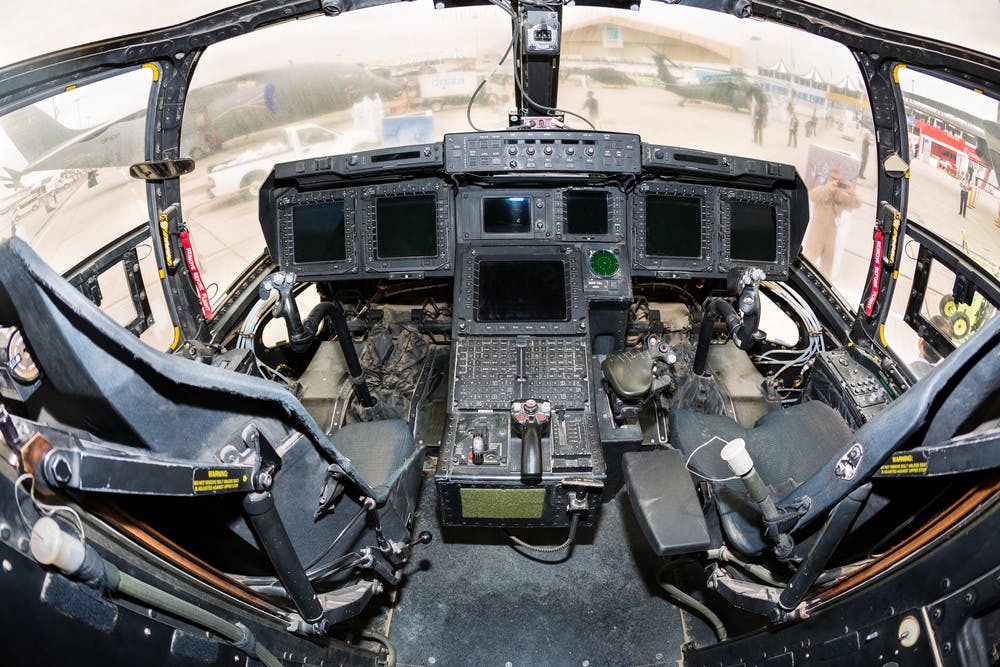 The cockpit of a V-22 Osprey on display at Dubai Airshow in 2015.
Shutterstock
The cockpit of a V-22 Osprey on display at Dubai Airshow in 2015.
Shutterstock
Will the Osprey get safer?
As the Osprey has flown more, more knowledge has been gained and the accident rate has declined. However, its accidents have tended to come in bunches. In the eight months from December 2016 to September 2017 there were three crashes; in the 18 months from March 2022 to now, there have been another three.
This all compares very unfavourably with American civil aviation, which has a much better safety record. In 2020, a report by the National Commission on Military Aviation Safety said the main culprits for the US military’s air accidents were insufficient flying hours to keep aircrew proficient, inadequate personnel training, inconsistent funding for spare parts supply and risky maintenance practices.
The implication is that safety can be improved. It just needs to be properly addressed.
Historically, the safety record of revolutionary aircraft like the Osprey improves as more operating experience is gained and unknown technical problems are found and addressed. That was certainly the Australian experience with the F-111 strike aircraft, which had an early run of crashes followed by many years of safe operation.
Will we see more tiltrotors like the Osprey in future?
This is important as the Osprey looks set to be the first of its type, not the last. The US Army has chosen a new generation tiltrotor, the V-280 Valor, to replace its ageing Blackhawk helicopters.
Over time, the Valors will inevitably be deployed to Australia on training exercises. Meanwhile, Australia is acquiring Blackhawks to replace the Australian Army’s Taipan helicopters, which are apparently difficult to maintain.
When those new Blackhawks eventually are themselves replaced, it is likely Australia will go the way of the US and buy tiltrotors too. Civil aviation is getting interested in tiltrotors as well.
Tiltrotors like the Osprey and its successors are likely to fly in Australian skies well into the future.
Authors: Peter Layton, Visiting Fellow, Griffith Asia Institute, Griffith University

















