

How Russian history and the concept of 'smuta' (turmoil) sheds light on Putin and Prigozhin – and the dangers of dissent
- Written by Danica Jenkins, Postdoctoral Teaching and Research Fellow, University of Sydney
In Russia, failed coups portend turmoil and collapse. They also herald greater repression, and a tightening of centralised control. This is because Russian history has swung back and forth between chaos and autocracy, which have become mutually reinforcing symptoms of the same historical condition.
Russians have a word for the periods of turmoil: smuta.
Wagner leader Yevgeny Prigozhin has come to symbolise a new cycle of this history taking place in Russia today. While the fallout from his aborted mutiny in June and recent death remains uncertain, it is possible to see these events as the reverberations of a centuries-old power system grinding forward into new terrain.
Prigozhin’s mutiny had similarities with other failed uprisings in Russian history, from the Decembrist revolt in 1825, to Lavr Kornilov’s march on St Petersburg in 1917, to the attempted coup against Mikhail Gorbachev by Communist Party hardliners in 1991.
These comparisons led some to warn of growing political instability in Russia, on the grounds that Prigozhin was less a threat to Putin’s rule than a manifestation of its essential fragility. Others have argued, in the aftermath of Prigozhin’s death, that the rebellion has provided Putin with an opportunity to consolidate his authority.
Whether or not Prigozhin may have exposed Putin’s vulnerabilities, history suggests that what is to come could well be worse. “As Russians know only too well,” Russian author Mikhail Shishkin warns, “one should not wish death on a bad tsar. For who knows what the next one will be like?”
To understand this maxim, one needs to understand Russia’s history and its underlying power dynamics. On the morning of Prigozhin’s rebellion, Putin referred to the smuta in a national address. Prigohzin, he said, was attempting to “create internal turmoil” and “split and weaken the country, which is now confronting a colossal external threat, unprecedented pressure from outside”.
There was not a single Russian who wouldn’t have understood the fearsome double meaning of “turmoil” (the literal translation of smuta) and the existential threat to the Russian nation it evoked.
By referencing the smuta Putin was reminding Russians of the profound dangers of dissent – and of his mandate to suppress it.
The gathering of the lands
The origins of this historical syndrome can be traced back to Ivan IV, better known as Ivan the Terrible, who in the 16th century transformed Russia from a loosely connected group of medieval states into the foundations of a modern empire.
Upon taking power in 1533, Ivan embarked on a brutal and bloody campaign to consolidate his rule over Russian territories. The campaign, begun under his predecessor Ivan III (“Ivan the Great”), is known as the “Gathering of the Lands”.
This is another core theme of the Russian cultural tradition.
Ivan the Terrible’s subjugation of rival principalities enabled his expansion eastwards into the Siberian steppe. Under the guise of protecting the Orthodox lands from its Muslim and Catholic foes, he razed any site, inside or outside his realm, with the potential for independent power. Most famously, he decimated the ancient Russian city of Novgorod, whose advanced culture and commercial vitality represented a challenge to Muscovy’s hegemony.
Ivan’s expansionism was driven by the recognition, in the wake of the Mongol invasions and the rise of the Polish-Lithuanian Empire, that Russia’s lack of natural frontiers exposed it to foreign threats. Ever since, Russian leaders have perpetuated the idea that Russia must dominate its peripheral lands as a defensive act of national survival.
Ivan also subordinated Russia’s nobility, terrorising them with the help of his caste of personal henchmen, the oprichniki – before eventually turning on them as well. The terror he wrought on his people, economy and lands through years of war and repression sowed the seeds for the smuta to come.
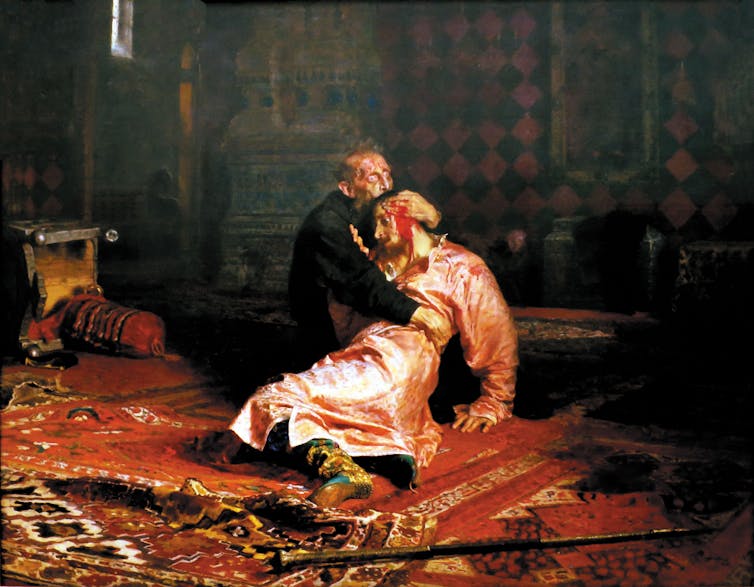
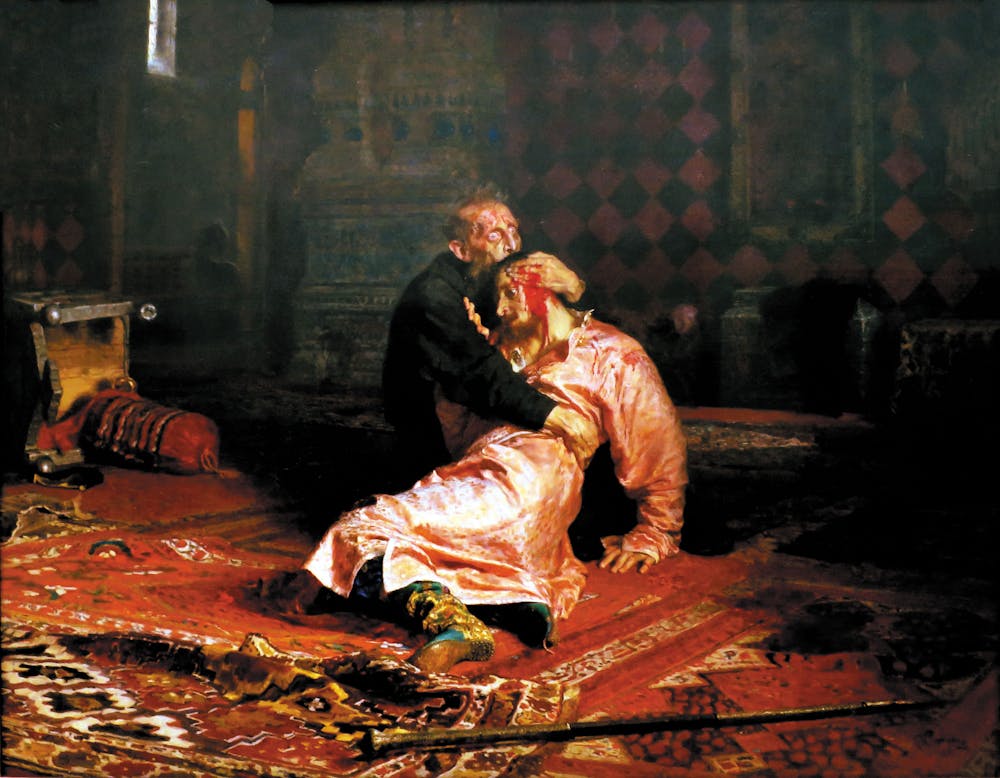
In the years before his death, Ivan grew isolated and paranoid. When he murdered his favourite son and only viable heir, Ivan Ivanovich, in a manic fit of rage, he created a succession crisis.
Boris Godunov
In 1825, just months before the revolt of the Decembrists against Tsar Nicholas I was suppressed, Alexander Pushkin – “Russia’s Shakespeare” – wrote a historical play about a period of political intrigue and upheaval in Russia similar to the one unfolding around him.
Boris Godunov was inspired by a period of crisis that forms the bedrock of Russia’s national mythology. At the centre of the play’s dramatic events is the samozvanets, or “pretender-tsar”, a recurring figure in Russian history.
The samozvanets historically appears during periods of upheaval or dynastic uncertainty as a challenger to the Russian throne. In many ways, Prigozhin was a modern iteration of this Russian historical figure.
Pushkin’s play tells the story of Boris Godunov, a Russian nobleman who came to power at the end of the 16th century during the “Time of Troubles”, the first period of smuta – a succession crisis that began in 1598 with the death of Tsar Fyodor I, the last of Russia’s founding Rurikid dynasty.
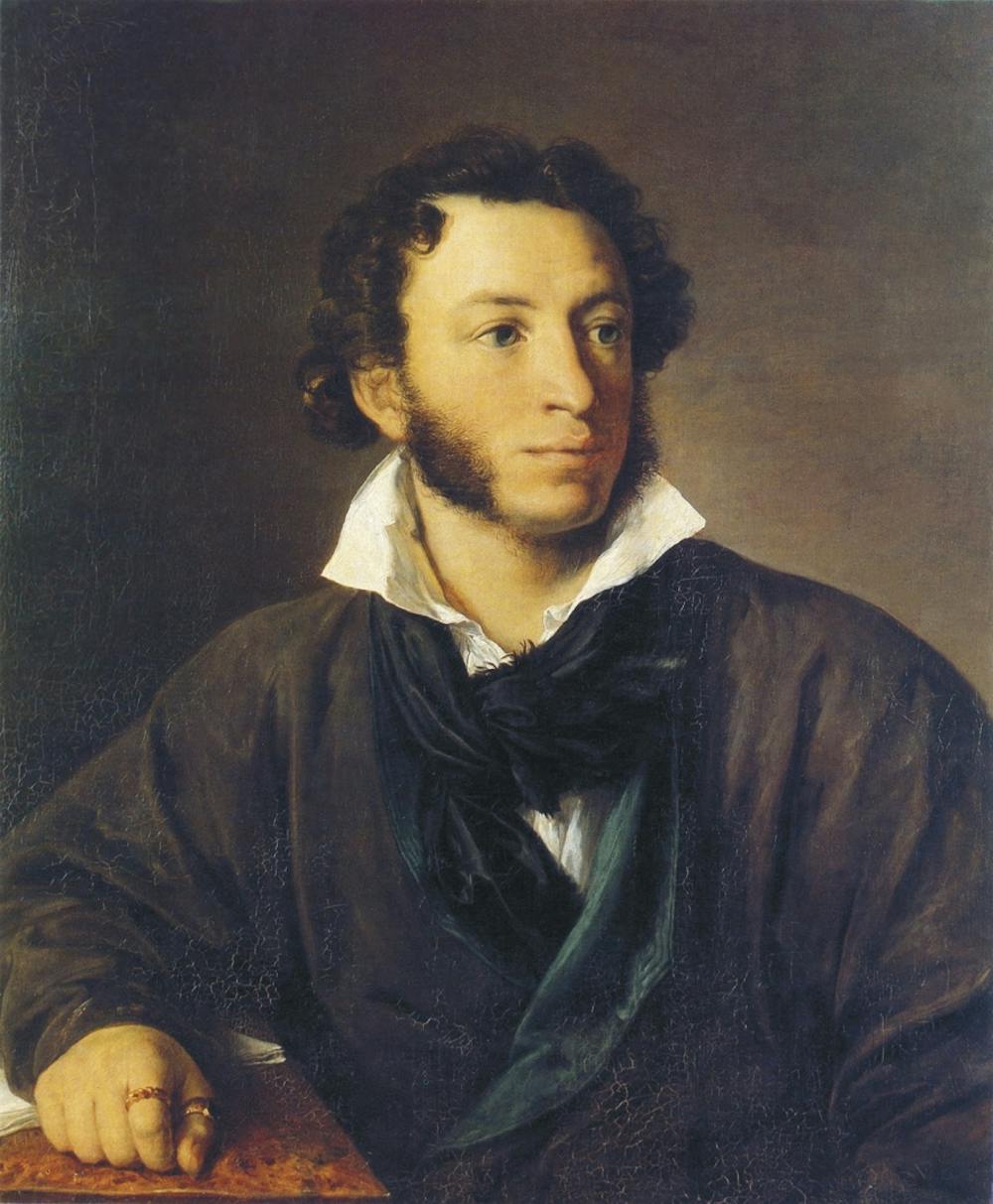 Alexander Pushkin – Vasily Andreevich Tropinin (1827).
Public domain.
Alexander Pushkin – Vasily Andreevich Tropinin (1827).
Public domain.
Fyodor’s reign had been marred by his incompetence, which exacerbated the power struggles that began after the death of his father, Ivan the Terrible. When Fyodor died childless with no appointed heir, his brother-in-law Boris seized the throne, becoming Russia’s first non-Rurikid Tsar.
As the play implies, Boris had been plotting his ascent to power for years. Despite his desire to restore order to Russia, his reign was beset by famine, financial instability and civil unrest. He struggled to maintain control.
Even worse: rumours grew of Boris’s involvement in the mysterious death of Fyodor’s younger brother and heir apparent Dmitry several years earlier, fomenting doubts about Boris’s legitimacy as Tsar.
Amid this period of turmoil, an opportunistic young priest named Grigory Otrepyev posed as the dead Dmitry and amassed a grassroots following on the pretence of being the true Rurikid heir. Garnering support from the Polish nobility, who were keen to exploit Russian factionalism, Otrepyev (who is now known by the sobriquet “False Dmitry”) advanced on Moscow in 1604, flanked by the Polish army and ordinary Russians compelled to fight for the man they believed to be the only legitimate Tsar.
Pushkin’s play ends as Boris, haggard in the face of increasing dissent, dies as a result of foul play.
Smuta
The political crisis that followed the events depicted in Pushkin’s play has become deeply embedded in the Russian consciousness.
Otrepyev was crowned Tsar Dmitry I, but his reign lasted less than a year. Over the following eight years a brutal struggle for sovereignty took hold. Waves of new False Dmitrys emerged, each making claims to throne.
The crown changed hands numerous times through a series of bloody coups. The country descended deeper into civil war. At the height of this breakdown of central authority, the unthinkable happened: a Polish king, Sigismund III Vasa – a Catholic – occupied the Russian throne.
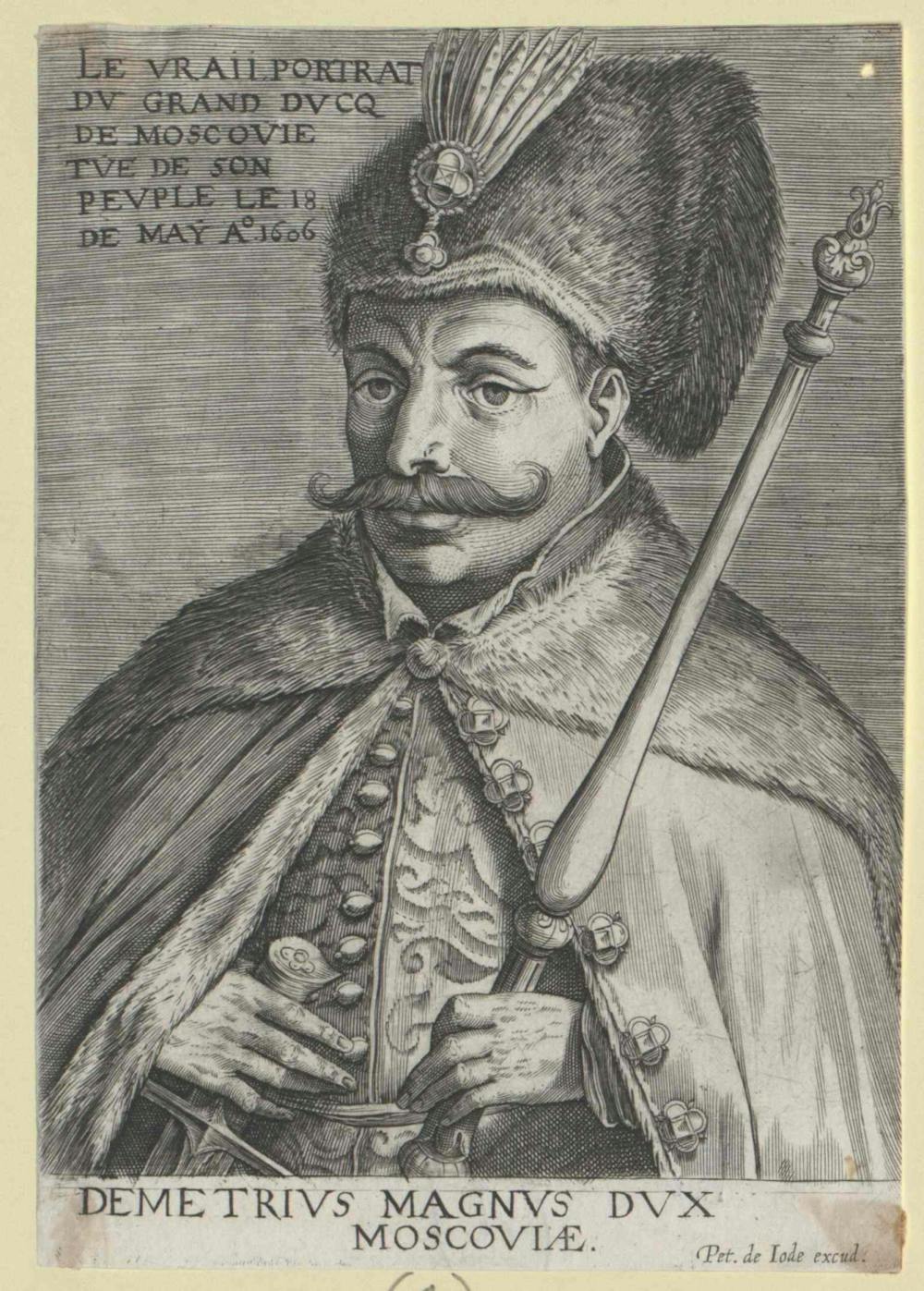 Grigory Otrepyev, aka ‘False Dmitriy’ (1606).
Wikimedia Commons
Grigory Otrepyev, aka ‘False Dmitriy’ (1606).
Wikimedia Commons
With the shared mission, finally, to unite against their common foe and defend the Orthodox faith, the Russians expelled the Poles in 1612. Mikhail Romanov was crowned Tsar the following year. The smuta thus ended with the founding of a new autocratic bloodline that would rule and expand the Russian Empire for the next 300 years.
From the collective trauma of this experience came the notion that questioning the political legitimacy of Russian leaders creates social strife and exposes Russia to foreign occupation. In the centuries since, this idea has coalesced into a national myth. It has been used to justify the absolutism and revanchism of Russian leaders from Tsars through to Soviet Commissars and modern-day politicians.
Divine right
Russian Tsars were legitimised by the myth of divine right, meaning their power and authority as “Guardian of Holy Russia” was derived from God, rather than the Russian people. This placed them beyond political accountability.
Soviet leaders, outwardly atheist, exercised a similar prerogative. The General Secretary of the Communist Party was vested by the laws of History to lead Russians and their Soviet comrades along the true path to their glorious future. This, too, placed Soviet leaders above political accountability.
When Mikhail Gorbachev came to power in 1985, he instituted the policies of glasnost (“openness”) and perestroika (“restructuring”), both of which introduced real politics into the Russian system. These changes gave Russians previously unthinkable levels of freedom. It created the possibility - for the very first time - to elect a government accountable to the people.
Yet after centuries of paternalism, Russians had very little experience with democracy and civic participation. Gorbachev’s reforms led to the collapse of the Soviet Union. From the ruins, Boris Yeltsin built the corrupt foundations of the current political system.
For the past 23 years under Putin – a man described by Russia’s Orthodox patriarch as God’s earthly representative – the pious impetus has returned to Russian politics. Putin has made it his spiritual mission to shield the Russia from the chaos of democratic and liberal freedoms. He has also invoked religion as a pretext for invading Ukraine.
Read more: 'Today is not my day': how Russia's journalists, writers and artists are turning silence into speech
The roots of Russian silence
When Putin took power from Yeltsin after the smuta of the 1990s, he was not merely a new proponent of Russia’s historical syndrome, but a new symptom. He promised to restore order and stability in Russia after years of lawlessness and anomie. All he asked for in return was “unity”, which in Russian is a byword for passivity and acquiescence.
The backbone of Putin’s enduring popular domestic support is that this restoration of order has been achieved. The fact it has come at the cost of human rights, freedoms – and lives – was merely a small price to pay.
The passivity of the Russian people often baffles the Western world, particularly in response to the war in Ukraine, which is being waged in their name. But as Shishkin writes, “quiescence has been the survival strategy of Russians for centuries”.
Pushkin describes the narod – the Russian people – as “obedient to the suggestion of the moment, deaf and indifferent to the actual truth, a beast that feeds upon fables”. They are portrayed in his play as a rabble that is roused by False Dmitry. It is not long before they demand Boris Gudanov’s death, along with that of his innocent wife and young son.
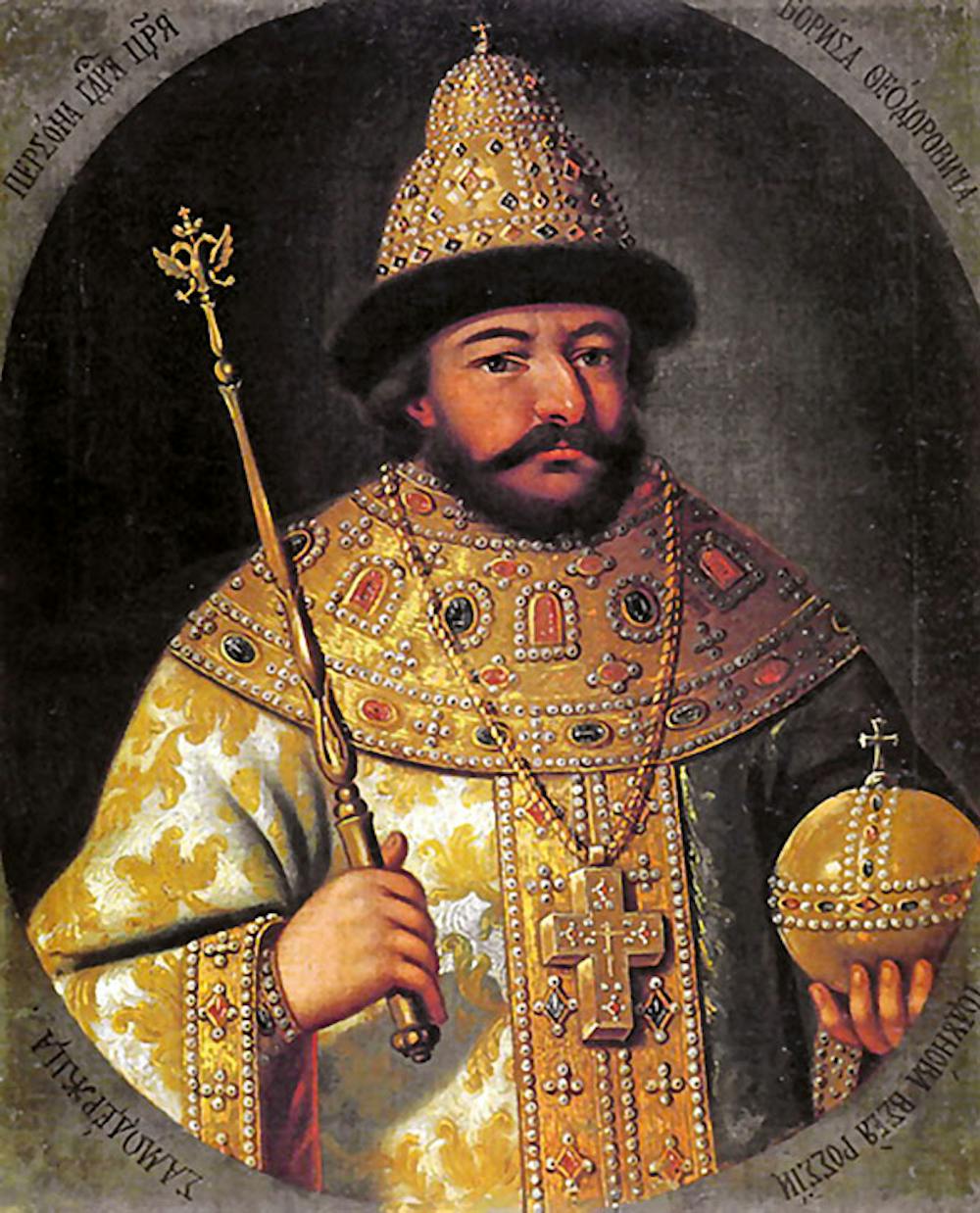 Boris Godunov (1552-1605).
Public domain
Boris Godunov (1552-1605).
Public domain
In the last lines of Boris Godunov, when faced with the shocking fruits of their cause, Pushkin writes that “the people are silent with horror”. When they are called on to cry out in support of the pretender they sanctioned, “the people remain speechless”.
This silence is best understand as passive complicity. It represents the horror of what is taking place in the narod’s name, but also their resignation. They tolerate the situation: their silence is equivalent to looking away.
“The persistence of autocracy in Russia,” the historian Orlando Figes has observed, “is explained less by the state’s strength than by the weakness of society.” This dynamic has shaped, and continues to shape, the course of Russian history.
Legitimacy, in Russia, comes from maintaining order and control, not from being democratically accountable. The face of the system may change, but never its underlying patterns, structures or forms. “The principle of Russian power hasn’t even remotely changed in the last five centuries,” wrote Vladimir Sorokin three days after Russia invaded Ukraine in February 2022. “I consider this to be our country’s main tragedy.”
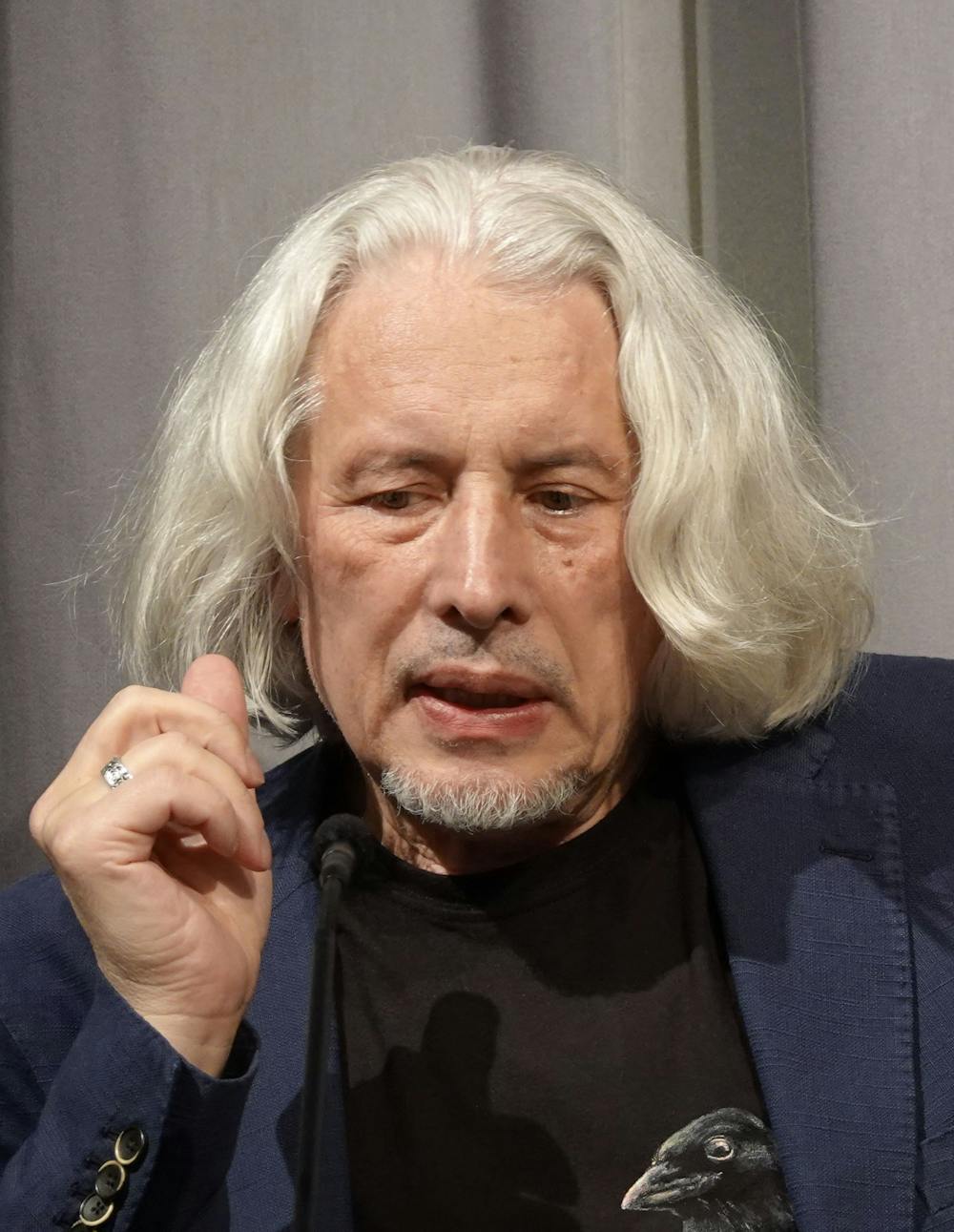 Vladimir Sorokin.
Haemmerli/Wikimedia Commons, CC BY-SA
Vladimir Sorokin.
Haemmerli/Wikimedia Commons, CC BY-SA
Autocratic culture reproduces itself in the sociopolitical structures of the modern Russian state, but also in the mentality of its people. The truth is that the Russian ruler’s prerogative as tsar-batiushka or “Father Tsar” can only hold sway over an acquiescent, even infantilised realm.
Prigozhin’s mutiny will only cement Putin’s – or his successor’s – autocratic prerogative. As Hannah Arendt argued, authoritarian regimes hold out the carrot of stability, while constantly manufacturing the threat of instability. It is a self-perpetuating system. Chaos provides the impetus for autocratically imposed unity.
We don’t know who might eventually succeed Putin, but history suggests the next leader is unlikely to be liberal or democratic.
An old question arises: will the Russian people remain silent?
Authors: Danica Jenkins, Postdoctoral Teaching and Research Fellow, University of Sydney

















