

Natural hazards, a warming climate and new resource laws – why NZ needs geoscientists more than ever
- Written by Martin Brook, Associate Professor of Applied Geology, University of Auckland
Earth scientists and technical staff are in scope for potential job losses at New Zealand universities as part of a wider cost-cutting exercise. As a geologist, I find these mooted redundancies stupefying.
New Zealand faces multiple natural hazards, the geotechnical industry is already struggling to recruit graduates, and the demand can only grow as we tackle multifaceted global problems such as climate change and reliable energy supplies.
We need geoscientists more than ever, and here are three big reasons why.
Construction demand
Most of the land in New Zealand is “greenfield” and undeveloped. We are either building new houses and infrastructure or rebuilding damaged houses and infrastructure following natural hazard events.
New Zealand is yet to develop serious public transport infrastructure (intercity rail, tunnels) and has only relatively recently embarked on major roading projects, including the Waikato expressway and Kāpiti expressway.
Rail to Auckland’s North Shore, and rail and vehicle harbour tunnels, are only now being seriously considered.
Read more: Slow train coming: only a genuine shift to rail will put NZ on track to reduce emissions
A prerequisite for any new construction is a ground investigation to understand the subsurface. This is to identify any potential ground hazards – subsidence, flooding, groundwater, slips, weak soils and rocks – and to mitigate any geotechnical “ground risks” through sound land-use planning and zoning, and appropriate building design.
Even the building of a single-storey house requires a geologist to drill a shallow borehole into the soil and to undertake shear-strength and penetration-resistance tests.
Geohazards and climate
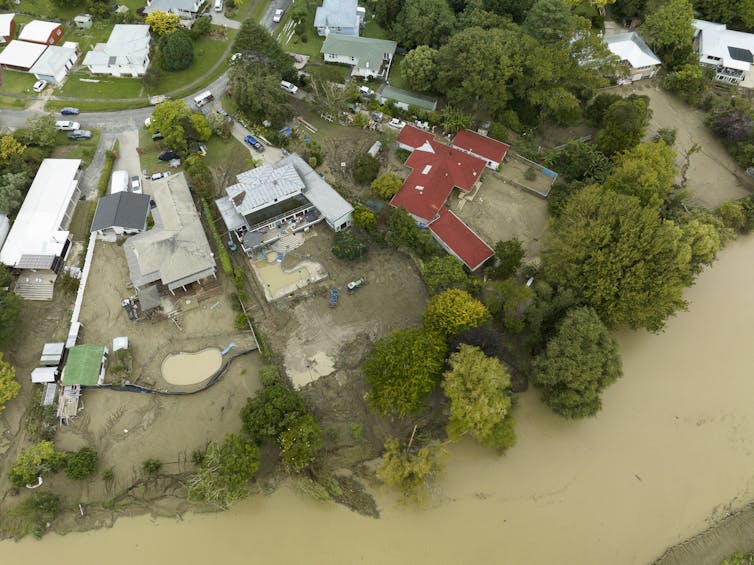
New Zealand straddles a convergent plate boundary and is surrounded by mid-latitude oceans creating a humid climate. We are in the gun barrel of several natural hazards. In a warming world, New Zealand will also experience more extreme weather events.
When a construction site, house, road, rail line or water pipeline is affected by natural hazards, we need geologists to respond. They advise on mitigation so that temporary works can occur, and they provide information to inform longer-term engineering design solutions.
Demand is high and rising for earth science and civil engineering graduates to deal with these large-scale environmental management issues. Graduates at my department all receive multiple job offers, including from overseas, and universities are struggling to supply domestic needs.
Critical minerals
In addition to the above roles, geoscientists are also in demand in the minerals and energy sectors, both vital industries to mitigate climate change and provide us with technology. In New Zealand, we tend to conveniently ignore the minerals that facilitate our everyday existence.
Take the 14 different minerals (at least) used in a typical smartphone. The tantalite that provides the tantalum used in smartphone capacitor anodes comes from the Democratic Republic of Congo and is recognised as a conflict mineral.
The beryllium used to make the battery contacts either comes from Mozambique, China or the US. Cassiterite is mined for the tin used to solder components together and likely comes from a mine in Myanmar or Indonesia.
Read more: Critical minerals are vital for renewable energy. We must learn to mine them responsibly
Brushing your teeth tonight? That’s flourite, diatomite, calcite, quartz, barite and rutile in your toothpaste. If your toothbrush handle is made of plastics, it likely originated in a Middle East oil field.
Some of these minerals exist in New Zealand’s rocks in sufficient concentrations to make mining viable, but we shift environmental and social impacts to other countries. This allows New Zealand to claim a “clean and green” image, but reflects badly on us as global citizens.
The extraction of some of our own minerals with targeted precision mining is surely more appropriate, especially given the uncertainty of global supply chains.
Environmental management legislation
An additional demand for geoscience graduates will emerge with the reform of the Resource Management Act 1991 (RMA), the main law that determines how people interact with New Zealand’s natural resources. It sets out the rules about air, soil, freshwater and coastal and marine areas, as well as regulating land use and the allocation of scarce resources.
The RMA is being replaced by three bills. The Natural and Built Environment Bill and the Spatial Planning Bill have both passed their third readings in parliament this month. A third bill focuses on climate adaptation.
All three new laws will create new compliance requirements that will need to be negotiated. Geoscientists, including those with geospatial skills, are fundamental to that process.
Much of the above creates domestic demands for geoscience graduates in environmental management and geotechnical sectors. This is irrespective of additional demands by Australian mining companies.
If we were to get serious about geoscience, it would be prudent for the government to develop an updated National Geospatial Strategy (NGS). As the Norwegian NGS states:
Good quality geospatial information is a core part of the knowledge base for many processes in society.
The New Zealand NGS was developed in 2006. It has been superseded by a range of technological advances in software, computing and satellite sensor platforms. It’s no longer fit for purpose.
Apart from an updated strategy, a national geotechnical engineering office should take overall responsibility for the range of geotechnical activities related to the safe and economic use and development of land in New Zealand. It could be modelled on Hong Kong’s geotechnical engineering office.
At present we have Auckland Council and EQC funding the nationwide New Zealand landslides database. Surely, a national body should be overseeing this as well as other geological hazard data sets and mitigation initiatives, under one umbrella.
Notwithstanding all of the above, if the work of geoscientists is to be effective, we also need social scientists, many of whom are also facing redundancies, to consult with communities, with the necessary skills in cultural awareness and diversity of thought.
Authors: Martin Brook, Associate Professor of Applied Geology, University of Auckland

















