

How gene mapping almost all remaining kākāpō will help NZ’s rare night parrot survive
- Written by Joseph Guhlin, Postdoctoral Researcher with Genomics Aotearoa, University of Otago
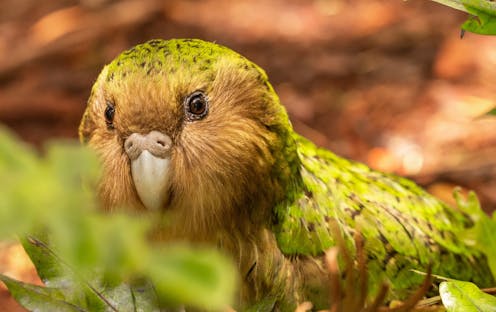
The genetic mapping of almost the entire kākāpō population has shed new light on specific traits that will help conservation biologists in their efforts to save the critically endangered flightless night parrots.
It also provides a blueprint for conservation genomics of other threatened species.
Kākāpō are remarkable and unusual birds, found only in Aotearoa New Zealand. They only breed every few years, triggered by the availability of certain forest foods such as the fruits of the native rimu tree.
The parrots’ life history and habits, combined with the impact of people, brought them close to the brink when their population dropped as low as 51 during the 1990s.
Thanks to the sustained efforts of the Department of Conservation, in partnership with Ngāi Tahu iwi, the kākāpō population is now up to 247 birds, living on offshore, predator-free islands. Earlier this month, four male kākāpō returned to the mainland for the first time in decades when they were transferred to the Maungatautari sanctuary.
But kākāpō suffer from diseases such as the fungal infection aspergillosis and many of their eggs are infertile.
Our genome analysis provides major insights into the genetic reasons behind these problems and will aid the birds’ recovery.
Read more: Plant hormone boost for New Zealand's critically endangered night parrot
Intense species management
Only remarkable conservation efforts have saved kākāpō from extinction – for now.
The extent of the work is astounding. Each bird is tracked and mechanical bird feeders are coded such that only individual birds have access to food prepared specifically for them. Vast amounts of data are recorded and stored, and veterinary hospitals around the country stand by to intervene if a kākāpō becomes ill or injured.
A few years ago, as part of this conservation effort, a crowdfunding project led by the Genetic Rescue Foundation raised money to sequence the genomes of all kākāpō. This was a considerable task, even with only 125 birds alive at the time. Additional generations were added later to bring the total to 169 sequenced individuals.
The aim was to gather as much information as possible on each bird, hoping this would allow better management and identification of risks.
The guardians of this genome data are Ngāi Tahu and the Department of Conservation. Our team from Genomics Aotearoa applied for access to the data to see if we could develop new tools to help manage kākāpō and perhaps other endangered species.
Read more: A huge project is underway to sequence the genome of every complex species on Earth
Understanding the genetics of kākāpō biology
We used the most up-to-date tools to identify genetic variation between kākāpō, employing AI technology to mark those areas of the genome that differ between individuals. This allowed us to update the kākāpō family tree and to identify families with unusual genetics.
We studied a range of biological features to link genomic information with observable traits. This has produced a wealth of information on genetic variations affecting growth, fertility, embryo survival and the number of eggs in each clutch.
But we wanted to go beyond genetics to find ways to support the kākāpō recovery team, providing them with science-based tools and advice that will make managing the birds more effective and less resource-intensive.
One important trait is the early growth rate of chicks. Each kākāpō chick that hatches is monitored closely and weighed frequently. We wondered if, from the genomic data, we could predict the growth rates of chicks based on their parents’ genomes.
To do this, we had to consider all other factors influencing growth rates – food sources, whether the birds were hand-reared or not, what island they are on – and remove that variation to see what comes from genetics alone.
Using new probability tools developed for other complex processes, such as predicting traffic flows, we developed a technique that predicts the growth rate of a chick from the genomes of its parents.
This gives the kākāpō recovery team a way to know when a chick is deviating from its expected growth, and to intervene with extra care. Prioritising care using genomics-based information will also help to identify individual birds for transfers to other sites, and to monitor those with poor growth or high disease risk.
Read more: Back from the brink: how genome research is helping the recovery of the Chatham Island black robin
Looking towards kākāpō’s future
None of this work would be possible without the considerable data the kākāpō recovery team has gathered for this species. This is not always available for other species of conservation concern.
Our work confirms that the active management carried out over the past 45 years has maintained diversity in breeding values. This diversity means that kākāpō have enough genetic diversity and evolutionary potential to cope with future challenges.
The kākāpō recovery programme is now incorporating our data, showing that genomic science can inform the day-to-day decisions of a conservation team.
In the past few months, we have caught up with the sequencing by completing the genomes of all the chicks hatched since the first sequencing effort. These are a test of our predictions and an opportunity to finetune our models to raise the future prospects for the species.
We can’t wait to see if our work is validated in the genomes of the next generations of kākāpō.
Authors: Joseph Guhlin, Postdoctoral Researcher with Genomics Aotearoa, University of Otago

















