

Modern Australian
The Times

Long COVID symptoms can improve, but their resolution is slow and imperfect

  • Written by Suman Majumdar, Chief Health Officer, Burnet Institute

Long COVID symptoms can improve, but their resolution is slow and imperfect

Around 5–10% of people who get infected with SARS-CoV-2 will experience symptoms that persist way beyond the initial acute period, a clinical syndrome we are learning more about, known widely as long COVID.

Shortness of breath, brain fog, lethargy and tiredness, loss of smell or taste are common features of long COVID, as is the development of new conditions such as diabetes, heart disease, stroke, depression and dementia.

But how long is the “long”? If and when do symptoms resolve?

Read more: When does COVID become long COVID? And what's happening in the body when symptoms persist? Here's what we've learnt so far

A recent study has examined this in detail, following people for two years after their infection. This and other recently published studies on long COVID show that while symptoms do resolve in many people, their resolution is slow and imperfect.

What did the study find?

The key work, led by Ziyad Al-Aly, examines the effect of SARS-CoV-2 two years after infection in a large group of US veterans. The researchers followed 139,000 people with COVID and almost six million uninfected controls for two years, tracking deaths, hospitalisations and 80 long-term impacts of COVID, categorised into ten organ systems.

They found that people who were initially hospitalised with COVID were 1.3 times more likely to die and 2.6 times more likely to be hospitalised again, compared to the control group (people without COVID), over the two years. After two years, this “hospitalised” group remained at increased risk of 50 conditions.

People who had milder COVID (who weren’t hospitalised with their initial COVID infection) had an increased risk of death for up to six months and increased risk of hospitalisation for up to 18 months. However, at two years, they remained at increased risk of 25 conditions.

So, while people who were initially hospitalised for COVID had worse outcomes over the two-year follow-up, there was still a substantial burden of illness in people who initially had milder COVID. This included a risk of clots and blood disorders, lung disease, fatigue, gut disorders, muscle and joint disorders and diabetes.
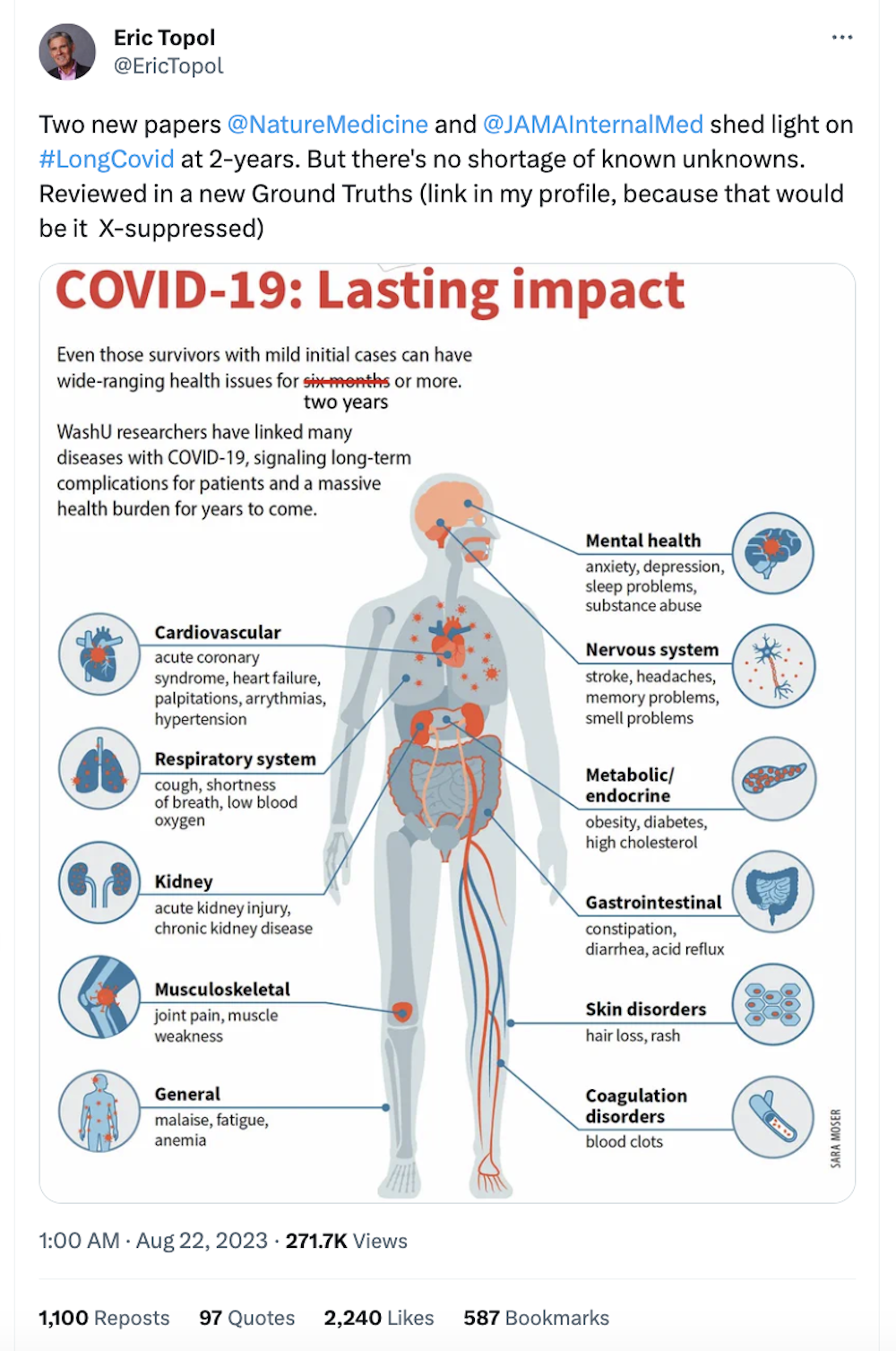

X (formerley Twitter) Findings from other recent research were similar A separate cohort study followed more than 208,000 veterans with COVID over two years. It showed that overall, 8.7% died compared with 4.1% in the uninfected control group. The risk of death was concentrated in the first six months after infection. A third, not yet peer-reviewed and smaller cohort study of 341 people with long COVID from Spain, found only 7.6% of them recovered at two years. Read more: What is POTS? And how is it related to long COVID? Another significant (not yet peer-reviewed) study from the United Kingdom assessed diabetes risk after COVID by following 15 million people in England from 2020–21. It found a 30–50% elevated risk of new type 2 diabetes after COVID. This increased risk persisted up to two years. But the risk for type 1 diabetes risk did not persist. An Australian (not yet peer-reviewed) study followed 31 people who developed long COVID and 31 matched controls who recovered from COVID for two years. It found that most of the concerning immunological dysfunction effects that had been present at eight months, had resolved by two years. While almost two-thirds of those with long COVID (62%) reported improved quality of life over the two years, one-third were still struggling in this regard two years after their infection. Finally, a recent whole-body positron emission tomography (PET) imaging and biopsy study showed prolonged tissue level immune-activation and viral persistence in the gut for up to a remarkable two years after COVID. These studies have some limitations It’s important to note the observational studies have some inherent limitations. The US veterans cohort studied by Al-Aly is nearly 90% men, with an average age of 61 years, which is different to groups most at risk of long COVID. They acquired their initial infection in 2020, before Omicron, before vaccination and before therapies – all of which are protective against long COVID to a degree. Having said that, long COVID still frequently occurs in vaccinated people infected with Omicron. We still don’t have treatments for long COVID Increasing understanding about underlying mechanisms of long COVID, such as those involving persistent virus and effects on mitochondria – the powerhouse of the cells - can lead to treatment options that need to be trialled. In July 2023, the White House established the Office of Long COVID Research and Practice. Two randomised trials are testing whether the antiviral nirmatrelvir-ritonavir (Paxlovid) can treat long COVID are currently recruiting patients. Man looks at pill Research is underway to see if drugs can prevent long COVID. Pexels/Ron Lach A separate randomised, placebo-controlled trial has shown that metformin, a commonly prescribed anti-diabetic medication, taken for two weeks (and taken within three days of testing positive for COVID) reduced the chance of developing long COVID by 41%. The mechanism may involve an effect on mitochondria or directly on the virus. Read more: Paxlovid is Australia's first-line COVID antiviral but Lagevrio also prevents severe disease in over-70s But it’s still important to prevent COVID (re)infections Taken together, these studies on the longevity of long COVID add substantially to the case to fast-track the development of interventions and therapies to prevent and/or cure the condition. In the meantime, it’s crucially important to prevent (re)infections in the first place to reduce the future burden of long COVID, already estimated to be greater than 65 million people globally. Breathe clean air by ensuring indoor spaces are well-ventilated. In poorly ventilated or crowded spaces, wear a well-fitted and high-quality mask (a P2, KN95 or N95 mask), and/or use air filtration devices suitable for the space you are in. Keep up to date with boosters. And get tested so you can get antiviral treatment if you’re eligible. If you suspect you have long COVID, discuss this with your GP, who may refer you to specialised services or multidisciplinary care. Authors: Suman Majumdar, Chief Health Officer, Burnet Institute

Read more https://theconversation.com/long-covid-symptoms-can-improve-but-their-resolution-is-slow-and-imperfect-212015

Why Regular Skills Updates Are Essential for Licensed Security Officers

A guard at a Brisbane shopping centre gets a call about a shoplifter who's turned aggressive.  They’ve done the job for six years. But their de-...

10 Benefits of Choosing Professional Tutoring Penrith Services

Every student has unique learning strengths, challenges, and academic goals. While classroom teaching provides essential knowledge and structure, so...

Sunshine Coast Baby Classes Prove Big Hit Among First-Time Mums

There's a movement gaining traction on the Sunshine Coast, providing a village of support, socialisation and relief for first-time mothers and babie...

Father's Day Gift Ideas for Men Who Are Hard to Buy For

Some dads are easy to buy for. Others do not want anything, already have everything, or give you the classic "don't worry about me" answer every yea...

Top 5 Mistakes That Wear Out Your Brakes Faster

Brakes don't need frequent replacements like oil changes do.   But a lot of the wear happens quietly, over months, because of habits most drivers...

Plantation Shutters vs Curtains: Which Is Better for Your New Home?

Moving into a new home is an exciting opportunity to personalise your space and make it your own. While many homeowners focus on furniture, flooring...

Celebration of Life vs Traditional Funeral: What's the Difference?

When saying goodbye to someone you love, there is no single way to honour their life. Every family has different traditions, beliefs, and preference...

Building Approval for Roofing Projects: What Homeowners Need to Know

Roofing projects are an important part of maintaining and protecting your home. Whether you're repairing storm damage, replacing an ageing roof, or ...

Chatswood Tutoring And Its Role In Academic Achievement

Academic success often requires more than classroom attendance alone. Students face increasing expectations as they progress through school, particu...

Why Laser Hair Removal Treatments Continue Growing In Popularity

Managing unwanted hair can become time-consuming and frustrating for many people, especially when shaving, waxing, and other temporary methods requi...

Choosing the Right Devices for a Flexible Workplace

For IT leaders managing large fleets, the device layer is where workforce productivity and security policy meet. The shift towards flexible and hybrid...

How Business Advisory Services Help Companies Achieve Sustainable Growth

Every business owner aims to build a profitable and sustainable organisation. While dedication, innovation, and hard work are important, achieving l...

Why Body Contouring Has Become A Popular Cosmetic Treatment

Many people maintain healthy lifestyles through regular exercise and balanced eating habits but still struggle with stubborn areas of fat that are d...

How to Choose the Right POS Hardware for Your Business in Australia

A lot of Australian business owners spend weeks researching POS software but buy hardware almost as an afterthought. That's a mistake. The wrong har...

Why Material Handling Hose Is Critical for Industrial Efficiency

A high-performance material handling hose is an essential component in industries that transport abrasive, dry, or bulk materials on a daily basis...

How to Choose the Right Lawyer in Melbourne for Your Situation

Choosing legal support can feel difficult, especially when the stakes are personal or business-related. The right lawyer in Melbourne should underst...

Hoteliers Look to Clever Value Adds to Increase Revenue

The Australian hospitality industry is still in recovery mode after a notoriously rough patch in recent years. While there has been a post-COVID tra...

Moving to Queensland? Here’s How to Prep Your Car for the Big Move North

There’s no sign of the northern migration slowing down, with thousands of southerners fleeing from chaotic lifestyles and cooler climates for a brig...















