

Being the main breadwinner didn't necessarily keep married mums in work during the pandemic
- Written by Leah Ruppanner, Professor of Sociology and Founding Director of The Future of Work Lab, The University of Melbourne

In the toughest days of the pandemic, many dual-income families made the difficult choice to drop down to one income.
With dads being the primary earners in many heterosexual households, it was often the mother who gave up her job to manage all the extra housework, homeschooling and childcare the pandemic brought.
But what about heterosexual households where the mother was the primary earner?
Our study, published in the Journal of Marriage and Family, involved analysis of 7,139 different-sex married parents in the United States, captured at multiple time points. We found many married mothers who earned half or more of the family’s income got knocked out of employment during the first 18 months of the pandemic.
The employment rate of fathers who earned the bulk of the money over this time dropped much less, we found. In fact, it barely changed.
Our study also found the ability to work remotely was an important lifeline for mothers to retain employment. Overall, earning more of the income couldn’t guarantee mothers would be protected from employment loss, but working remotely was crucial to mothers remaining employed.
Read more: The 'great resignation' didn't happen in Australia, but the 'great burnout' did
Even earning more, many mothers were knocked out of employment
To track US mothers’ employment over the duration of the pandemic, we used data from the Annual Social and Economic Supplement of the Current Population Survey. The data are collected by the US Census Bureau.
Our sample included civilian respondents aged 25–54 who were different-sex, married parents with children 12 years or younger. In each case, both the respondent and their spouse reported working for pay in 2019, before the pandemic started.
We used this data set to follow mothers’ and fathers’ employment patterns over the first year of the pandemic (January 2020 to May 2021).
We found fathers in this group who were primary earners tended to remain employed over this period.
The employment rate for mothers, by contrast, dropped significantly in the first few months and never fully recovered. It didn’t matter if mothers were primary earners or not – their employment rate still dropped.
In fact, by the March to May period of 2021, mothers’ employment was over four percentage points lower than pre-pandemic levels – regardless of their earnings.
So, earning more of the family income didn’t necessarily shield mothers from employment loss. What did matter, however, was access to telecommuting.
Mothers who could work online had significantly higher employment rates across the period of our study than mothers who couldn’t. Additionally, the positive effect of telecommuting on employment was four times larger for mothers than for fathers.
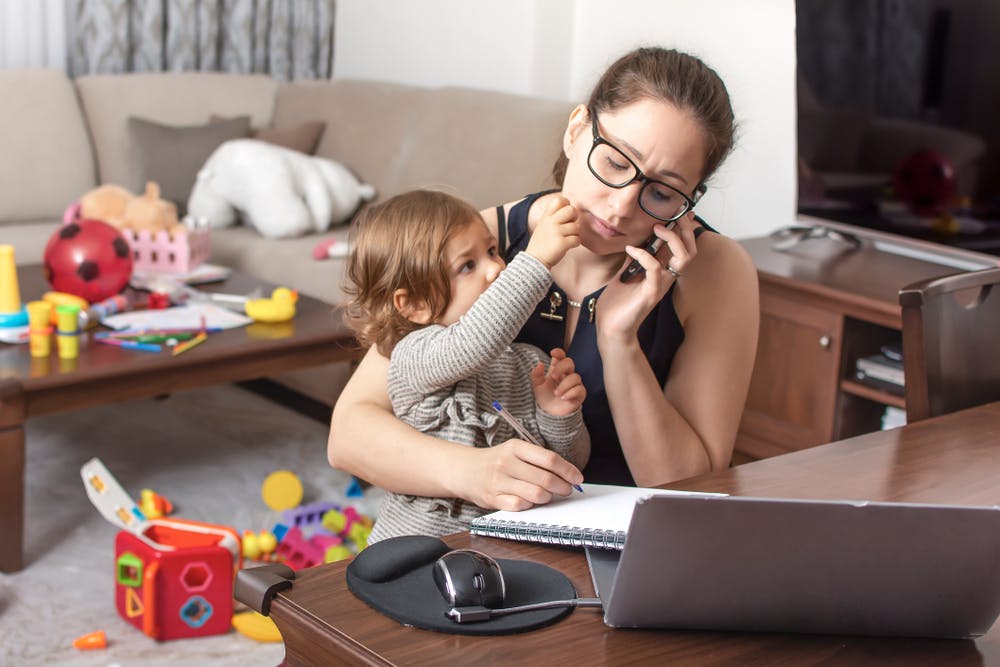
Telecommuting was a lifeline for mothers’ employment during the pandemic.
 Earning more of the family income didn’t buffer mothers from employment loss.
Shutterstock
Earning more of the family income didn’t buffer mothers from employment loss.
Shutterstock
The pandemic-pummelled mothers
These findings build on our previous research showing US mothers’ employment was hit hard during the pandemic.
At the start of the pandemic, our previous research found nearly 250,000 more mothers than fathers exited employment from February to April 2020.
We also found in prior studies that US mothers with children aged five or under reduced their work time four to five times more than equivalent fathers.
We also showed that in-person learning in the latter part of 2020 was lower in US districts with higher proportions of Black and Hispanic students. Remote learning across the 2020–2021 school year led mothers’ but not fathers’ employment to drop, especially for those with less education and limited access to telecommuting.
And our earlier research revealed how US mothers stepped into more housework and childcare, causing sleep problems, anxiety and stress.
As we discussed these findings with researchers and the community, one question would keep coming up: isn’t all this just the consequence of fathers earning more?
Isn’t it a “rational” choice to shield fathers from job loss, rather than mothers, because men tend to be the primary earners?
Our recently published research shows that, no, this was not necessarily about who made more money in the household – it is often about who is expected to provide care when times get tough.
Many mothers got knocked out of employment even when they were the family’s highest earner.
 Working remotely has been critical to mothers remaining employed.
Shutterstock
Working remotely has been critical to mothers remaining employed.
Shutterstock
Where to from here?
US mothers have now returned to employment at pre-pandemic levels. But we can’t ignore the fact many mothers stepped into the added care of the pandemic while also trying to maintain their work lives. Many couldn’t and employment dropped. Others experienced significant earnings losses even while remaining employed.
For those with the option to work remotely – who are largely employed in professional jobs – this benefit was and remains critical to their ability to hold onto their job. Despite this, employers are increasingly removing this lifeline and demanding a return to the workplace.
These lessons also extend to other Western nations. In Australia, for example, mothers picked up more housework and childcare at the expense of their health and wellbeing (as did fathers). Australian workers want remote work to remain which has long been critical to mothers maintaining employment and to avoid burnout.
The pandemic showed care work is critical to our lives and we must support those who do it.
For married heterosexual mothers, this means acknowledging the tolls of the pandemic and ensuring access for all in relevant occupations to critical resources like telecommuting.
Authors: Leah Ruppanner, Professor of Sociology and Founding Director of The Future of Work Lab, The University of Melbourne

















