

How diving as a boy took Tim Flannery on the trail of the megalodon in all its 'terrifying glory'
- Written by Vivienne Westbrook, Adjunct Senior Research Fellow, Oceans Institute, The University of Western Australia
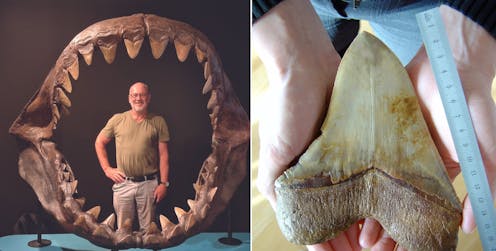
With Meg 2: The Trench currently showing in cinemas – its eponymous star looking unhelpfully like an oversized great white shark – megalodons are having another pop cultural moment.
Cinema-goers may, justifiably, have questions about the accuracy of this latest representation of these prehistoric creatures. The good news is that Tim and Emma Flannery have written a book that will both thrill and inform such curious readers.
Review: Big Meg: The Story of the Largest and Most Mysterious Predator that Ever Lived – Tim Flannery and Emma Flannery (Text Publishing)
Megalodons had cartilaginous structures, rather than the bony skeletons of the dinosaurs. While dinosaurs roamed Earth during the Triassic, Jurassic and Cretaceous periods (from 252 million to 66 million years ago), it is believed the megalodon emerged a mere 23 million years ago.
Megalodons had big, serrated teeth that could cut through large marine animals. When they became extinct, about 3.6 million years ago, palaeontologists were left only with remnants of their toothy smile from which to unpick the story of these sharks.
A palaeontologist by training, Tim Flannery’s prolific literary output has contributed both to academic debate and general awareness-raising about the nature and needs of the planet we continue to dominate. In this latest book, he has combined forces with his daughter, Emma, a scientist and explorer in her own right, but this is very much his story.

 Tim and Emma Flannery.
Photo: Kate Holden
Exactly when the megalodon became extinct remains a mystery, but several reasons are offered as to why it did – including, perhaps, that the food required to sustain such enormous creatures was running low during the Pliocene epoch (5.33 million to 2.58 million years ago). With fierce competition from sharks such as great whites, the supposedly bigger female megalodons, in particular, may have been just too large for the oceans to sustain the needs of any more than a small population. The species, write the authors, “may have always lived on a knife edge”.
As we follow this toothy tale, we learn of the cult of collectors, some of whom will go to extraordinary lengths, diving to dangerous, pitch-dark depths, to acquire a much-prized tooth.
Megalodon teeth vary considerably in appearance because of the absorption of particular chemicals in rocks and sediment in the many locations where they have been found. The authors describe the beauty of some of the teeth they have seen – jewel-like, variously coloured and patterned – pointing readers towards some of the likeliest sites for successful fossil-hunting. The US east coast (especially North Carolina) is a particularly rich hunting ground.
However, they point out that hunting is not without its dangers. Amateur fossil excavation can also risk disturbing valuable sites.
Read more:
Meg 2: the truth about the extinct mega shark – and why even this ridiculous film could inspire future palaeontologists
In the absence of a fully fossilised megalodon discovery that might reveal its shape and likely weight, it seems there is still a lot of truth in a tooth. The largest megalodon tooth yet found is “18cm from base to tip” and “almost certainly came from an individual that exceeded 15m in length”.
Tim and Emma Flannery.
Photo: Kate Holden
Exactly when the megalodon became extinct remains a mystery, but several reasons are offered as to why it did – including, perhaps, that the food required to sustain such enormous creatures was running low during the Pliocene epoch (5.33 million to 2.58 million years ago). With fierce competition from sharks such as great whites, the supposedly bigger female megalodons, in particular, may have been just too large for the oceans to sustain the needs of any more than a small population. The species, write the authors, “may have always lived on a knife edge”.
As we follow this toothy tale, we learn of the cult of collectors, some of whom will go to extraordinary lengths, diving to dangerous, pitch-dark depths, to acquire a much-prized tooth.
Megalodon teeth vary considerably in appearance because of the absorption of particular chemicals in rocks and sediment in the many locations where they have been found. The authors describe the beauty of some of the teeth they have seen – jewel-like, variously coloured and patterned – pointing readers towards some of the likeliest sites for successful fossil-hunting. The US east coast (especially North Carolina) is a particularly rich hunting ground.
However, they point out that hunting is not without its dangers. Amateur fossil excavation can also risk disturbing valuable sites.
Read more:
Meg 2: the truth about the extinct mega shark – and why even this ridiculous film could inspire future palaeontologists
In the absence of a fully fossilised megalodon discovery that might reveal its shape and likely weight, it seems there is still a lot of truth in a tooth. The largest megalodon tooth yet found is “18cm from base to tip” and “almost certainly came from an individual that exceeded 15m in length”.
 A fossilised megalodon tooth in the Pilbara, WA.
WA Parks and Wildlife Service/AAP
The shape of the tooth and its serrations confirm its job was to kill other marine mammals. The tooth’s marks on ancient bones or positions within them can reveal what the megalodon ate, while its colour, pattern and lustre can reveal the location of the creature when it died.
The authors acknowledge that the megalodon is not the ancestor of the great white shark – but analogies are made with this shark to allow the reader to get some sense of the kind of creature the megalodon might have been.
Two chapters, “Shark Eats Man” and “Man Eats Shark”, are almost entirely taken up with accounts of great white sharks, tiger sharks or bull sharks, either attacking humans, being attacked, or otherwise being used by humans to feed their desire for shark deities, shark trophies or shark fin soup. All of this rather distracts from the otherwise entertaining and informative story.
There is real passion in this story, but also horror and terror. Given the frequent analogies made with much oppressed, present-day sharks, more moderate language might have been used. The poor Greenland sharks are gruesomely described. The great whites and others become the stuff of nightmares. Readers who will never experience the beauty of these elegant and inquisitive creatures in their own environments may well associate these sharks with the imagined meg, a “terrifying”, “horrifying” “monster”, with “razor-sharp teeth” that is the star of this book.
A fossilised megalodon tooth in the Pilbara, WA.
WA Parks and Wildlife Service/AAP
The shape of the tooth and its serrations confirm its job was to kill other marine mammals. The tooth’s marks on ancient bones or positions within them can reveal what the megalodon ate, while its colour, pattern and lustre can reveal the location of the creature when it died.
The authors acknowledge that the megalodon is not the ancestor of the great white shark – but analogies are made with this shark to allow the reader to get some sense of the kind of creature the megalodon might have been.
Two chapters, “Shark Eats Man” and “Man Eats Shark”, are almost entirely taken up with accounts of great white sharks, tiger sharks or bull sharks, either attacking humans, being attacked, or otherwise being used by humans to feed their desire for shark deities, shark trophies or shark fin soup. All of this rather distracts from the otherwise entertaining and informative story.
There is real passion in this story, but also horror and terror. Given the frequent analogies made with much oppressed, present-day sharks, more moderate language might have been used. The poor Greenland sharks are gruesomely described. The great whites and others become the stuff of nightmares. Readers who will never experience the beauty of these elegant and inquisitive creatures in their own environments may well associate these sharks with the imagined meg, a “terrifying”, “horrifying” “monster”, with “razor-sharp teeth” that is the star of this book.
 Man Eating Shark. Two chapters of the book focus on human-shark interactions.
Sculpture and Photo: Dave Williams
Read more:
Friday essay: The Meg is a horror story but our treatment of sharks is scarier
In a final chapter, the authors return to the megalodon. Cryptozoologists, who search the planet for signs that creatures believed to be extinct are still alive, are on the trail of the megalodon following the discovery by a US navy ship in 1976 of a supposedly extinct megamouth shark, a contemporary of the megalodon.
Tim and Emma doubt megalodons are still out there. The sharks would hunt, they reason, where they would be seen by us and there have been no traces of even parts of a megalodon washed ashore, as in the case of other large and mysterious creatures.
However, they’re optimistic that further scientific discoveries will reveal more about the true shape and size of the creature.
If a complete set of teeth could be found – exactly as they lay in the mouth – this would reveal how the jaws worked, how many teeth there were, and what megalodons primarily hunted. If enough of a fossil was found to indicate the length and shape of the fins, we might learn more about the megalodon’s swimming and hunting strategies.
In 1988, the fossil of an extinct cartilaginous shark (Carcharodon hubbelli) was unearthed by an olive farmer in the Pisco Formation of Southern Peru.
Tim Flannery suggests that if a megalodon fossil were to be found, it would most likely be in the Pisco Formation “where the ancient sea floor, miraculously preserved, is laid out in exquisite detail”.
For now, the creature, whose arrowhead tooth once sat in his youthful hand – pointing him to the path of palaeontology – exists largely in his imagination: the “megalodon in all its terrifying glory”.
Authors: Vivienne Westbrook, Adjunct Senior Research Fellow, Oceans Institute, The University of Western Australia
Man Eating Shark. Two chapters of the book focus on human-shark interactions.
Sculpture and Photo: Dave Williams
Read more:
Friday essay: The Meg is a horror story but our treatment of sharks is scarier
In a final chapter, the authors return to the megalodon. Cryptozoologists, who search the planet for signs that creatures believed to be extinct are still alive, are on the trail of the megalodon following the discovery by a US navy ship in 1976 of a supposedly extinct megamouth shark, a contemporary of the megalodon.
Tim and Emma doubt megalodons are still out there. The sharks would hunt, they reason, where they would be seen by us and there have been no traces of even parts of a megalodon washed ashore, as in the case of other large and mysterious creatures.
However, they’re optimistic that further scientific discoveries will reveal more about the true shape and size of the creature.
If a complete set of teeth could be found – exactly as they lay in the mouth – this would reveal how the jaws worked, how many teeth there were, and what megalodons primarily hunted. If enough of a fossil was found to indicate the length and shape of the fins, we might learn more about the megalodon’s swimming and hunting strategies.
In 1988, the fossil of an extinct cartilaginous shark (Carcharodon hubbelli) was unearthed by an olive farmer in the Pisco Formation of Southern Peru.
Tim Flannery suggests that if a megalodon fossil were to be found, it would most likely be in the Pisco Formation “where the ancient sea floor, miraculously preserved, is laid out in exquisite detail”.
For now, the creature, whose arrowhead tooth once sat in his youthful hand – pointing him to the path of palaeontology – exists largely in his imagination: the “megalodon in all its terrifying glory”.
Authors: Vivienne Westbrook, Adjunct Senior Research Fellow, Oceans Institute, The University of Western Australia 
















