

How hate speech during the Voice campaign can harm personal wellbeing, as well as democracy
- Written by Paul Komesaroff, Professor of Medicine, Monash University
Last week, Prime Minister Anthony Albanese announced Australia will vote in the Voice referendum on October 14.
When the proposal for a Voice to Parliament was first put forward in the Uluru Statement from the Heart, it was mostly welcomed as an invitation to Australians to come together.
The subsequent announcement of a referendum brought hope and history into alignment for a possible process of reconciliation – just as occurred with the 1967 referendum.
It was recognised that opinions would differ, but there was confidence these could be resolved through considered dialogue.
Now, however, we are seeing increases in racism and hardening of entrenched positions instead of respectful dialogue.
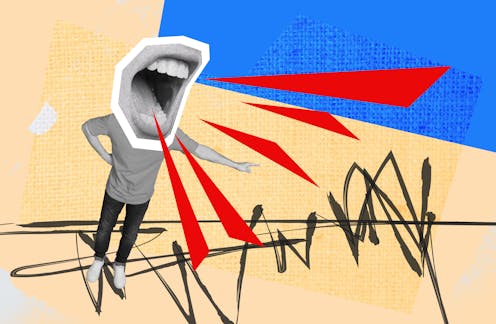
Where we need trustworthy analysis of and commentary on the proposed Voice, and careful, respectful discussion, there has been a torrent of misinformation, personal criticisms and even abuse.
Read more: How we can avoid political misinformation in the lead-up to the Voice referendum
Misinformation has multiplied
There have been claims and “theories” unleashed through the media, campaigning and social media that are often unverifiable and of uncertain origin. The surfacing of Donald Trump-style conspiracies has severed the link between political claims and established standards of truth.
We’ve heard claims such as the Voice would somehow lead to reparations for Aboriginal people or a new “Black State”. It has also been argued Australia Day will be abolished and the courts would be overwhelmed with claims from the Voice. Although there is no evidence for such claims, and a lot of them have been disproven, they have the potential to sow confusion and reap distrust of the proposed Voice.
However, the most concerning are the conspiracy claims and personal attacks against First Nations individuals and groups.
There have been calls for blood tests to verify Aboriginal heritage, and even accusations that some people darken their skin to gain some kind of advantage. These inflammatory claims have focused on undermining the validity of First Nations people, securing political advantage regardless of the truth.
It is our argument that many of these attributions qualify as “hate speech”. Hate speech is written or spoken communication that incites discrimination, prejudice or hatred based on race, ethnicity, religion, gender or other characteristics. The damage hate speech can cause is well established. Harms include the normalisation and more frequent occurrence of deliberate derogatory, discriminatory and dishonest speech.
Hate speech can cause physical and psychological harm
Hate speech causes harm at a social level, as it can worsen and even promote intolerance, divisiveness and hostility towards its targets. It hinders public discussion by using polarising and exaggerated claims, disrupting any chance of civil discussion. At its most extreme it can lead to the large-scale collapse of law and order, and catastrophic social division, as we have seen in the United States, and even overt political violence, as in the assault on the Washington Capitol.
At the individual level, evidence shows hate speech can also cause physical and psychological injury, including increased risk of stress-related illnesses. Hate speech can cause fear and anxiety, leading to social exclusion and isolation. It can also lead to discrimination becoming normalised and accepted.
It is true our democracy has become increasingly fragile. Political debates can easily be distorted or compromised. Access to reliable information cannot always be assumed. Particular voices can be excluded systematically from public discussions – traditionally, the voices of women and minority groups.
The undermining of the Voice debate has far-reaching and potentially dangerous consequences. The apparent inability of the nation to conduct a reasoned, respectful debate about an issue central to its collective identity will likely inflict lasting damage on our society. It will undermine confidence in public institutions, the legitimacy of government and social policies.
These are not extreme predictions. We have already seen how the questioning of health policy by some groups during the COVID emergency in some states led to actual violence. Overseas, examples of the breakdown of civil order have become common.
But it’s not too late to change course
It is important the debate be depoliticised, with politicians from all sides stepping back. The voices of ordinary people, including especially ordinary Aboriginal and Torres Strait Islander people, should be brought to the fore, in the spirit of the Uluru Statement. Careful truthfulness should be observed by all participants in the debate. And exaggerated claims calculated only to provoke discord should be named as such by existing fact-checking processes.
The authors of this article have developed a compendium of key resources that avoid ideological distortions and political grandstanding. It is available free of charge to all Australians to help them make up their minds about how to vote. Interested people are invited to visit https://voicetoparliament.info/ and download the pdf, read the text, or search it using a ChatGPT-powered search facility.
Australia is facing a test of the resilience of its peaceful social infrastructure and the safety of individual citizens.
Regardless of the referendum outcome, we must return to respectful, ethical, fact-based dialogues and political processes.
Authors: Paul Komesaroff, Professor of Medicine, Monash University

















