

Ever wonder how your body turns food into fuel? We tracked atoms to find out
- Written by James Carter, Adjunct Research Fellow, Griffith University
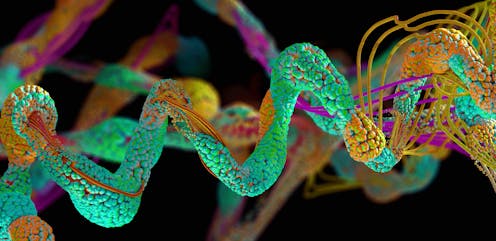
Inside our bodies at every moment, our cells are orchestrating a complex dance of atoms and molecules that uses energy to create, distribute and deploy the substances on which our lives depend.
And it’s not just in our bodies: all animals carry out this dance of metabolism, and it turns out none of them do it quite the same way.
In new research published in Science Advances, we analysed specific carbon atoms in amino acids – the building blocks of proteins – to discover distinctive fingerprints of the metabolism of different species.
These fingerprints reveal how different creatures meet the demands of survival, growth and reproduction – and offer a whole new way to understand metabolism in unprecedented detail.
A more detailed picture
We have developed a new way to study metabolism – the chemical processes inside your body that keep you alive and functioning – that reveals much more detail than previous methods. Our new technique looks at isotopes inside amino acids to see how metabolism is working.
Isotopes are versions of the same chemical element with different masses. For example, the most common kind of carbon is carbon-12, but there is also an isotope called carbon-13 that is a little heavier. We can measure the ratio of heavy to light isotopes in biological molecules such as proteins to learn about the organism that produced them.
Read more: Explainer: what is an isotope?
Traditionally, scientists would analyse the overall isotope ratio of the entire protein. This can reveal some information, particularly about what kinds of things an animal eats, but it is like averaging out a complex TV image into a single pixel of light – you lose all the detailed information.
More recently, scientists have been able to measure isotopes in each of the 20 individual amino acids that make up proteins. This is like having 20 dots of light – better, but still not very nuanced.
Our new method goes even further, by measuring isotopes in a particular carbon atom on each amino acid. It’s like seeing every pixel in the TV image, which gives us amazingly detailed metabolic info.
Finding the right carbon
We used a chemical called ninhydrin to chop off and isolate the carbon atom we wanted from each amino acid. We then sent these carbon atoms – from a very metabolically active part of the amino acid called the carboxyl group – through a machine called a mass spectrometer to read their isotope fingerprints.
This research began more than a decade ago, and developed into a collaborative project between Griffith University and Queensland Health. In 2018, working with colleagues in Japan, we were able to demonstrate that we could indeed use nihydrin to isolate the carbon atoms we wanted from amino acids.
The next stage was to combine our nihydrin technique with a process called high-performance liquid chromatography, which can separate out different kinds of amino acids.
In 2019, we were able to report position-specific isotope analysis for several different mammals. We found we could distinguish a clear metabolic “fingerprint” of each mammal.
The four phases of metabolism
In our latest work, we tested a broader range of animals including oysters, scallops, prawns, squid and fish. We found the patterns of isotopes in the amino acids could be tracked back to the biochemistry of mitochondria, the tiny energy-providing powerhouses in the cells of all animals and plants, as well as many other organisms.
We identified four distinct phases of metabolism: creating fats, destroying fats, creating proteins, and destroying proteins. Animals combine these phases in distinct ways to accomplish growth and reproduction.
For example, adult mammals use fats as a pantry to regulate their temperature, whereas adult prawns cannibalise their own proteins to make the fats they need for reproduction.
Read more: Why are bigger animals more energy-efficient? A new answer to a centuries-old biological puzzle
We also found that the humans we studied showed a very balanced, steady state metabolism, which is perhaps unsurprising given our generally stable and nutritious diets. Interestingly, this was quite similar to what we found in an oyster sample.
In this work, we studied individuals with generally normal metabolisms. Future applications might include studies of groups with abnormal metabolism such as cancer, obesity and starvation.
By peering deep into the isotopes of amino acids, we will be able to understand eukaryote metabolism like never before, in animals, plants and fungi.
Authors: James Carter, Adjunct Research Fellow, Griffith University

















