

what turns a festival into a disaster?
- Written by Warwick Frost, Professor of Tourism, Heritage and the Media, La Trobe University
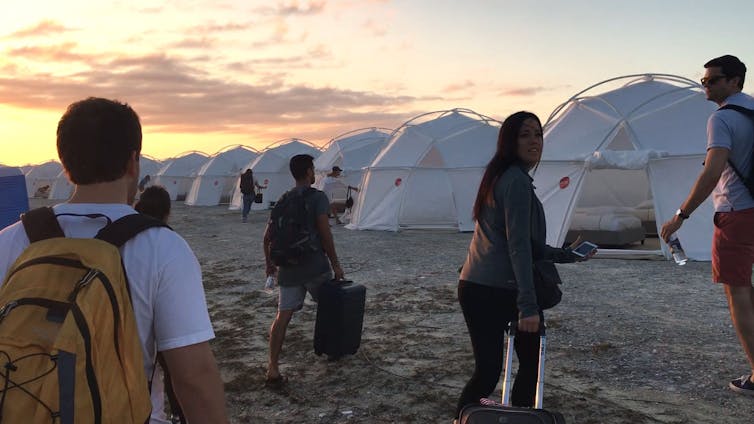
This year’s Burning Man Festival in Nevada has been washed out and 70,000 attendees are stuck in the mud. Summer rains have hit its desert location and, as we regularly find in the Australian Outback, when fine and dusty desert soils get wet, they are like glue. Transport becomes near impossible.
A large number of people are temporarily stuck at Burning Man and there are issues with emergency vehicle access. While it’s been reported a man has died at the festival, organisers say it was “unrelated to the weather”. However, the problem is not flooding, but rather mud and not being able to move.
This has created a media storm – but it is not a natural disaster of the severity of the recent fires in Hawaii and Greece, or the floods in Spain.
What is Burning Man?
Burning Man has been held at the same time of year in Nevada’s Black Rock Desert since 1991. It has generally been at a hot and dry period, perfect for an outdoor festival. Normally the venue is uninhabited, but for just over a week, up to 70,000 people come for this anarchic alternative arts and self-expression festival, forming a temporary camping city.
The culmination of the festival is the burning of a giant effigy of a man, a highlight based on a romanticised view of what our ancestors did in pre-historic times. A great experience, unless it rains.
Rain stops play
There is a long history of outdoor festivals being hit by summer rains. It rained at Woodstock in 1969 and images of hippies playing in the mud are part of the legend of that iconic counterculture festival.
It rained at Melbourne’s Sunbury Festival in 1975 and the lower-than-anticipated ticket sales almost sent its organisers broke. In 2022, rain also led to the cancellation of the Splendour in the Grass Festival at Byron Bay.
Going back to 1839, the Eglinton Tournament in Scotland, a medieval re-enactment event, was cancelled due to rain, with its grandstand collapsing and a reported 100,000 spectators stranded. For much of the 19th century, Eglinton was a byword for an event disaster.
Summer rain is a problem due to its unpredictability, intensity and the rapid runoff from baked soils. Festival organisers can make contingency plans to mitigate its effects, though they cannot avoid it and they cannot just wish it away. Outdoor festivals work well in natural or rural areas, but these need to be chosen and planned carefully, with the potential for storms taken into account.
Burning Man is situated on a playa (or dried lake), which provides an excellent flat surface for transport, motorhomes, displays and performances.
Global warming will lead to more frequent and more intense summer storms. The potential for weather chaos is only getting greater.

Other problems for festivals
The major problem for most festivals is not external shocks like rain, but rather deficiencies in management. The limited research we have indicates that many festivals have a short life-span and there is a high rate of failure.
Running annually for over 30 years, Burning Man is an exception. It is far more common to see short runs of a few years, one-offs, announced festivals that do not occur, re-branding of troubled events or changed venues and even cities.
For example, White Night in Melbourne drew enormous crowds, but only ran from 2013 to 2019. Paradoxically, the festival was too successful and overcrowding put too much of a strain on the city.
Common issues when events go wrong are unreal expectations, contradictory objectives, overzealous financial predictions, poor planning, lack of experience and the hubris of organisers. Staging an anarchic and edgy festival should not mean chaotic organisation, but it sometimes does.
Fyre Festival, held in the Bahamas in 2017, is perhaps the most infamous example, popularised by a Netflix documentary series.
Promoted as an up-market music festival through influencers on social media, attendees complained that the promised luxury accommodation and gourmet cuisine were not up to standard and most of the announced performers pulled out. In the end, legal action was successfully taken against the organisers.
Similar examples, albeit on a smaller scale, have occurred in Australia and throughout the world.
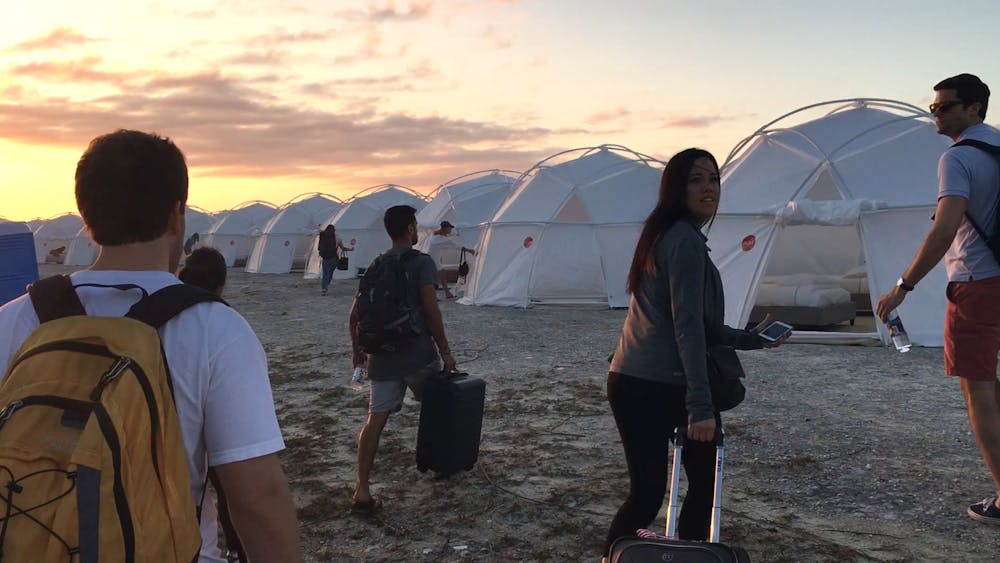 A still from the Netflix documentary FYRE: The Greatest Party That Never Happened.
Netflix
A still from the Netflix documentary FYRE: The Greatest Party That Never Happened.
Netflix
The nature of events
It is perhaps not widely appreciated that events like festivals have a very different nature to other forms of economic activity. Manufacturing, for instance, involves a focus on standardisation and testing. The products – whether cars or chocolate bars – have to conform to the same specifications and perform or taste the same. There is a need for certainty. This output is produced and checked and then sold and consumed at a later date.
Read more: Not burning, drowning: why outdoor festivals like Burning Man are reeling from extreme weather
In contrast, festivals are produced and consumed at the same time. Standardisation may be aimed for, but it cannot be guaranteed.
There are many “wildcard” factors that occur at the same time as production and consumption. These include the weather, the behaviour and attitude of the crowd, the variable quality of the performers and the staff, volunteers and other inputs in the production process. When it all comes together successfully, it makes for a magical festival.
Good management can help in this process and organisers need to be ready for contingencies. Rain at Burning Man was not a “freak” weather event – it needed to be planned for.
Authors: Warwick Frost, Professor of Tourism, Heritage and the Media, La Trobe University

















