

Australia's not likely to catch a cold, just a sniffle from China's economic downturn
- Written by James Laurenceson, Director and Professor, Australia-China Relations Institute (ACRI), University of Technology Sydney
There are few more reliable narratives in the business and financial press than, “If China sneezes, Australia will catch a cold”.
Such simple stories are likely part of the explanation why polling by the Australia-China Relations Institute finds three-quarters of Australians think our economy is “too reliant on China”.
In the middle of last year, indicators emerged that China’s large, and iron-ore-hungry, property construction sector was struggling. This meant, according to an analysis published by News.com.au, that “disaster loomed” for the local economy.
Late in 2022, there were hopes the Chinese economy more broadly might get a much-needed bounce after Beijing abandoned its harsh COVID-19 lockdown measures.
Read more: Australians' feelings towards China are thawing but suspicion remains high: Lowy 2023 poll
But with that recovery beginning to splutter in the second quarter of this year, we are now again being warned that a recession in China “could easily spark a recession in Australia”.
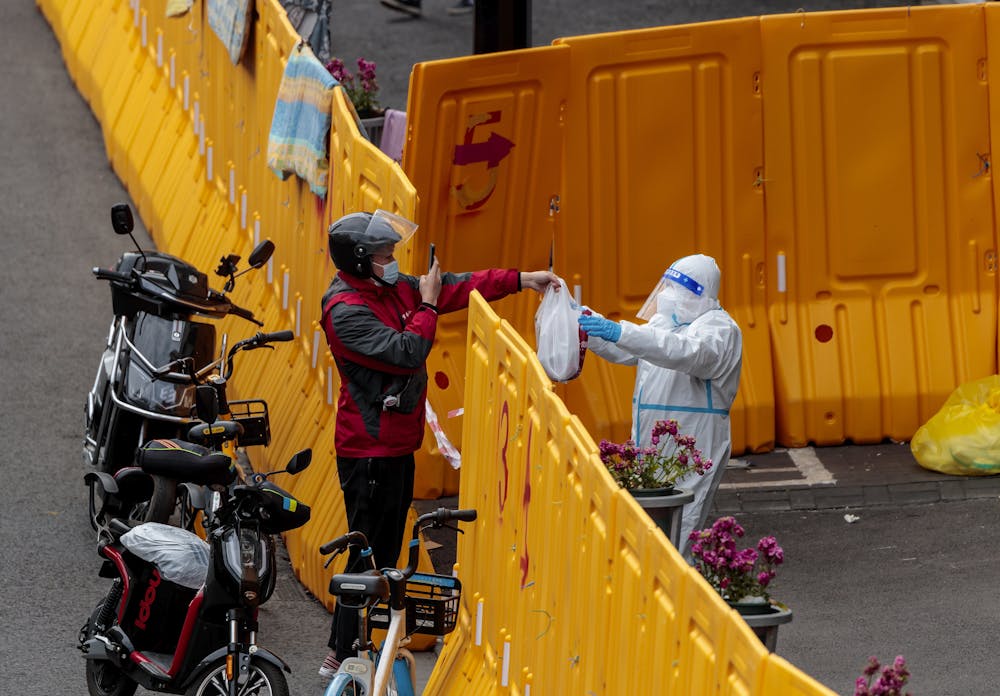
Last month, Treasurer Jim Chalmers appeared to add his official imprimatur to such assessments, calling China’s slowdown one of the “biggest challenges” facing the Australian economy.
He repeated this again on Wednesday when asked on ABC Radio National whether he thought there would be more interest rate rises:
… We already know that the combination of those two things, China and interest rates, is slowing our economy quite considerably.
Yet what most reporting and commentary misses is the basic fact there has never been a straightforward, one-to-one relationship between the ups and downs of economic activity in China and those in Australia.
Rarely mentioned amid the current doom and gloom about China’s economy is that in the year to June, Australia’s goods exports there hit a record high of A$192 billion. Since the end of last year, China’s share of Australia’s goods exports has jumped from 30.2% to 39.4%.
Might the coming year be different?
Perhaps. But there is little hard evidence suggesting it will be.
Resources giant BHP says the impact on China’s demand for iron ore from weak housing construction is being offset by “solid demand from infrastructure, power machinery, autos and shipping”. Independent commodity analysts concur.
Not surprisingly, then, iron ore future contracts put the price in September next year at more or less the same level as now.
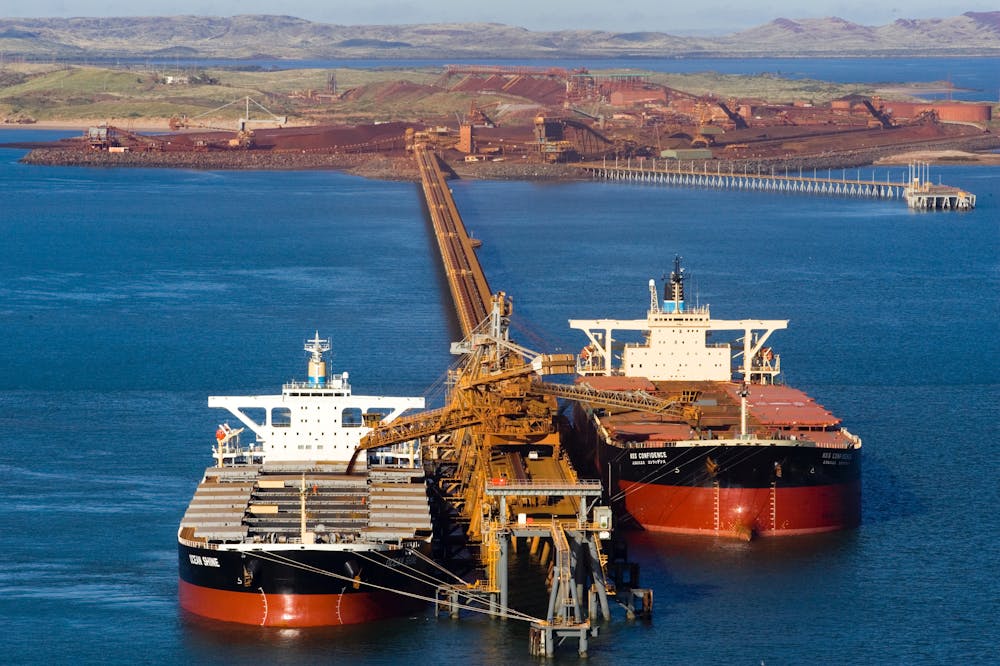 Demand for Australian iron ore is not expected to weaken despite China’s economy slowing.
AAP
Demand for Australian iron ore is not expected to weaken despite China’s economy slowing.
AAP
Meanwhile, China’s slowing economy hasn’t stopped massive new areas of trade opening. In the seven months to July, China imported nearly US$10 billion worth of Australian unprocessed lithium. During the same period in 2020, it was just US$327 million.
Post-pandemic, Australia-China services trade is also roaring back.
Visitor numbers start to climb
In June, there were 37,330 short-term visitor arrivals from China. That’s still well down on 80,680 in pre-pandemic June 2019, but quadruple the flow before Beijing relaxed its border controls last December.
In July, visa applications from would-be Chinese international students in Australia’s higher education sector stood at 8,379. This exceeded the 7,660 submitted in the same month in 2019.
The present resilience in bilateral trade is not unusual.
China’s growth rate has been grinding down since 2018. Yet between 2018 and 2022, Australia’s exports there rose by more than one-third.
Going back even further, China’s growth rate suddenly halved when it was hit by the effects of the Global Financial Crisis. Chinese demand for Australian commodity exports, however, surged.
The perception is not necessarily the reality
While all this data might appear at odds with common perceptions, it’s not news to those who haven’t resorted to lazy analysis.
The University of Western Australia’s Nic Groenewold modelled the effect of a permanent three percentage-point fall in Chinese GDP growth. He found this would reduce Australia’s GDP growth rate by between 0.15 and 0.57 percentage points depending on the time frame, summarising that:
While not trivial, given Australia’s current growth rate, these estimates are hardly enough to justify prophecies of doom.
Using a different modelling technique, the Reserve Bank of Australia estimated the implications of a sudden four percentage-point fall in Chinese growth.
In the most plausible scenario, it found greater short-run effects, albeit still unlikely to be recession-inducing. And after three years, Australia’s GDP was just 0.3% lower than if the shock had not occurred.
Read more: China's demand for coal is set to drop fast. Australia should take note
Aside from bilateral trade resilience, there are other factors that limit spillovers from China to Australia too.
An economic slump in the United States spills over to hurt Australia mostly via investment connections. In 2022, Australia’s stock of investment in the US stood at A$1.1 trillion. This channel is much weaker in the case of China, where Australia’s investment stock is only $62.5 billion.
Australia’s safety net
The Australian economy also has inbuilt “automatic stabilisers”. If there ever was a collapse in Chinese demand for Australian iron ore, the Australian dollar would immediately depreciate, improving export competitiveness across the board.
There would still be some painful costs, of course, such as households having to pay more for imported goods, and government revenues taking a hit.
Finally, some perspective is in order. It’s certainly true that China is, by far, Australia’s most important export market. Still, the value of these exports amount to around 7.5% of GDP. Compare that with domestic sources of demand such as household consumption that stand at 50% of GDP.
The key takeaway? If China sneezes, whatever the headlines might blare, don’t be surprised if Australia only gets a mild case of the sniffles.
Authors: James Laurenceson, Director and Professor, Australia-China Relations Institute (ACRI), University of Technology Sydney

















