

Drowning risk increases during heatwaves in unexpected ways -- here's how to stay safe this summer
- Written by Amy Peden, NHMRC Research Fellow, School of Population Health & co-founder UNSW Beach Safety Research Group, UNSW Sydney
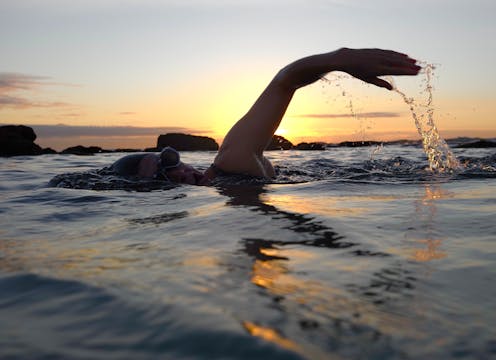
We know more people drown in summer. It’s the perfect time to visit the beach, river or local pool. Aussies love hitting the water to cool down.
But the connection between drowning and heatwaves in Australia has not been explored until now. Our new research, published today in the journal Injury Prevention, is the first to examine this link.
We found drowning risk during heatwaves was highest for males, older people and teenagers. But people of all ages were more likely to die from swimming or bathing in the heat. Drowning risk increased during low-intensity heatwaves and was higher still during severe heatwaves, but dropped back a little during extreme heatwaves, though the risk remained higher than usual.
Based on our findings, we want to raise awareness of drowning risk ahead of predicted heatwaves. We also offer strategies people can use to reduce their risk of drowning.
The Royal Life Saving National Drowning Report 2022 reveals a disturbing trend.Drowning and climate change
Drowning deaths are at an generational high in this country. Fatalities are the highest they’ve been since 1996.
A range of factors contribute to this upward trend, including climate. Drowning is inextricably linked to climate drivers such as extreme rainfall, as seen in the tragic flood emergencies across northern New South Wales. In 2021-22, 13% of drowning deaths in Australia were flood-related.
Overseas, warmer winters have led to an increase in drowning deaths in typically ice-covered regions, due to ice instability.
What we did
Using data from both the Australian Bureau of Statistics and the Bureau of Meteorology we looked at Queensland between 2010 and 2019. We examined the “incidence rate ratio” of drowning on a heatwave day compared to a non-heatwave day.
This means we compared the 248 non-heatwave drowning deaths and 603,892 non-heatwave days, with the 92 heatwave drowning deaths occurring on 191,420 heatwave days. In this way, we sought to identify any increased risk of drowning.
Queensland is a vast state that experiences wide variations in climate, so it’s a good case study.
What we found
We identified a 17% greater risk of drowning during a heatwave, compared to non-heatwave days. Within this though, there are variations.
Men were 22% more likely to drown during a heatwave than during non-heatwave days, compared to 5% for women. People 65 and over were 36% more likely to drown on heatwave days. This was higher than children and teenagers (24% more likely) and 20-64-year olds (7% more likely).
There was also a difference in terms of the activities we are doing in the water.
Drowning risk during heatwaves was highest for swimming and bathing-related drowning with a 28% increase compared to a non-heatwave day.
The risk of drowning due to a water transport-related incident (such as boating) was 27% lower during a heatwave.
The level of risk varies
We also found the link between heatwaves and drowning risk is not linear, meaning risk doesn’t necessarily climb as the temperature does. As heatwave intensity increases, so does drowning risk but only to a point. While risk rises from 17% during low-intensity heatwaves to 26% during severe heatwaves, risk of drowning reduced to just 9% during extreme heatwaves (the highest intensity).
Our results suggest hotter temperatures see more people in the water and therefore exposure to risk of drowning increases. For those with pre-existing medical conditions exacerbated by the heat, this likely also contributes to drowning risk.
Read more: 'Your first emotion is panic': rips cause many beach drownings, but we can learn from the survivors
Staying safe this summer
It’s important to communicate the increased drowning risk ahead of predicted heatwaves, just as we do ahead of other peak periods for drowning such as public and school holidays. It is also vital to educate people on simple strategies they can take to reduce their risk of drowning.
Some advice is pertinent regardless of the temperature. These include encouraging people to swim between the flags at patrolled beaches, supervising young children around the water, and wearing a lifejacket when boating or rock fishing.
But other safety messaging may be even more relevant during heatwaves. Alcohol intoxication dramatically increases drowning risk and our previous research on alcohol consumption at rivers shows a clear link between excessive drinking and the air temperature. That is, the hotter it is, the more people drink.
And given drowning risk increases for people with particular medical conditions, such as epilepsy and cardiac conditions, it is important to be mindful of the increased risk to health that is present during a heatwave, even before entering the water.
Surf Life Saving Australia’s 2018 powerful public safety campaign.What it means for those who keep us safe
Our research findings also have important implications for those who provide supervision around water, such as pool lifeguards and surf life savers.
During heatwaves, patrols could be staggered, starting earlier, with a break in the middle of the day, and extending longer into the evening, particularly with the sun setting later and warmer temperatures continuing into the night.
Extra resources are likely to be needed during low and severe heatwaves, but not necessarily heatwaves which reach extreme levels, as there appears to be a change in people’s behaviour and thus reduced drowning risk.
Those who respond to drowning emergencies must also prepare for more drowning incidents during heatwave conditions. Our excess mortality calculations identify heatwaves contributed to an additional 13 drowning deaths between 2010 and 2019.
Action on climate change is urgently needed for a range of reasons, including drowning risk. With global heat records being broken, Australia needs to be prepared for a potentially cruel summer and if you’re planning to hit the water, we urge you to be safe.
Read more: The 8 deadly days of Christmas: how to stay safe from drowning in Australia this summer
Authors: Amy Peden, NHMRC Research Fellow, School of Population Health & co-founder UNSW Beach Safety Research Group, UNSW Sydney

















