

'That's getting a bit wild, kids!' Why children love to play-fight and why it is good for them
- Written by Emily Freeman, Senior Lecturer in Psychology, University of Newcastle
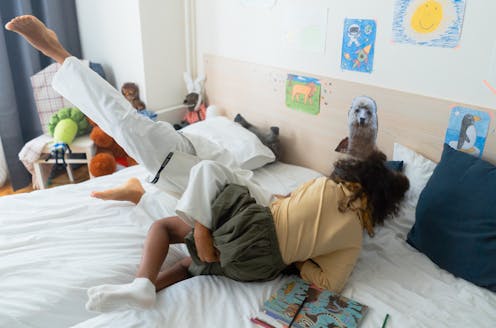
That’s getting a bit wild, kids! Why don’t you play something quieter?
How often have you found yourself saying something like this to your children as they’re rolling around on the lounge room floor?
Even if they are smiling and clearly having fun, as parents, we often worry that someone will get hurt or it will turn into aggression, and ultimately, tears.
As a family and child psychology researcher, parents often ask me why children engage in this type of rough-and-tumble play. What is it? Is it good for them? Should I be stopping it?
The short answers are: it’s fun, it’s good for their development and you can encourage a good quality rough play session with a few boundaries.
What is rough-and-tumble play?
Rough-and-tumble play is a type of energetic physical play that involves wrestling and chasing in a playful manner.
Parents often refer to it as “roughhousing”, “rumbling” or “play-fighting”.
An interesting thing about rough-and-tumble play is it is not unique to humans. In fact, it’s seen in almost all mammals, from rodents, to wolves, to bears and non-human primates.
Have you ever sat and watched a litter of puppies in their first four to six weeks of life? All they do is eat, sleep and rough-and-tumble play. When a behaviour is seen across numerous species, it suggests the behaviour plays a functional role in development.
Puppies wrestle in a similar way to children and other mammals, such as baby pandas or kittens.There are developmental benefits
Perhaps the most obvious benefit of this type of play is physical development.
Children develop balance, coordination, strength and agility through play fighting, wrestling and rolling around on the floor together or with a parent.
This style of play provides opportunities for children to explore and understand their bodies’ capabilities and limitations. One of our studies on father-child rough-and-tumble play showed children who engaged more frequently in this style of play had a lower injury risk than children who didn’t play like this often. This supports the idea that rough-and-tumble play helps teach children about their physical limits.
Rough-and-tumble play also helps children to develop their social and nonverbal communication skills. In a good bout of roughhousing, children engage in negotiation and cooperation with each other – they learn how to initiate the play, set boundaries and respect the boundaries of their play partner.
Most of this is done nonverbally. Children learn to read their play partner’s signals, such as their facial expressions and body language – are they leaning into the play or pulling away from it? Are they smiling or grimacing?
Read more: Kids learn valuable life skills through rough-and-tumble play with their dads
Managing emotions
Children also learn how to manage their emotions and self-regulate through this type of play. Think about all the emotions a child may go through while wrestling with their sibling. There might be:
excitement at the thought of winning and the opportunity to be loud and boisterous
frustration their sibling is stronger and it’s hard to pin them down or wriggle out from under them
enjoyment of the bond they are sharing with their sibling
and maybe a little bit of fear if they get a bit too wild and Mum or Dad breaks it up, or they accidentally knock something over.
Experiencing all these emotions and learning how to navigate them helps children develop emotional resilience.
Helping cognition
Rough-and-tumble play is also related to cognitive development. In one of our recent studies, we showed children who do more rough-and-tumble play have better working memory ability and fewer working memory problems.
Working memory is a cognitive function that allows us to hold and manipulate a small amount of relevant information.
If I gave you a maths problem (such as 4 + 6 - 2) and asked you to solve it in your head, you would be using your working memory (the answer is 8, by the way!). Similarly, if I told you the rules of a rough-and-tumble game, like “sock wrestle”, you would have to keep those rules in mind while playing the game and at the same time trying to win.
How to play ‘sock wrestle’How can you encourage good play?
Given all these benefits, how should you encourage good quality rough-and-tumble play?
Most importantly, you want to keep it safe.
Ideally, rough-and-tumble play should happen in large open spaces. Having a designated playmat is a good idea, as is moving the coffee table out of the way if you get a chance before the play starts.
You should also make sure all players actually want to play. Setting some rules around what types of contact are off-limits – no hitting, kicking or biting is a good place to start.
You also want to allow enough time so everyone wears themselves out.
It’s a nice idea to have a signal the kids use to indicate the play is over and which helps build a warm and loving connection – a handshake, high-five or hug, whatever works in your house.
Authors: Emily Freeman, Senior Lecturer in Psychology, University of Newcastle

















