

Fire regimes around Australia shifted abruptly 20 years ago – and falling humidity is why
- Written by Roger Jones, Professorial Research Fellow, Victoria University
This century, Australia has suffered more frequent and more severe bushfires. The Black Summer fires of 2019–20 were the worst on record for the area burned and property loss.
How much climate change has contributed to these increases is a hot topic. Bushfire risk is dialled up by four switches: fuel amount and condition, fire weather and ignition sources. Untangling these various influences is difficult, so the role played by the warming climate is heavily debated.
Fire-weather measures fire risk on a daily basis, while a fire-climate regime measures fire risk over seasonal and longer time scales. Our research shows almost everywhere in Australia is now in a different fire climate than it was just 20 years ago, with falling relative humidity a key factor. Previous research has also identified these sudden jumps in fire danger.
What caused fire climates to shift? Conventional scientific wisdom assumes the climate’s response to increasing emissions is gradual and linear. When rapid change happens, it’s often thought to be due to climate variability. But that’s not what happened here.
Most Australian fire climate regimes have already shifted
Fire weather is calculated using the Forest Fire Danger Index, which takes into account vegetation dryness, windspeed, temperature and relative humidity.
Obtaining reliable long-term records using these measures is difficult, so we used high quality seasonal and annual climate inputs to estimate the annual fire climate for different regions of Australia from 1957–58 to 2021–22.
We tracked changes in this fire danger index over that 64-year period across all states and the Northern Territory. We also looked at distinct sub regions such as southwest Australia. What we found was startling. Rather than a linear increase, fire regimes tracked along a similar line – and then suddenly jumped. For most states and territories, that happened around the year 2000.
There is no evidence for a long-term trend. Instead, the data shows a shift from one stable fire climate regime to another.
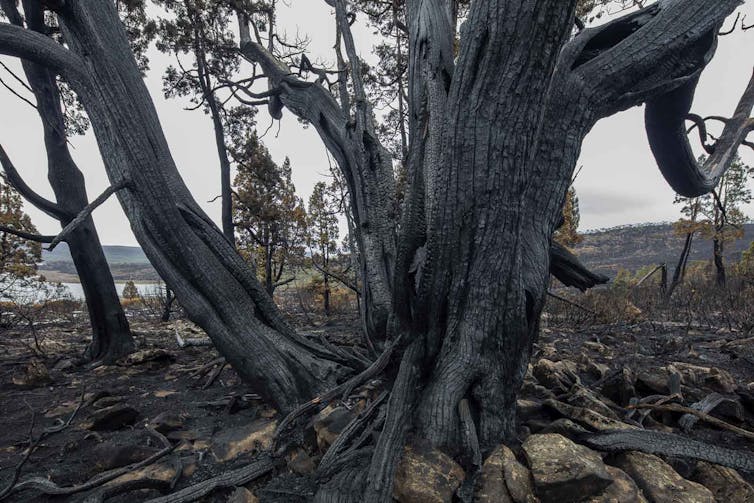
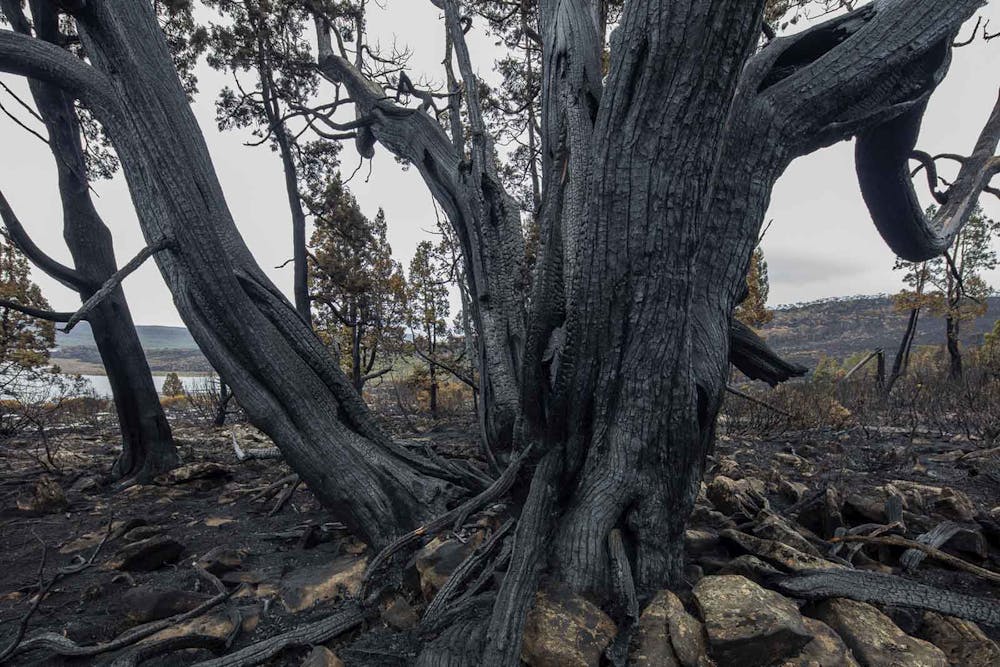
We’re already seeing these changes play out. Whenever you see a news article about intense fires in areas not used to fire, that’s likely to be due to a shift in fire climate. Think of the fires devastating Tasmania’s alpine regions in 2016, killing off many old pencil and King Billy pines.
When did these jumps happen?
Here’s when each region shifted from one fire regime to the next:
You can see the shift in the number of days above “high fire danger”.
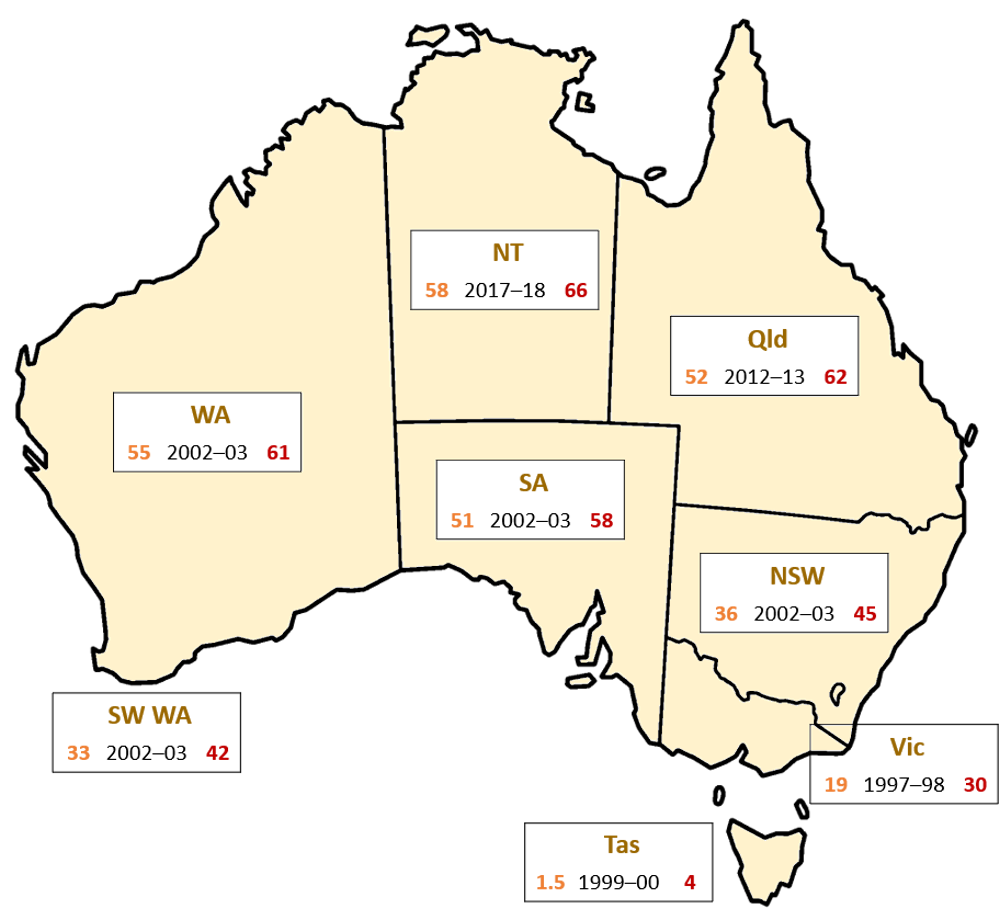 Orange numbers are the average number of days per year rated above high fire danger during the old fire regime (1957–58 to regime shift), the year the fire regime shifted. Red numbers are the average number of days from the start of the new regime to 2021–22.
Author supplied, CC BY-ND
Orange numbers are the average number of days per year rated above high fire danger during the old fire regime (1957–58 to regime shift), the year the fire regime shifted. Red numbers are the average number of days from the start of the new regime to 2021–22.
Author supplied, CC BY-ND
When we showed this research to Greg Mullins, former Commissioner of Fire & Rescue New South Wales, he said it was
utterly consistent with what firefighters are experiencing worldwide: more frequent, intense, and damaging bushfires that sometimes are impossible to control.
Is it really that bad? Yes.
For instance, what would have been the one in ten bad fire season under the earlier regime (occurring once in ten years) became, on average, a one in two fire season in the second regime.
That means the worst 10% of fire years were now happening every second year.
When we looked at even worse fire years – the worst year in 20 fire seasons – the shift was shocking. On average, we are now seeing these years twice every five years.
Why did fire climates shift so abruptly?
That’s the big question.
To find out, we analysed all the available input variables for regime shifts and tested their influence on the results. We found wind speed was not a factor. Changes in rainfall had little effect.
So what was it? We found the main driver was relative humidity in combination with higher daily temperatures during the fire season. Recently, we examined global humidity data and found large-scale downward shifts in humidity. In the Southern Hemisphere, that happened in 2002. In the Northern Hemisphere, it happened in 1999.
Humidity reductions in each region of Australia were closely followed by shifts to higher fire season maximum temperatures, amplified by soils drying out.
We also tested global average fire season length from 1979 to 2013 for regime shifts, finding a rapid expansion in 2002. That’s the same year Australia’s median fire danger jumped.
The consequences of these shifts are profound. The unprecedented fires in Canada and Europe, the devastating fires in Hawaii and the increasing frequency of wildfires around the world have their roots in lower relative humidity, which leads to higher daytime temperatures. That, in turn, creates these dangerous new fire regimes.
Why haven’t we heard about these sudden shifts in fire climate? One reason is much of our modelling is built on the assumption the steady accumulation of heat trapped by greenhouse gases leads to linear changes elsewhere.
But as this year’s climate chaos suggests, this assumption may be unfounded.
In our earlier research, we found zero of 32 climate models were able to reproduce the sudden shifts in relative humidity across the globe.
What does this mean for this year’s fire season?
Many parts of New South Wales, Queensland, the western Northern Territory and northwest Victoria have already dried out, though large forests will keep some moisture after the years of rain. Grass fires are already raging in the Northern Territory.
That suggests the greatest risks this summer will be in grassland, scrubland and suburbs on the fringe of cities. Widespread catastrophic forest fires are probably less likely. But the major fires will return if dry conditions persist.
In fact, in the current climate, land can dry out much faster than it used to, leading to flash droughts which swing from very wet to very dry in a short period of time.
Remember – this current fire regime may not be permanent. As the climate warms further, it’s entirely possible our fire regimes could warp into something even more dangerous. Ensuring our climate models are capable of predicting these changes is an urgent task.
Read more: Australia's Black Summer of fire was not normal – and we can prove it
Authors: Roger Jones, Professorial Research Fellow, Victoria University


















