

Yes, Labor's misinformation bill could jeopardise free speech online
- Written by Jay Daniel Thompson, Lecturer and Program Manager, Professional Communication program, RMIT University
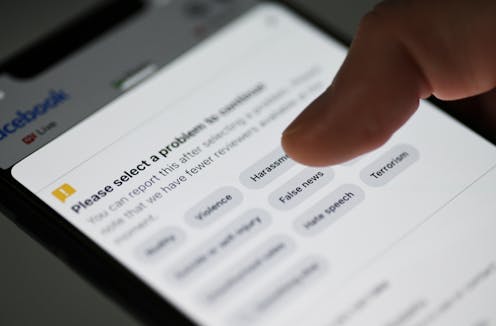
In January this year, the federal government proposed legislation that seeks to curb the online spread of false and misleading information.
Since then, a range of experts and groups have accused the draft Communications Legislation Amendment (Combating Misinformation and Disinformation) Bill of being vaguely worded and encouraging censorship.
Is this bill really an affront to free speech and, therefore, to democracy itself? And if so, how might it be strengthened to protect online expression?
An overview of the bill
The bill aims to amend the Broadcasting Services Act 1992 to grant the Australian Communications and Media Authority (ACMA) “powers to combat online misinformation and disinformation”.
Specifically, ACMA would be given the power to make platforms report back on the measures they are taking to combat what is sometimes called “fake news”. Should ACMA determine that “stronger protections for Australians are required”, it can then alter the existing media codes of practice and introduce new codes.
ACMA will also have the power “to make an enforceable standard for all digital services providers in the relevant section[s] of the industry”.
The federal government has emphasised ACMA will not remove content from platforms.
The government has also stated the bill “seek[s] to strike a balance between the public interest in combating the serious harms that arise from the propagation of misinformation and disinformation, with freedom of speech”.
But some critics – including constitutional law expert Anne Twomey and the Australian Human Rights Commission (AHRC) – have argued the bill doesn’t successfully strike this balance, and may have a chilling impact on online expression.
Combating fake news, or silencing expression?
The bill’s problems stem largely from the definitions it uses. Both misinformation and disinformation are defined as “information that is false, misleading or deceptive” and that “is reasonably likely to cause or contribute to serious harm”.
But there is a key difference between these two terms: disinformation is information that is distributed with the express purpose of deceiving others, whereas misinformation isn’t necessarily spread with deceptive intent.
The Law Council of Australia warns the broadness and imprecision of key terminology in the bill may result in confusion in its application. Similarly, the AHRC has said:
The broad definitions used here risk enabling unpopular or controversial opinions or beliefs to be subjectively labelled as misinformation or disinformation, and censored as a result.
Put simply, the bill could threaten freedom of speech: the ability to speak one’s mind in a public forum without the unreasonable threat of being silenced (such as via lawsuits or incarceration).
Freedom of speech has been heralded as a bulwark of any robust democracy; for a democracy to function, citizens must have the right to have their say on the issues of the day.
In the United States, free speech is protected by the First Amendment. No such formal protection exists in Australia. Nevertheless, the AHRC notes:
the High Court has held that an implied freedom of political communication exists as an indispensable part of the system of representative and responsible government created by the Constitution.
Read more: No, Twitter is not censoring Donald Trump. Free speech is not guaranteed if it harms others
Risk of ‘double standards’
The risk to free speech is further heightened by the bill’s interpretation of what constitutes harm. Historically, the potential of speech to cause harm (either physical or psychological) has been understood as one of the few reasons that speech should ever be censored.
The bill identifies one harm as being the “disruption of public order or society in Australia” – but does not clarify what such a disruption would actually entail.
The Media, Entertainment and Arts Alliance argues this concept of “harm” is especially vulnerable to misuse. It notes “there is a long history of important social movements being considered ‘disruptive’ by governments and powerful interests”.
It’s easy to imagine online campaigns opposing Australian refugee policy, taxation laws or institutionalised racism being labelled as “misinformation” – even if they have a factual basis.
The bill does feature a list of exemptions, including authorised government content. This could include press releases and social media posts.
The Victorian Bar posits this exemption creates a “double standard” that “disadvantages critics of government in comparison with a government’s supporters”.
There is also the patently false implication that government information can’t be incorrect.
What happens now?
Despite its faults, the bill is well intentioned. As Minister for Communications Michelle Rowland rightly says:
Mis- and disinformation sows divisions within the community, undermines trust and can threaten public health and safety.
The bill is yet to be debated in parliament, which means there’s still time for amendments to be made. In particular, the imprecision of key terminology is ripe for amendment.
Should the bill pass into law as it is, it could lead to censorship – endangering the very democracy it purports to defend.
Authors: Jay Daniel Thompson, Lecturer and Program Manager, Professional Communication program, RMIT University

















