

Devastatingly low Antarctic sea ice may be the ‘new abnormal', study warns
- Written by Edward Doddridge, Research Associate in Physical Oceanography, University of Tasmania
For most of us, Antarctic sea ice is an abstraction – something far away we may have seen on a documentary. But the radiant white sheets of ice floating on the seas around the snowy continent are a crucial component of Earth’s climate processes.
Sea ice insulates the ocean, reflects heat, drives currents, supports ecosystems and protects ice shelves. It also has an annual seasonal cycle – some of the ice melts, then freezes again.
Every year, the cycle of freeze and melt around Antarctica has been extremely reliable. Until recently.
In a new study published today in Communications Earth & Environment, we have found a preliminary indication that Antarctic sea ice may have entered a new state of diminished coverage.
The seasonal expansion and contraction of Antarctic sea ice (Animation by NASA/GSFC Science Visualisation Studio)A sudden, dramatic loss
For many years, while the Arctic lost sea ice, the Antarctic did not. Then, in the spring of 2016, Antarctic sea-ice coverage dropped dramatically. Over two years, the Antarctic lost as much sea ice as the Arctic had lost in three decades. Since then, Antarctic sea ice has been below average almost constantly.
This past Southern Hemisphere summer, Antarctic sea ice was the lowest it has ever been, with dire consequences. In late 2022 we saw the heartbreaking loss of 10,000 emperor penguin chicks, when the sea ice they lived on melted before they had grown their waterproof feathers.
On February 19 2023, Antarctic sea ice set a new record minimum of 1.77 million square kilometres, 36% below the 1979–2022 average for the summer minimum.
Read more: Antarctica's heart of ice has skipped a beat. Time to take our medicine
Since then, things have gone from bad to worse. The winter around Antarctica is cold and dark. Ever since we’ve had satellites to measure it, the surface of the ocean has reliably frozen into sea ice at about the same pace every winter, even following low sea ice summers. Except for this year.
This winter we have seen the largest negative anomaly – deviation from the norm – since reliable satellite measurements began in the late 1970s. What’s more, this record negative anomaly happened at a time of year when there has historically been very little variation from one year to the next.
Something has fundamentally changed Antarctic sea ice this year.
Two main drivers of sea ice
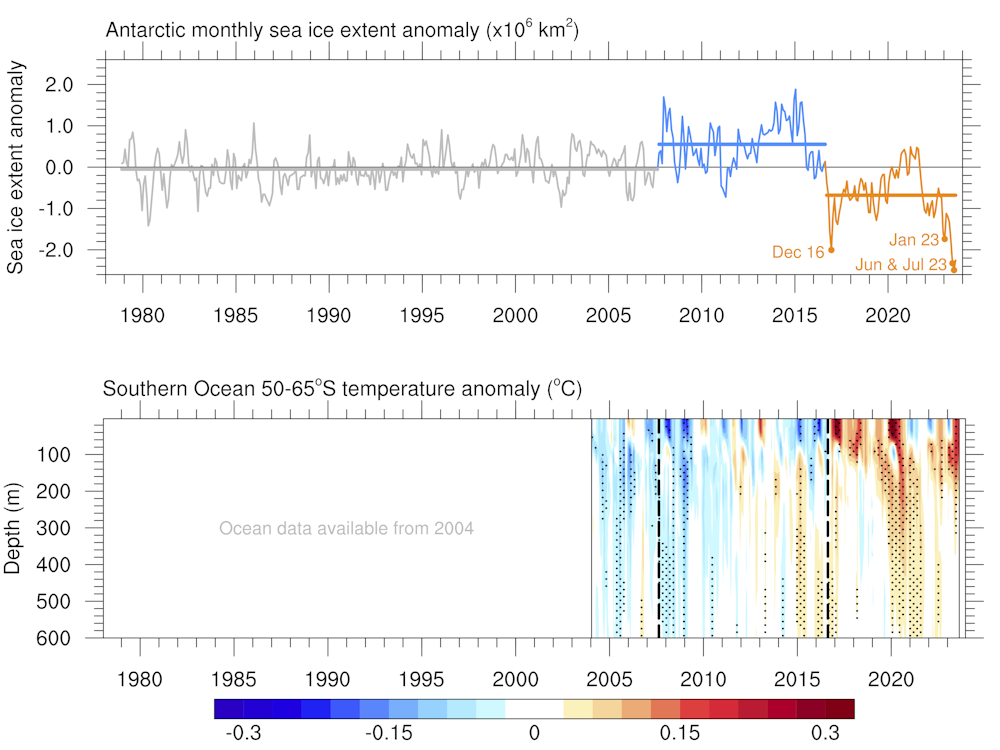
In our study, we used a statistical algorithm to identify three different periods in the sea-ice record. The first was a neutral sea-ice period from November 1978 to August 2007, the second a high sea-ice period from September 2007 to August 2016, and the third a low sea-ice period from September 2016 until now.
Our analysis of the relationship between sea ice and the underlying ocean suggests this current low sea-ice period may represent a new state or “regime” for Antarctic sea ice. What does that mean?
Sea ice forms a thin layer between the ocean and the atmosphere. Therefore, it is affected by both.
On timescales of days and weeks, the atmosphere is what controls sea ice – it forms when the air above is cold, and is blown around by the wind.
However, the ocean is crucial in determining how the sea ice responds to the atmosphere. The waters beneath are what influences sea ice variation and change in the long term.
Read more: Why Antarctica's sea ice cover is so low (and no, it's not just about climate change)
Lately, sea ice seems to be responding to atmospheric drivers differently than it did in the past, suggesting an influence from the slowly varying ocean may be important.
Research published in 2019 suggested ocean warming may have played a role in the low sea ice extent observed in the 2016/17 summer.
Building on this hypothesis, our study examined the long-term variations in sea ice and ocean temperature, finding that ocean warming has pushed Antarctic sea ice into a new low-extent state.
A clear warming trend
Using data from ocean temperature measurements 100-200m below the surface, we found a clear warming trend over the period for which we have reliable observations.
Importantly, strong subsurface ocean warming began in 2015, in the same regions that lost substantial sea ice in 2016. This is a key indication the ocean was important in driving the low sea ice in 2016. Since then, the warm subsurface ocean seems to be maintaining the low sea-ice coverage.
Prior to 2016 there was no relationship between the amount of sea ice at the summertime minimum and the amount at the following wintertime maximum. Since 2016 there is a strong relationship. This change suggests something has fundamentally altered the relationship between the ocean and the sea ice.
Together, this evidence suggests the overall way of how Antarctic ice behaves in the atmosphere-ocean-sea ice system has changed.
Our results suggest that even though the record-breaking low sea ice we’ve seen this year is shocking, it is likely to be the new abnormal.
We may now be seeing the inevitable decline in Antarctic sea ice, long projected by climate models. The Antarctic region is changing rapidly. To understand these rapid shifts, we urgently need to support fieldwork in sea ice, and develop computer models that will help us to understand the changes we are already seeing, and to predict what the future will look like.
Reduced sea ice will have serious implications for Southern Ocean ecosystems and global consequences for the climate system. Dramatic changes in a seasonal cycle as reliable and critical as Antarctic sea ice underscores the urgency to reduce fossil fuel emissions.
Authors: Edward Doddridge, Research Associate in Physical Oceanography, University of Tasmania

















