

How rising water vapour in the atmosphere is amplifying warming and making extreme weather worse
- Written by Kevin Trenberth, Distinguished Scholar, NCAR; Affiliate Faculty, University of Auckland
This year’s string of record-breaking disasters – from deadly wildfires and catastrophic floods to record-high ocean temperatures and record-low sea ice in Antarctica – seems like an acceleration of human-induced climate change.
And it is. But not only because greenhouse gas emissions continue to rise. What we are also observing is the long-predicted water vapour feedback within the climate system.
Since the late 1800s, global average surface temperatures have increased by about 1.1℃, driven by human activities, most notably the burning of fossil fuels which adds greenhouse gases (carbon dioxide and methane) to the atmosphere.
As the atmosphere warms, it can hold more moisture in the form of water vapour, which is also a greenhouse gas. This in turn amplifies the warming caused by our emissions of other greenhouse gases.
Some people mistakenly believe water vapour is a driver of Earth’s current warming. But as I explain below, water vapour is part of Earth’s hydrological cycle and plays an important role in the natural greenhouse effect. Its rise is a consequence of the atmospheric warming caused by our emissions arising especially from burning fossil fuels.
Water vapour: the other greenhouse gas
For every degree Celsius in warming, the water-holding capacity of the atmosphere increases by about 7%. Record-high sea temperatures ensure there is more moisture (in the form of water vapour) in the atmosphere, by an estimated 5-15% compared to before the 1970s, when global temperature rise began in earnest.
Water vapour is a powerful greenhouse gas. Since the 1970s, its rise likely increased global heating by an amount comparable to that from rising carbon dioxide. We are now seeing the consequences.
In many ways, water vapour is the most important greenhouse gas as it makes Earth habitable. But human-induced climate change is primarily caused by increases in the long-lived greenhouse gases carbon dioxide, nitrous oxide, methane and chlorofluorocarbons (CFCs).
As a general rule, any molecule with three or more atoms is a greenhouse gas, owing to the way the atoms can vibrate and rotate within the molecule. A greenhouse gas absorbs and re-emits thermal (infrared) radiation and has a blanketing effect.
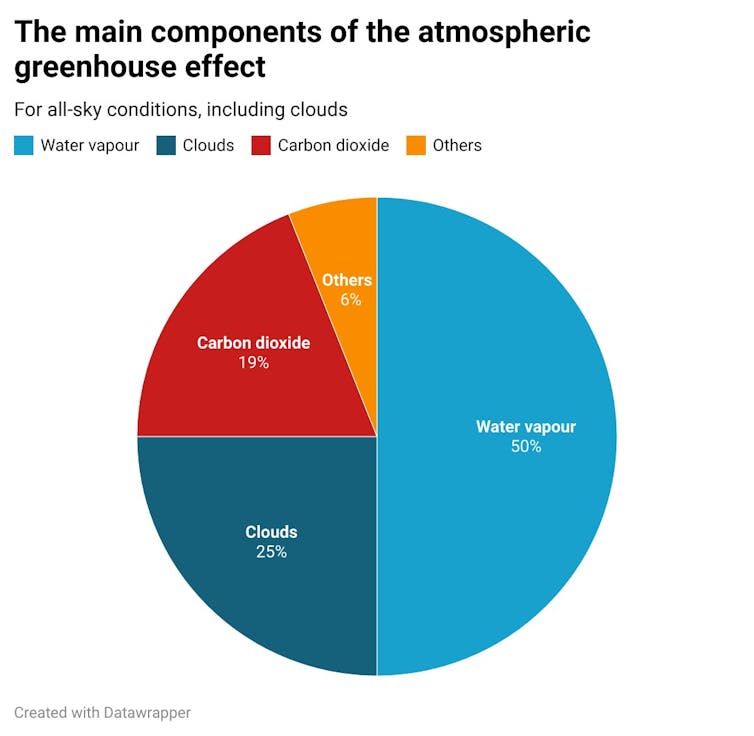
Clouds have a blanketing effect similar to that of greenhouse gases but they are also bright reflectors of solar radiation and act to cool the surface by day. In the current climate, for average all-sky conditions, water vapour is estimated to account for 50% of the total greenhouse effect, carbon dioxide 19%, ozone 4% and other gases 3%. Clouds make up about a quarter of the greenhouse effect.
Why is water vapour different?
The main greenhouse gases – carbon dioxide, methane, nitrous oxide and ozone – don’t condense and precipitate. Water vapour does, which means its lifetime in the atmosphere is much shorter, by orders of magnitude, compared to other greenhouse gases.
On average, water vapour only lasts nine days, while carbon dioxide stays in the atmosphere for centuries or even millennia, methane lasts for a decade or two and nitrous oxide a century. These gases serve as the backbone of atmospheric heating, and the resulting rise in temperature is what enables the observed increase in water vapour levels.
Read more: Extreme precipitation events have always occurred, but are they changing?
The rise in carbon dioxide doesn’t depend on weather. It comes primarily from the burning of fossil fuels. Atmospheric carbon dioxide has increased from pre-industrial levels of 280ppmv to 420ppmv (an increase of 50%) and about half of that increase has happened since 1985.
This accounts for about 75% of the anthropogenic heating from long-lived greenhouse gases. The rest of human-induced atmospheric warming mainly comes from methane and nitrous oxide, with offsets from pollution aerosols.
The extra heating from water vapour has been on a par with that from increased carbon dioxide since the 1970s.
Water vapour and the water cycle
Water vapour is the gaseous form of water and it exists naturally in the atmosphere. It is invisible to the naked eye, unlike clouds, which are composed of tiny water droplets or ice crystals large enough to scatter light and become visible.
The most common measure of water vapour in the atmosphere is relative humidity.
During heatwaves and warm conditions, this is what affects human comfort. When we sweat, the evaporation of moisture from our skin has a cooling effect. But if the environment is too humid, then this no longer works and the body becomes sticky and uncomfortable.
This process is important for our planet, too, because about 70% of Earth’s surface is water, predominantly ocean. Extra heat generally goes into evaporating water. Plants also release water vapour through a process called transpiration (releasing it through tiny stomata in leaves as part of photosynthesis). The combined process is called evapotranspiration.
The moisture rises into the atmosphere as water vapour. Storms gather and concentrate the water vapour so that it can precipitate. As water vapour has an exponential dependence on temperature, it is highest in warm regions, such as the tropics and near the ground. Levels drop off at cold higher latitudes and altitudes.
The expansion and cooling of air as it rises creates clouds, rain and snow. This vigorous hydrological cycle means water vapour molecules only last a few days in the atmosphere.
Water is the air conditioner of the planet. It not only keeps the surface cooler (albeit at the expense of making it moister) but rain also washes a lot of pollution out of the atmosphere to everyone’s benefit.
Precipitation is vitally important. It nourishes vegetation and supports various ecosystems as long as the rate is moderate. But as the climate warms, higher moisture levels increase the potential for heavier rainfall and the risk of flooding.
Moreover, the latent energy that went into evaporation is returned to the atmosphere, adding to heating and causing air to rise, invigorating storms and making weather extremes greater and less manageable.
These changes mean that where it is not raining, drought and wildfire risk increase, but where it is raining, it pours.
Authors: Kevin Trenberth, Distinguished Scholar, NCAR; Affiliate Faculty, University of Auckland

















