

A Haunting in Venice is Kenneth Branagh's 20th film – what do we make of his prodigious output?
- Written by Benjamin Kooyman, Learning Adviser, Australian National University
In an essay on Kenneth Branagh, screenwriter Scott Frank recalls meeting the future star and director of his screenplay Dead Again (1991) and wondering “why the guy would want to direct a loopy, film noir thriller like mine?”
He goes on to say “the answer became abundantly clear: Kenneth Branagh wants to do everything”.
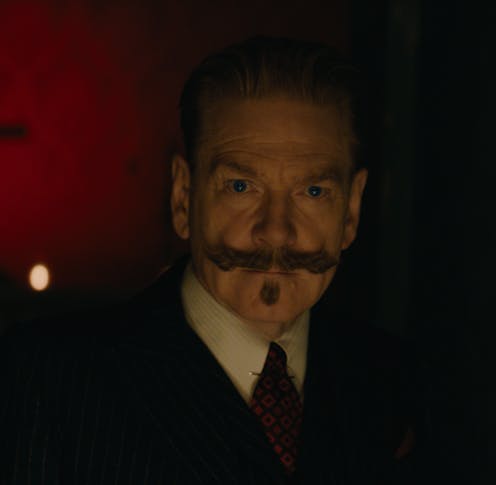
Branagh has not shaken this compulsion. A Haunting in Venice, his 20th film as director, opens in Australia today. It is his third appearance as Agatha Christie’s Belgian sleuth Hercule Poirot; his first based on a Christie source not previously adapted for film (1969’s Hallowe’en Party); and fifth “loopy” thriller following the Poirots, Dead Again and Sleuth (2007).
It is par for the course for Branagh: dabbling across genres, putting fresh spins on well-worn material, and following in the footsteps of British acting and filmmaking luminaries.
Branagh as acting royalty
Over his first two decades in film, Branagh’s signature work was Shakespearean, beginning with his 1989 directorial debut, Henry V.
In this respect, he followed in the footsteps of Laurence Olivier, whose directorial debut was his wartime Henry V (1944), and Orson Welles, another wunderkind with Shakespearean credentials.
Olivier and Welles created three Shakespeare films apiece. Branagh has, so far, directed five: Henry V, Much Ado about Nothing (1993), Hamlet (1996), Love’s Labour’s Lost (2000) and As You Like It (2006).
He portrayed Iago in Oliver Parker’s Othello (1995), helmed In The Bleak Midwinter (1995) – the story following a semi-professional troupe staging Hamlet – and starred as the Bard himself in All is True (2018). Even Branagh’s self-aggrandising autobiography opens each chapter with lines from Shakespeare.
In addition to courting association with Shakespeare, Branagh’s choices cultivated association with his stage and screen precursors. Like Olivier, he has played both Henry V and Hamlet. Branagh even portrayed Olivier in My Week with Marilyn (2012).
In playing Poirot, Branagh followed the footsteps of British acting luminaries such as Albert Finney, Peter Ustinov and David Suchet.
He positions himself alongside luminaries, casting actors like Derek Jacobi, Paul Scofield, Judi Dench and John Gielgud in his films.
As the director of the Sir Kenneth Branagh Archive, Mark Thornton Burnett, notes, Branagh “deployed seasoned figures from the Royal Shakespeare Company to authenticate his entry into a sacrosanct arena”.
He canonised himself rather than waiting to be canonised.
It worked. Now an elder statesman, he recited Shakespeare scored to Elgar at the 2012 Olympic opening ceremony and lends gravitas to the films of Christopher Nolan.
To Branagh’s credit, he has parodied his upstart crow status, for instance in his role as Gilderoy Lockhart in the Harry Potter films.
Branagh as pop culture connoisseur
While his Shakespearean films position Branagh as a classicist, his genre-hopping around those films is eclectic. He directed thrillers Dead Again and Sleuth, the dramedy Peter’s Friends (1992) and Mary Shelley’s Frankenstein (1994).
My PhD, completed in 2009, considered Branagh’s self-fashioning through Shakespeare, little anticipating in the subsequent 13 years he would direct films as disparate as Marvel’s Thor (2011), the Tom Clancy action movie Jack Ryan: Shadow Recruit (2014), Disney’s Cinderella (2015), the intimate All is True, children’s fantasy Artemis Fowl (2020), his Poirot trilogy and autobiographical Belfast (2021).
Read more: Belfast – archiving all the voices of the Troubles
From a cynical perspective, Branagh has made overtures to commercial filmmaking. Alternately, as Frank suggested, Branagh really does “want to do everything”.
Branagh genre-hopped even within his Shakespeare films. His dramatic entrance in shadow in Henry V evokes Darth Vader; his arrival on horseback in Much Ado about Nothing summons The Magnificent Seven (2016); the musical numbers in Love’s Labour’s Lost echo classic Hollywood musicals.
Hamlet, in particular, invites association with Hollywood epics. At 242 minutes, it was the longest commercial release since 1963’s Cleopatra, the first 70mm British production since 1970’s Ryan’s Daughter, and shot by Lawrence of Arabia’s focus-puller Alex Thomson.
The film’s palatial wintry setting recalls Doctor Zhivago, as does Julie Christie’s casting as Gertrude. Charlton Heston’s casting evokes his popular biblical epics. Placing Hamlet’s “How all occasions” soliloquy before intermission mirrors Gone with the Wind’s famous pre-intermission speech.
Branagh’s staging of Hamlet’s “To be or not to be” monologue even suggests Taxi Driver, where anti-hero Travis Bickle likewise fantasises dangerous courses of action before a mirror.
While Branagh’s Shakespearean output links him to high culture, his dabbling across genres and homages to classic films show him to be a pop culture connoisseur.
Branagh as maximalist
Branagh is a maximalist whose precursors are, in some respects, Ken Russell and Richard Lester: directors with idiosyncratic and irreverent relationships to British heritage cinema who were unafraid to take creative swings.
Like Branagh, Russell was tongue-in-cheek in grappling with the canon (D.H. Lawrence, Elgar, Mahler, Liszt, Tchaikovsky, Byron and the Shelleys), but far more subversive.
Like Branagh, Lester was an energetic, lively filmmaker who dabbled in Hollywood superhero fare (Superman II and III) and populist classic literature (his Musketeers films and Robin and Marion), but far more counter-cultural.
Joe Wright is arguably Branagh’s contemporary and successor. He too has a penchant for long tracking shots (see Atonement’s Dunkirk sequence and Henry V’s post-Agincourt march); delivers spry, earthy takes on canonical material (Pride and Prejudice); and is unafraid of genre fare (Hanna), postmodern approaches (Anna Karenina) or looking silly (Pan).
Branagh is, ultimately, an important figure who traverses mediums, roles, genres and tastes. Though varying wildly in quality – Rotten Tomato scores for his directorial features range from 8% for Artemis Fowl to 98% for Henry V – his output showcases a quite remarkable straddling of genres and production scales, seemingly hidden in plain sight.
Authors: Benjamin Kooyman, Learning Adviser, Australian National University

















