

Are we about to see a rare green comet light up the sky? An expert on what to expect from Nishimura
- Written by Jonti Horner, Professor (Astrophysics), University of Southern Queensland
Of all the objects in the Solar System, perhaps the most spectacular are the great comets that occasionally grace our skies. If you’ve been on social media in the past few days, you’ve probably seen articles proclaiming we have such a comet in our skies right now: C/2023 P1 (Nishimura).
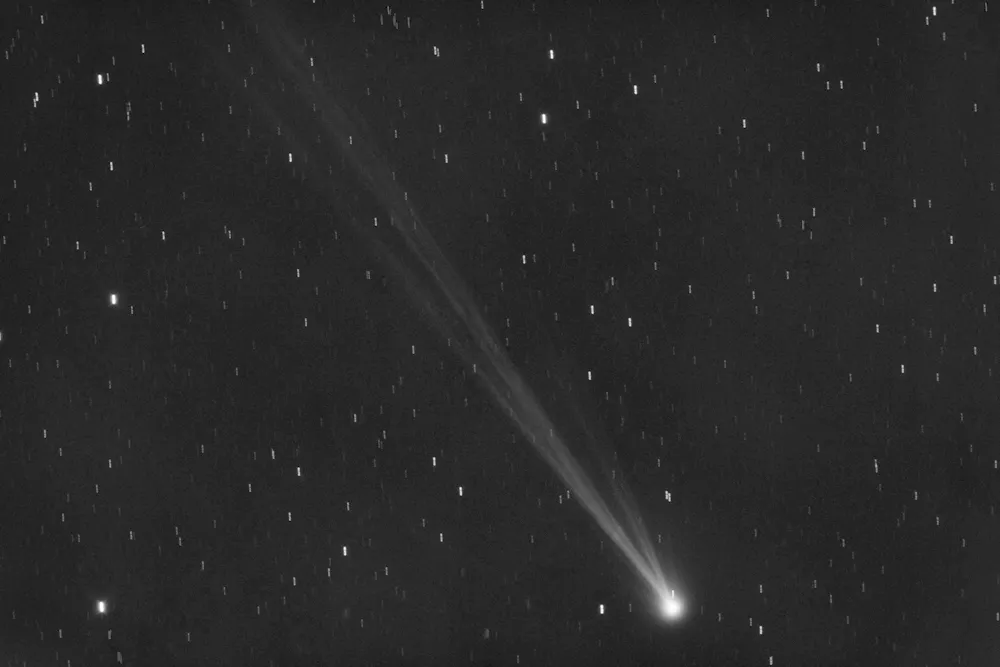
As I write this, comet Nishimura is swinging past on its first visit in more than 400 years. Japanese astronomer Hideo Nishimura discovered the comet on August 12. Soon after, pre-discovery images of the comet dating back to January were found, allowing astronomers to determine its path.
They quickly realised Nishimura would swing closer to the Sun than the orbit of Mercury this month. Given the comet’s brightness at the time of discovery, it could become bright enough to see with the naked eye. So, will it be a spectacular sight in our skies? Probably not.
Unfortunately, Nishimura’s path will keep it close to the Sun in the sky as observed from Earth. While it’s definitely bright enough to be visible to the naked eye in dark skies, at best it will hug the horizon just after sunset – almost lost in the Sun’s glow.
Still, astronomers across the globe are excited. Even a hard-to-spot naked-eye comet is worth observing. And as science writer and astronomer David H. Levy once said:
Comets are like cats: they have tails, and they do precisely what they want.
There’s a chance Nishimura might brighten unexpectedly. If it does, we might see something special in the couple of weeks. If not, there’s always next year – but more on that later.
Recipe for a bright comet
When they are far from the Sun, in the icy depths of space, comets are essentially dirty snowballs: lumps of ice, dust and rock left over from the Solar System’s formation.
As a comet approaches the Sun, its surface begins to heat up. The ices near the surface get hot and “sublime”, turning to gas and erupting outward from the comet’s surface. This gas carries dust and debris, shrouding the nucleus in a diaphanous cloud of gas and dust called a “coma”.
The solar wind then blows the gas and dust away from the Sun, which gives the comet its tail (or tails). The tails always point away from the Sun.
The comet we see is sunlight being reflected from the gas and dust in the coma and tails – the nucleus itself is hidden from sight. A comet’s brightness, therefore, is typically determined by three things:
- the size of the nucleus: a bigger nucleus typically means a larger active area (though some comets are more active than others) and more gas and dust production
- distance to the Sun: the closer the comet is to the Sun, the more active (and brighter) it will become
- distance to Earth: the closer the comet is to us, the brighter it will appear.
What about Nishimura?
That brings us to comet Nishimura. It seems likely Nishimura isn’t that large – otherwise we’d have spotted it sooner – nor is it particularly close to Earth. It is, however, passing relatively close to the Sun and is expected to be very active around perihelion (its closest point to the Sun).
Were it possible to view in a dark night sky, the comet would be quite impressive. Sadly, even at its best Nishimura will be close to the Sun in the sky.
On top of that, it just so happens the comet and Earth are located at about the worst orientation for viewing: Nishimura will stay close to the Sun as it recedes from us, remaining buried in the star’s glare.
A short window to see Nishimura from Australia
Nishimura will soon peek above the western horizon after sunset, but only just. The best chance to see it from Australia comes in the week of September 20 to 27, when the comet’s head will set around one hour after the Sun. It will be farthest from the Sun in the evening sky on September 23.
As twilight ends, Nishimura will be very close to the western horizon, about to set. That means it will probably be lost in the Sun’s glare.
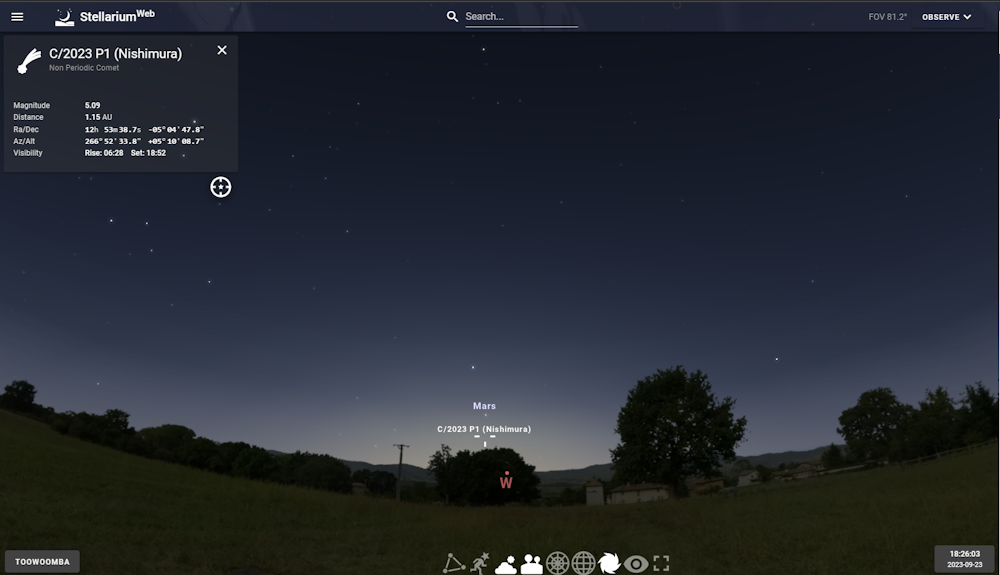 This image shows Nishimura’s location in the sky, as seen from Toowoomba, 40 minutes after sunset on the evening of September 23. At that time, in the fading twilight, the comet will be just 5 degrees above the western horizon.
Screenshot/Stellarium
This image shows Nishimura’s location in the sky, as seen from Toowoomba, 40 minutes after sunset on the evening of September 23. At that time, in the fading twilight, the comet will be just 5 degrees above the western horizon.
Screenshot/Stellarium
But remember, comets are like cats. Some comets fall apart when at their closest to the Sun, in which case they often brighten significantly. If that were to happen to Nishimura, it could become much easier to spot.
Unfortunately, the comets most likely to fragment are those visiting the inner Solar System for the first time, moving on very long-period orbits of tens or hundreds of thousands of years. Nishimura is a seasoned visitor, with an orbital period of around 430 years. It has likely swung past the Sun many times and survived, which lowers the odds of it breaking apart.
Nonetheless, while the head of the comet might be lost in the twilight, the tail might still be visible as the sky darkens. Before the comet was lost in the glare to northern hemisphere viewers, observers put its tail at around six degrees in length – and it will likely grow as the comet swings closer to the Sun.
If you’re lucky, you might spot the tail standing proud above the horizon as the sky darkens.
The next great comet
If Nishimura doesn’t turn out to be the show you hoped for, there’s a chance another comet could put on a truly spectacular show next year. Comet C/2023 A3 (Tsuchinshan-ATLAS) was discovered at the start of this year. It’s currently almost as far from the Sun as Jupiter.
Over the next 12 months it will continue to fall sunward, coming closest to the Sun in late September 2024. Tsuchinshan-ATLAS is looking promising. If it behaves as expected it could be a spectacular sight – but just remember: comets are like cats!
Authors: Jonti Horner, Professor (Astrophysics), University of Southern Queensland

















