

a Gothic horror, supernatural, Agatha Christie murder mystery which all becomes quite camp
- Written by Stuart Richards, Lecturer in Screen Studies, University of South Australia
Agatha Christie regularly drew upon the supernatural to generate a feeling of uncertainty. We – the audience, and the ensemble of characters – are given limited information regarding a murder.
This uncertainty, ultimately, concerns the fear of death. Is something more sinister, dangerous and supernatural at play? Witches, seances and hauntings often appeared as devices in Christie’s writing to generate these macabre tones.
A séance is faked in The Sittaford Mystery. A ghost supposedly haunts a house in Sleeping Murder. Witchcraft is a red herring in Murder is Easy, Endless Night and The Pale Horse.
While these supernatural inclusions develop the mood of the story, the logic of the “whodunit” dictated these potentially supernatural elements were explained away as the workings of an individual trying to cover their crimes.
Embracing the Gothic
There is a long history to Christie adaptations engaging with horror and Gothic aesthetics.
Sarah Phelps’ adaptations for the BBC are all darker than their source texts. Ghostly visions appear in And Then There Were None; the witches in The Pale Horse really do have supernatural powers; Ordeal by Innocence embraces many Gothic tropes, such as the dark, terror-filled, isolated mansion.
In Ils Etaient Dix, the French series adaptation of And Then There Were None, the murder mystery is more of a slasher than a traditional whodunit. As Mark Aldridge notes in Agatha Christie on Screen, many early Christie adaptations even had aural and visual motifs associated with the macabre, such as the 1947 television drama Three Blind Mice.
René Clair’s 1945 adaptation of And Then There Were None, which was released for Halloween, was reviewed by The New York Times as having “humour with a light macabre touch” and that the film is “perfect for black cats and Hallowe’en goblins”.
Being haunted in Venice
In A Haunting in Venice, Kenneth Branagh continues this tradition of adapting Christie through the lens of horror. This is his third adaptation of Christie’s work, following Murder on the Orient Express and Death on the Nile, both of which received mixed reviews from critics and Christie fans.
In this outing as Hercule Poirot, Branagh has loosely adapted Christie’s 1969 A Hallowe’en Party.
In the original novel, Poirot’s friend, Ariadne Oliver – a fictional crime writer that was a satirical stand-in for Christie – phones Poirot, asking him to come to a small village where a child has been murdered at a Halloween party. This child had proclaimed that she had once witnessed a murder, only for no one to believe her. Once the party is over, she is found dead, having been drowned while bobbing for apples.
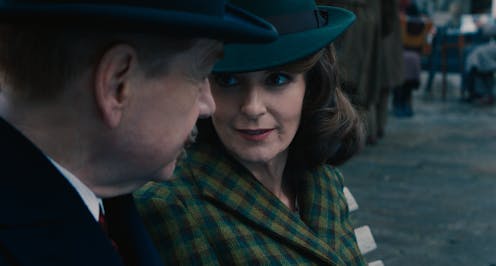
By choosing a lesser-known Christie novel, Branagh isn’t as burdened by the expectations that come with the adaptation of a much-loved classic. Branagh relocates this mystery to Venice, where Oliver (Tina Fey) asks the retired Poirot to attend a séance at a grand old Palazzo. Rather than being asked to investigate a murder, Oliver asks Poirot to investigate whether the celebrated medium, Joyce Reynolds (a brilliant Michelle Yeoh), is legitimate.
The action surrounding the mystery is contained in a common whodunit trope known as the closed circle, where an ensemble of suspects is isolated from the outside world, and it is ostensibly impossible for anyone to come and go from the location. On the evening of the séance, there is a terrible storm and Poirot traps everyone in the Palazzo until he solves the crime.
The Palazzo is steeped in a miserable history, which is a nice Gothic touch to the central mystery. Owned by a former opera singer, Rowena Drake (Kelly Reilly), the Palazzo was once home to children who died during the plague. A party is held for orphaned children and concludes with a séance so Rowena can contact her recently deceased daughter, Alicia.
So, too, are all the guests haunted by their pasts, with the film being relocated from 1960s England to 1947 Venice, many characters are still shaken by the horrors of the second world war.
Like many closed circle mysteries, the Palazzo’s various rooms function as highly stylised interrogation rooms, where secrets are revealed and accusations are hurled. Branagh infuses the film with Gothic horror aesthetics to the extent where the production design becomes quite camp. Shadows loom by candlelight and ghostly figures appear when lightning briefly brightens a room.
Hildur Guðnoadóttir’s score is effective in further evoking these macabre themes. Haris Zambarloukos’ cinematography is stunning in key moments, where characters are dwarfed by the spectacular Venetian architecture. In other parts, tight framing, Dutch angles, severe high and low angles disorient the viewer and become occasionally distracting.
Read more: A Haunting in Venice is Kenneth Branagh's 20th film – what do we make of his prodigious output?
Leaping into the fantastic
The film is at its strongest when the story leans into the fantastic mode, a term defined by Tzvetan Todorov to describe the liminality between nature and the supernatural, where bizarre occurrences are unable to be neatly classified.
The fantastic is an interesting space for a whodunit, which is fundamentally about rational explanations. For Poirot, and the audience, there is this hesitation. Is the Palazzo actually haunted? Can a rational mind make room for the supernatural?
This hesitation is effective when the film takes on Poirot’s perspective. This unsettling feeling is not necessarily about cheap jump scares (and there are a few in this film) but more about this pervasive atmosphere of uncertainty.
And yet, as with all whodunits, no amount of fantastic atmosphere can save a film when the reveal just isn’t that ingenious or exciting. The central puzzle to the film, largely changed from the source text, is fairly obvious to anyone paying attention.
While the film is good fun, the denouement arrives as a bit of a letdown, like a theme park ride ending too soon.
A Haunting in Venice is in cinemas now.
Authors: Stuart Richards, Lecturer in Screen Studies, University of South Australia

















