

Why New Zealand was the first country where women won the right to vote
- Written by: Katie Pickles, Professor of History at the University of Canterbury and current Royal Society of New Zealand Te Apārangi James Cook Research Fellow, University of Canterbury
125 years ago today Aotearoa New Zealand became the first country in the world to grant all women the right to vote.
The event was part of an ongoing international movement for women to exit from an inferior position in society and to enjoy equal rights with men.
But why did this global first happen in a small and isolated corner of the South Pacific?
Read more: Women's votes: six amazing facts from around the world
Setting the stage
In the late 19th century, Aotearoa New Zealand was a volatile and rapidly changing contact zone where British settlers confidently introduced systematic colonisation, often at the expense of the indigenous Māori population. Settlers were keen to create a new world society that adapted the best of Britain and left behind behind the negative aspects of the industrial revolution – Britain’s dark satanic mills.
Many supported universal male suffrage and a less rigid class structure, enlightened race relations and humanitarianism that also extended to improving women’s lives. These liberal aspirations towards societal equality contributed to the 1893 women’s suffrage victory.
At the end of the 19th century, feminists in New Zealand had a long list of demands. It included equal pay, prevention of violence against women, economic independence for women, old age pensions and reform of marriage, divorce, health and education – and peace and justice for all.
The women’s suffrage cause captured widespread support and emerged as the uniting right for women’s equality in society. As suffragist Christina Henderson later summed up, 1893 captured “the mental and spiritual uplift” women experienced upon release “from their age-long inferiority complex”.
Two other factors assisted New Zealand’s global first for women: a relatively small size and population and the lack of an entrenched conservative tradition. In Britain, John Stuart Mill presented a first petition for women’s suffrage to the British Parliament in 1866, but it took until wartime 1918 for limited women’s suffrage there.
Women as moral citizens
As a “colonial frontier”, New Zealand had a surplus of men, especially in resource towns. Pragmatically, this placed a premium on women for their part as wives, mothers and moral compasses.
There was a fear of a chaotic frontier full of marauding single men. This colonial context saw conservative men who supported family values supporting suffrage. During the 1880s, depression and its accompanying poverty, sexual licence and drunken disorder further enhanced women’s value as settling maternal figures. Women voters promised a stabilising effect on society.
New Zealand gained much strength from an international feminist movement. Women were riding a first feminist wave that, most often grounded in their biological difference as life givers and carers, cast them as moral citizens.
Local feminists eagerly drew upon and circulated the best knowledge from Britain, America and Europe. When Mary Leavitt, the leader of the US-based Women’s Christian Temperance Union (WCTU) visited New Zealand in 1885, her goal was to set up local branches. This had a direct impact, leading to the country’s first national women’s organisation and providing a platform for women to secure the vote in order to affect their colonial feminist concerns.
Other places early to grant women’s suffrage shared the presence of liberal and egalitarian beliefs, a surplus of men over women, and less entrenched conservatism. The four frontier US western mountain states led the way with Wyoming (1869), Utah (1870), Colorado (1893) and Idaho (1895). South Australia (1894) and Western Australia (1899) made the 19th century and, before the first world war, were joined by other western US states, Australia, Finland and Scandinavia.
Local agency
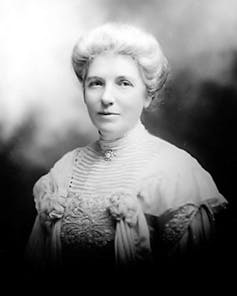 Social reformer and suffragist Kate Sheppard, around 1905.
Wikimedia Commons, CC BY-ND
Social reformer and suffragist Kate Sheppard, around 1905.
Wikimedia Commons, CC BY-ND
New Zealand was fortunate to have many effective women leaders. Most prominent among them was Kate Sheppard. In 1887, Sheppard became head of the WCTU’s Christchurch branch and led the campaign for the vote.
The campaign leaders were well organised and hard working. Their tactics were petitions, pamphlets, letters, public talks and lobbying politicians - this was a peaceful era before the suffragette militancy during the early 20th century elsewhere.
Read more: Adela Pankhurst: the forgotten sister who doesn't fit neatly into suffragette history
The women were persistent and overcame setbacks. It took multiple attempts in parliament before the Electoral Act 1893 was passed. Importantly, the suffragists got public opinion behind the cause. Mass support was demonstrated through petitions between 1891 and 1893, in total garnering 31,872 signatures, amounting to a quarter of Aotearoa’s adult women.
Pragmatically, the women worked in allegiance with men in parliament who could introduce the bills. In particular, veteran conservative Sir John Hall viewed women’s suffrage as a way to a more moral and civil society.
The Suffrage 125 celebratory slogan “whakatū wāhine – women stand up!” captures the intention of continuing progressive and egalitarian traditions. Recognising diverse cultural backgrounds is now important. With hindsight, the feminist movement can be implicated as an agent of colonisation, but it did support votes for Māori women. Meri Te Tai Mangakāhia presented a motion to the newly formed Māori parliament to allow women to vote and sit in it.
New Zealand remains a small country that can experience rapid social and economic change. Evoking its colonial past, however, it retains both a reputation as a tough and masculine place of beer-swilling, rugby-playing blokes and a tradition of staunch, tea drinking, domesticated women.
Authors: Katie Pickles, Professor of History at the University of Canterbury and current Royal Society of New Zealand Te Apārangi James Cook Research Fellow, University of Canterbury


















