
Why does my hair turn green from the swimming pool?
- Written by: Magdalena Wajrak, Senior lecturer, Chemistry, Edith Cowan University
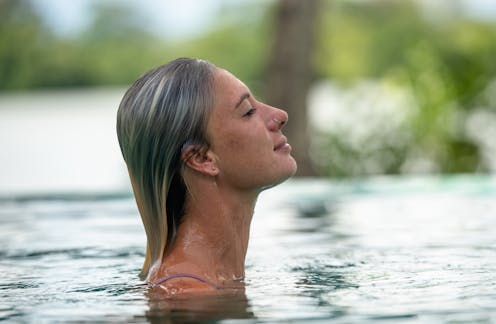
If you are a blonde like me and enjoy laps in a swimming pool, you may have noticed your hair acquires a green tint after frequent swims in chlorinated water.
This happens to both bleached and natural blondes. In fact, the green tinge happens to everyone, but it’s less visible on dark hair and those whose hair isn’t damaged by chemical treatments such as bleaching.
But what exactly causes this green discoloration, and what can we do about it? Most of us blame the chlorine in the pool water. However, although chlorine does play a part, it is not the main culprit.
Which chemicals in the pool turn the hair green?
The element to blame for the green staining of hair is copper.
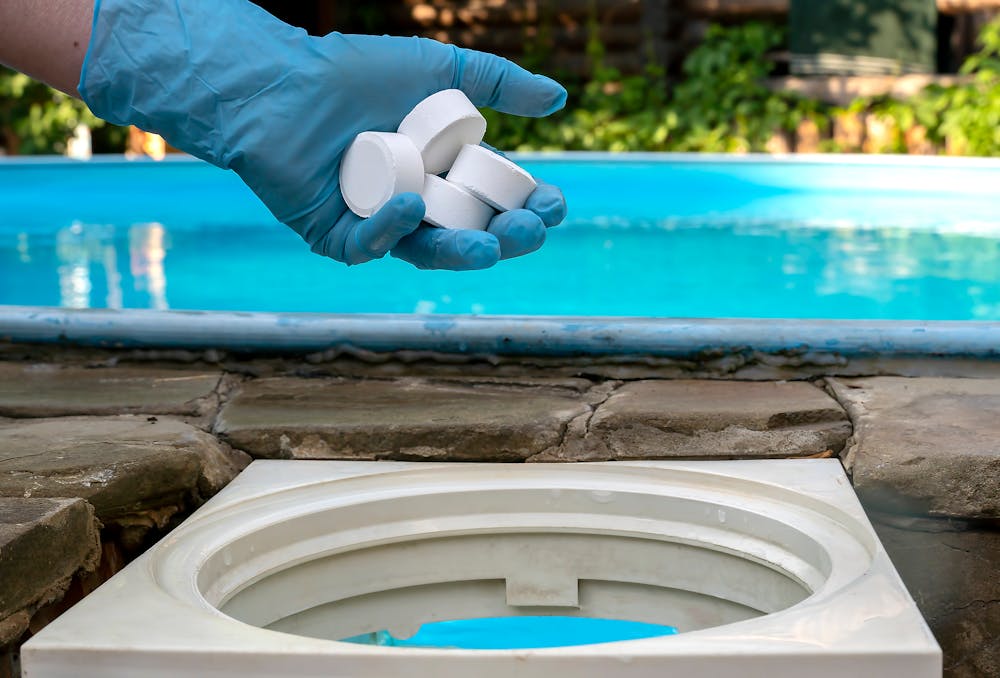
The main source of copper is copper sulfate (CuSO₄), a compound added to swimming pools to prevent the growth of algae. Contact with algae can cause skin irritation and respiratory issues, and ingesting water with algae can lead to serious gastrointestinal problems. Only a small amount (around 0.5mg per litre or 0.5 parts per million) of copper sulfate is needed to prevent algal growth.
However, copper can also enter swimming pools through the corrosion of water pipes, so concentrations may be higher in some pools.
Copper sulfate crystals are greenish-blue in colour. So, when hair comes into contact with copper ions – a positively charged variant of a copper atom with extra electrons – those ions get absorbed by the hair and cause the greenish hue.
Scientists were fascinated by the green “pool hair” phenomenon as far back as the 1970s, so we actually have research data on copper being the cause.
One very interesting study in 1978 performed experiments by immersing hair samples into water containing different concentrations of copper ions, chlorine and various pH values (neutral and basic). Their results showed hair exposed to free copper ions does turn green.
Furthermore, when hair is oxidised (meaning electrons are removed from the hair proteins) by chlorine, it actually damages the hair, enhancing the absorption of copper ions. Hair submerged in water with chlorine but without copper ions did not turn green. Meanwhile, hair exposed to water with only copper ions and no chlorine still formed a green colour.
Hence, chlorine by itself does not play a role in causing the green hue we see in “pool hair”, but it does exacerbate it.
So, how does copper get into the hair?
Other research teams have conducted more extensive studies, using sophisticated instruments, such as scanning electron microscopy, to examine how exactly copper ions attach to the hair.
Our hair is predominantly composed of protein called keratin. Keratin is classified as a “structural fibrous protein”, meaning it has an elongated, sheet-like structure.
The keratin structure is composed of various chemical groups (types of atom groupings with similar properties), such as carboxyl groups, amino groups and disulfide groups. Copper ions have the ability to form bonds with these groups, forming a copper-keratin complex. This complex remains in the hair, causing it to appear green.
Interestingly, the most recent study conducted in 2020, showed copper ions mainly bind to the disulfide groups. This study also found other metal ions such as zinc, lead, chromium and mercury also bind to hair in the same way. This is very useful in forensic analysis, for example, because forensic scientists can analyse hair samples to determine if a person has been exposed to a particular metal.
Light-coloured hair already has the most visible green discoloration, but research has shown that damaged hair, caused by bleaching, straightening, or exposure to sun, is the most susceptible to the binding of copper ions. This is because in damaged hair the disulfide groups have “broken bonds” (the link that holds the elements within these groups together is broken), making it easier for the copper ions to bind to the hair.
Can I prevent the green colour or get rid of it?
To prevent your hair from turning green in a swimming pool, you have two basic options. The first is a physical barrier – just wear a swim cap.
The second option is chemical – you can pre-treat your hair with an alkaline shampoo. Studies have shown under alkaline pH conditions, the copper ions won’t attach to the hair. To treat your hair before going to the pool, you can either use a shampoo with a pH lower than 7, or you can even try mixing some baking soda into your regular shampoo.
But what can you do if your hair has already turned greenish? Well, you can try washing your hair with a shampoo designed to achieve this, typically marketed as a “chlorine removal” shampoo. These products contain a chemical called EDTA – it can bind to metal ions (such as copper) and thus will remove copper from the hair.
You may have heard tomato sauce or ketchup is a good way to get the green out of your pool hair – potentially because the red pigments are supposed to “cancel out” the green ones. However, I’m not aware of any scientific evidence this would work.
Read more: Why do fingers get wrinkly after a long bath or swim? A biomedical engineer explains
Authors: Magdalena Wajrak, Senior lecturer, Chemistry, Edith Cowan University
Read more https://theconversation.com/why-does-my-hair-turn-green-from-the-swimming-pool-211736


















