

Seals, swimmers, bat carers – exploring the world of the pale brown, oft-maligned Yarra River
- Written by: Ian A Wright, Associate Professor in Environmental Science, Western Sydney University
Author Harry Saddler’s book on Melbourne’s Yarra River is an engaging account of his years exploring its native species and human communities. He acknowledges the river’s First Nations name of Birrarung, writing with a boyish enthusiasm. At times I felt his emotion jumping out of the pages, almost channelling David Attenborough’s passion for species and the environment.
Review: A Clear Flowing Yarra – Harry Saddler (Affirm Press)
The book’s major focus is on Saddler’s obvious fascination with native animals. He delights in telling us about his adventures finding them on, in, and near to the Yarra. It sometimes reads like a police drama as be describes “staking out” the habitat of an elusive species. Night after night, Saddler keeps going back to potential hideouts. At one point he watches eleven sugar gliders emerge from a hollow in a river red gum, only metres from townhouses.
Saddler had me hooked with his description of first encounter with a Yarra platypus:
We gawped and we gaped in mind-bent wonderment as a dark-brown platypus bobbed up to the surface of the pale brown Yarra and then dived again, disappearing instantly in the turbid water.

One of this book’s themes is Melburnians don’t really think much about the Yarra River. And not just the locals. I’m ashamed to remember hearing unflattering jokes about the Yarra in my childhood in Sydney. They involved the muddy appearance of the river, that looked like it flowed “upside down”.
Read more: New law finally gives voice to the Yarra River's traditional owners
Once the Yarra was world famous for swimming: a long distance (three-mile) swim was held there for nearly 50 years up to 1964. It was once the largest open water swimming competition in the world. Perhaps this book might help address the Yarra River’s image problem. And remind people of its many values, from its rich biodiversity to providing 5 million people with much of their water supply.
It might surprise many the Yarra River is still popular for swimming. Saddler tells us of his amazement when on a hot March day near Warrandyte in 2017:
As if in a dream, I found there a remarkable sight: hundreds of people swimming and bathing in a wide sparkling stream.
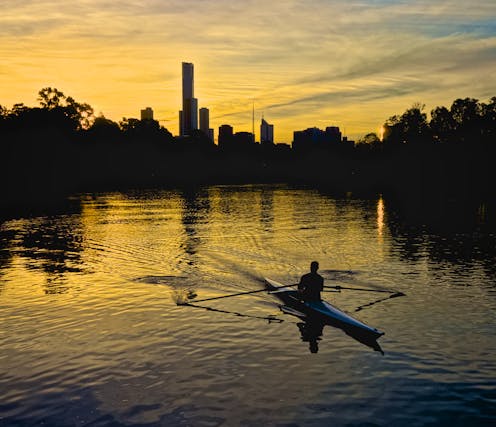
 The Yarra in Warrandyte at sunset.
Nils Versemann/Shutterstock
The Yarra in Warrandyte at sunset.
Nils Versemann/Shutterstock
Just a word of warning though. As with many rivers affected by urbanisation and other human activities, water quality in the Yarra can be poor and hazardous to human health. As tennis player Jim Courier discovered, when he dived in the river after celebrating his 1993 men’s singles victory in the Australian Open and picked up a stomach bug.
As I read, I could not help myself. I looked up the latest water quality advice for swimming provided by the Victorian EPA. At the time of writing, they showed the river at Warrandyte had “good” water quality. This offered the only suitable swimming location on the river. The other three sites (Kew, Healesville and Yarra Junction) were all rated as “poor”.
 Angelique Kerber repeated Jim Courier’s stunt, swimming in the Yarra the morning after winning the Australian Open women’s singles title in 2016.
Fiona Hamilton/AP/Tennis Australia
Angelique Kerber repeated Jim Courier’s stunt, swimming in the Yarra the morning after winning the Australian Open women’s singles title in 2016.
Fiona Hamilton/AP/Tennis Australia
Read more: A tale of 2 rivers: is it safer to swim in the Yarra in Victoria, or the Nepean in NSW?
This book is written in contrasting layers. Chapters alternate between exploring different native species found in the Yarra, and exploring how people interact with the river.
Native species that get their own chapter include the Powerful Owl, Brush-Tailed Phascogale, Short-finned Eel, Swamp Wallaby, Snakes, Rakali (the native water rat), Azure Kingfisher and Grey-Headed Flying Foxes.
 Flying foxes get their own chapter.
Craig Dingle/Shutterstock
Flying foxes get their own chapter.
Craig Dingle/Shutterstock
The Flying Fox chapter reveals a Yarra species, also commonly called fruit bats, that seems to attract very strong emotions. We are introduced to people caring for their welfare, such as Megan from “Friends of Bats and Bushcare”. She points out how vulnerable they are to stress in very hot weather, with sprinklers installed in the Yarra bat colony to help keep them cool during heat waves.
On the opposing side we are told about the removal of a colony that had settled along the Yarra in the Royal Botanic Gardens – dispersed using noise, smoke and lights. It also gets political. The book mentions an unnamed former politician who tried to have a colony of bats in his electorate removed.
Read more: Not in my backyard? How to live alongside flying-foxes in urban Australia
Saddler describes how:
The biggest and most beautiful tiger snake I’ve ever seen was sliding out of the Plenty River onto broad, sunny rocks where that tributary joined the Yarra.
In case the reader still has any doubt about his feelings towards snakes, he states: “Snakes are great. I’ll tolerate no snake badmouthing here”.
For me, a major appeal is that along with celebrating the remarkable biodiversity of the river, Saddler explores the many groups and individuals who care about it: cleaning up litter, clearing the banks of invasive weeds. Dedicated people such as Daniella, who has lived near the river for 20 years. She has regularly picked up rubbish to help keep the river and its banks clean.
As I read, I wondered if Saddler would have written this book if a native Melburnian. He moved to Melbourne from Canberra about 20 years ago, where he lived far from the ocean. He grew up comfortable in fresh water: swimming in Lake Burley-Griffin and ACT rivers such as the Cotter, Molonglo and Murrumbidgee.
His book reads like an adventurous exploration of an unknown world. At least to him. And also, perhaps, millions of Melburnians. There is something about the excitement of exploring around the next bend of the river. Documenting unfamiliar landscapes, and discovering the home and habits of another species.
Apart from the playtpus, my other favorite species described by Saddler is Salvatore the Australian Fur Seal, who gets his own chapter. Salvatore became an unlikely star attraction living in the river during a very dark time for Melbourne, in 2021 during one of its tough COVID lockdowns. For thousands of people, capturing a sight of this unusual visitor provided a thrill.
Harry describes the thousands of teasing photos and videos of Salvatore on the internet. I felt his frustration growing as he cycled up and down the river, meeting crowds of people elated after an encounter with the famous seal. But he kept missing out. Until finally, one day, near the Gipps Street bridge, on the main Yarra trail, his patience was rewarded.
He dived, and sometimes disappeared for what seemed like minutes before resurfacing further upstream, or further downstream; in these moments people on canoes would occasionally paddle by and I shouted out warning to them: be careful, there was a seal here just a minute ago and he’s massive.
 Affirm Press
Perhaps another edition of this book might have pictures. And I really would have loved a map or two. Still, it reminds me of the importance of providing safe access for communities to engage with waterways, perhaps helped by walking or cycling paths, parks and public transport. Even in highly modified urban settings we might be able to observe native species mostly hidden from the public gaze.
This book, while a love letter to the Yarra/Birrarung, might also remind those readers not in Melbourne a similar unexplored river or natural landscape likely exists right under their noses.
Authors: Ian A Wright, Associate Professor in Environmental Science, Western Sydney University
Affirm Press
Perhaps another edition of this book might have pictures. And I really would have loved a map or two. Still, it reminds me of the importance of providing safe access for communities to engage with waterways, perhaps helped by walking or cycling paths, parks and public transport. Even in highly modified urban settings we might be able to observe native species mostly hidden from the public gaze.
This book, while a love letter to the Yarra/Birrarung, might also remind those readers not in Melbourne a similar unexplored river or natural landscape likely exists right under their noses.
Authors: Ian A Wright, Associate Professor in Environmental Science, Western Sydney University 

















