

Modern Australian
Times Advertising

From stock markets to brain scans, new research harmonises hundreds of scientific methods to understand complex systems

  • Written by Ben Fulcher, Senior Lecturer, School of Physics, University of Sydney

From stock markets to brain scans, new research harmonises hundreds of scientific methods to understand complex systems

Complexity is all around us, from the daily fluctuations of financial markets to the intricate web of neurons in our brains.

Understanding how the different components of these systems interact with each other is a fundamental challenge for scientists trying to predict their behaviour. Piecing together these interactions is like deciphering a code from an intricate set of clues.

Scientists have developed hundreds of different methods for doing this, from engineers studying noisy radio channels to neuroscientists studying firing patterns in networks of interacting neurons. Each method captures a unique aspect of the interactions within a complex system – but how do we know which method is right for any given system sitting right in front of us?

In new research published in Nature Computational Science, we have developed a unified way to look at hundreds of different methods for measuring interaction patterns in complex systems – and working out which ones are most useful for understanding a given system.

A scientific orchestra

The science of complex systems can be, well, complex. And the science of comparing and combining different ways of studying these systems even more so.

But one way to think about what we’ve done is to imagine each scientific method is a different musical instrument playing in a scientific orchestra. Different instruments are playing different melodies with different tones and in different styles.

Read more: Fireflies, brain cells, dancers: new synchronisation research shows nature's perfect timing is all about connections

We wanted to understand which of our scientific instruments are best suited to solving which types of problems. We also wanted to know whether we could conduct all of the instruments to form a harmonious whole.

By presenting these methods as a full orchestra for the first time, we hoped we would find new ways of deciphering patterns in the world around us.

Hundreds of methods, more than 1,000 datasets

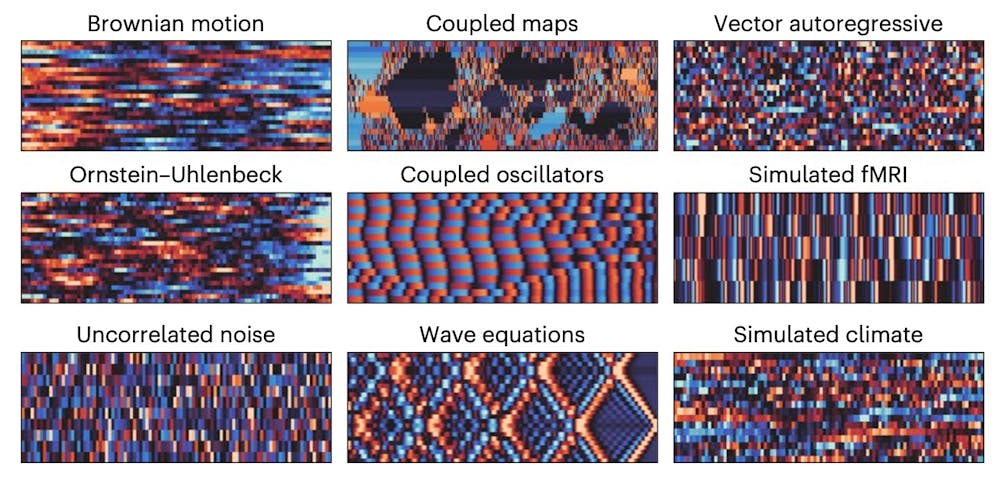
To develop our orchestra, we undertook the mammoth task of analysing more than 200 methods for computing interactions from as many datasets as we could get our hands on. These covered a huge range of subjects, from stock markets and climate to brain activity and earthquakes to river flow and heart beats.

In total, we applied our 237 methods to more than 1,000 datasets. By analysing how these methods behave when applied to such diverse scientific systems, we found a way for them to “play in harmony” for the first time.

In the same way that instruments in an orchestra are usually organised as strings, brass, woodwind and percussion, scientific methods from areas like engineering, statistics and biophysics also have their traditional groupings.
Applying different methods to more than 1,000 datasets from a wide range of fields revealed surprising similarities and differences. Cliff et al. / Nature Computational Science, CC BY-SA

But when we organised our scientific orchestra, we found that the scientific instruments grouped together in a strikingly different way to this traditional organisation. Some very different methods behaved in surprisingly similar ways to one another.

This was a bit like discovering that the tuba player’s melody was surprisingly similar to that of the flute, but no one had noticed it before.

Our weird and wonderful new orchestral layout (which sometimes places cello and trumpet players next to the piccolo player), represents a more “natural” way of grouping methods from all across science. This opens exciting new avenues for cross-disciplinary research.

The orchestra in the real world

We also put our full scientific orchestra to work on some real-world problems to see how it would work. One of these problems was using motion data from a smartwatch to classify activities like “badminton playing” and “running”; another was distinguishing different activities from brain-scan data.

Properly orchestrated, the full ensemble of scientific methods demonstrated improved performance over any single method on its own.

To put it another way, virtuosic solos are not always the best approach! You can get better results when different scientific methods work cooperatively as an ensemble.

Read more: Electricity flow in the human brain can be predicted using the simple maths of networks, new study reveals

The scientific ensemble introduced in this work provides a deeper understanding of the interacting systems that shape our complex world. And its implications are widespread – from understanding how brain communication patterns break down in disease, to developing improved detection algorithms for smartwatch sensor data.

Time will tell what new music scientists will make as they step up to conduct our new scientific orchestra that simultaneously incorporates diverse ways of thinking about the world.

Authors: Ben Fulcher, Senior Lecturer, School of Physics, University of Sydney

Read more https://theconversation.com/from-stock-markets-to-brain-scans-new-research-harmonises-hundreds-of-scientific-methods-to-understand-complex-systems-214261

What People Mean by “Alternative Doctor” And Why Expectations Around Care Are Changing

When people search for an “alternative doctor,” they’re usually looking for something specific, even if they haven’t fully defined it yet. I...

Why Does My Power Keep Tripping? Common Causes Explained by Electricians Sydney

The electrical system is the lifeblood of your home, powering everything from your phones to cooking utensils and more. But from time to time, your po...

Interstate Car Transporter Urges Buyers to Book Early

As the conflict in the Middle East continues to put increasing pressure on local fuel supply, Australian transport companies are experiencing increasi...

Digital Minimalism for Business Owners: Fewer Tools, Better Systems

Be honest. How many apps are open right now? One for scheduling, another for invoices, a third for customer notes, plus a spreadsheet someone email...

The Importance Of Proactive NDIS Renewal Preparation For Sustaining Your Provider Business

Your NDIS renewal notice is not a signal to start preparing. By the time it arrives, preparation should already be well underway. For new providers, s...

Why Fire Extinguisher Testing in Sydney Is Becoming a Records Game, Not Only a Maintenance Job

A fire extinguisher used to feel like one of the simpler parts of building safety. It hung on the wall, wore a service tag, and sat there quietly unle...

The Switchboard Upgrade Question Every Melbourne Renovator Should Ask Before the Walls Close Up

Renovations have a funny way of making people think on surfaces first. Splashback, stone, joinery, tapware, paint. Fair enough too. That is the exciti...

Winter Sanitation Gaps in Parramatta Kitchens: A Hidden Pest Risk

Winter brings a host of changes to our homes, from the chill in the air to the cozy warmth indoors. However, this season also introduces sanitation ch...

When to Seek Advice from Employment Lawyers in Melbourne

Australian employment law is detailed and, at times, complex, with rights and obligations that aren't always obvious to employees or employers witho...

7 Benefits of Professional Gutter Cleaning for Australian Homeowners

Gutters aren't exactly glamorous. They sit up there on the edge of your roof, doing their job quietly - until they stop working. Clogged, overflowing ...

Pipe Floats Strengthening Pipeline Performance In Demanding Environments

Pipelines often travel through environments that are anything but predictable, water currents shift, terrain changes, and materials keep moving unde...

Why Ceiling Fans Are Essential For Comfort, Efficiency, And Modern Living

Creating a comfortable indoor environment is not just about temperature; it is about how air moves, how a room feels, and how efficiently energy is ...

Why Duct Cleaning In Melbourne Is A Smart Investment For Healthier Living Spaces

Behind your walls, ceilings, and vents lies a network quietly working every day to keep your home comfortable. Yet over time, this system can become...

Disability Service Providers Supporting Inclusive And Independent Living

Finding the right support system can feel like assembling a puzzle where every piece must fit just right. For individuals and families navigating di...

A Beginner's Guide to Owning a Caravan in Australia

Owning a caravan opens up a style of travel that's hard to match for freedom and flexibility. However, for those just starting out, the process of c...

Preparing Your Air Conditioner for Summer: What Most Homeowners Overlook

As temperatures rise, many homeowners switch on their air conditioning for the first time in months — only to find it’s not performing the way i...

What Actually Adds Value to Properties in Newcastle

Newcastle has seen steady growth over the past few years, with more buyers looking beyond Sydney for lifestyle, space, and long-term value. As dema...

What is Design and Build in Construction?

Imagine you’re about to start a new construction project, maybe it’s a custom home or a commercial building. You’ve got the idea, the land, an...
















