Google AI


Modern Australian

Australia's emissions must decline more steeply to reach climate commitment: OECD

  • Written by: Michelle Grattan, Professorial Fellow, University of Canberra
Australia's emissions must decline more steeply to reach climate commitment: OECD

Australia’s emissions need to decline “on a much steeper trajectory” if it is to meet its declared commitment of a 43% reduction by 2030 and net zero by 2050, the Organisation of Economic Co-operation and Development says.

In its report on Australia, released as part of its Going For Growth update on Tuesday, the OECD recommends Australia develop

a national, integrated long-term emissions reduction strategy with clear goals and corresponding policy settings to achieve climate targets.

The OECD also suggests broadening the scope of Australia’s so-called Safeguard Mechanism, which at present regulates the emissions of Australia’s 215 biggest polluting facilities.

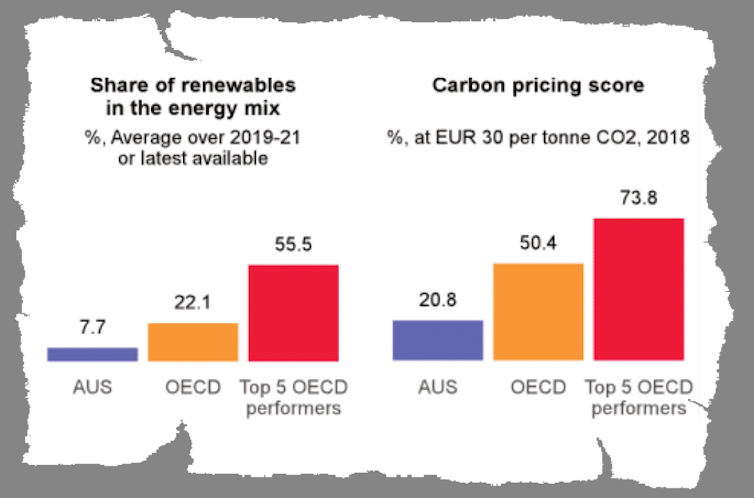
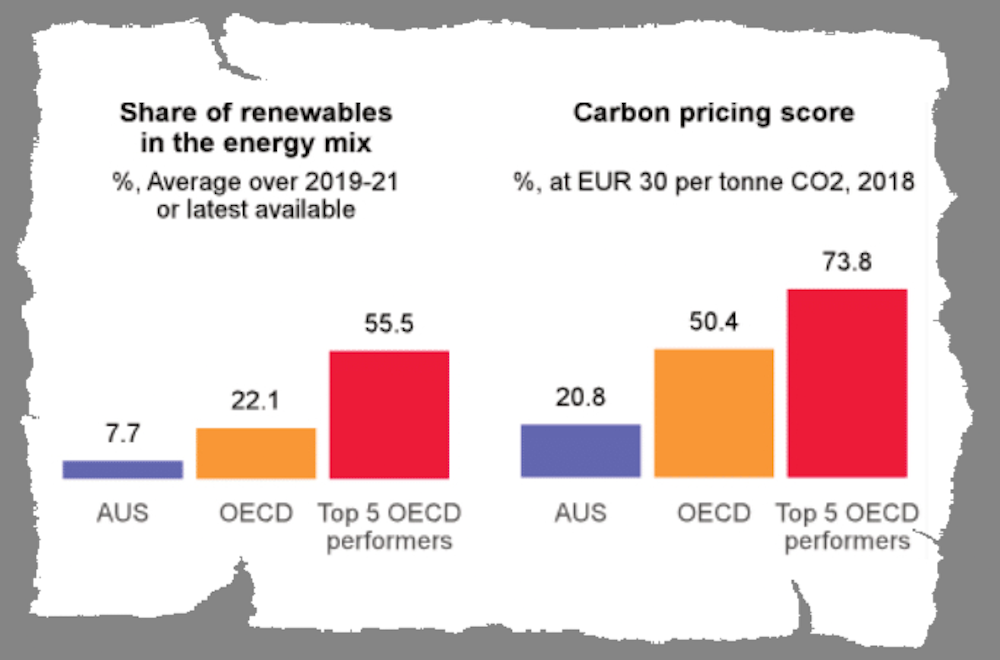
It awards Australia a score on carbon pricing well below the OECD average and even further below that of the top OECD performers.

It says the share of renewables in Australia’s energy supply averaged only 7.7% between 2019 and 2021, compared to an average of 22.1% for OECD members, and 55.5% for the top performers.

OECD, Going for Growth 2023 The OECD is a forum of 38 mainly high-income countries, including Australia, that describe themselves as committed to democracy and market economies. The report is critical of Australia’s performance on a number of other fronts, including income support for the unemployed, job market flexibility and the recognition of trade qualifications. It says Australia’s JobSeeker unemployment benefit remains among the lowest in the OECD and below the relative poverty line when compared to the wages available from work. The Albanese government has increased the rate of JobSeeker in the May budget. The report recommends the government consider “further increasing” it. Declining productivity, declining competitiveness The OECD finds signs of “reduced competitive intensity” in product markets, as well as falling labour mobility. “Productivity growth has also slowed down.” It says about one in five workers needs a licence to do their work, raising economic costs, and calls for automatic mutual recognition of licenses across states. Access to fast broadband is low compared to other developed countries, and the take-up of digital technologies by businesses can be improved, the report says. The OECD also draws attention the “large” gaps in economic and wellbeing measures between Indigenous and other Australians. It recommends the government “embed the Productivity Commission Indigenous Evaluation Strategy in the policy design and evaluation process of all Australian government agencies”. Workforce transformation needed for 2050 target Meanwhile, a report prepared by Jobs and Skills Australia entitled The Clean Energy Generation: workforce needs for a net zero economy says the government’s 2050 net-zero emissions target will require a transformation in the workforce that is “substantial but not unprecedented”. “Like the post-war industrial transformation and the digital transformation of the late twentieth century, a new generation of workers will be required, both from existing energy sectors and through new pathways into clean energy. New jobs, skills, qualifications, training pathways, technologies and industries will emerge over the next 30 years,” the report says. “Australia will need to consider the full range of levers across the education, training, migration, procurement, and workplace relations systems to ensure a sustainable and equitable path towards net zero.” Treasurer’s response to OECD Treasurer Jim Chalmers said the Albanese government was acting on the areas identified in the OECD report. Its policies were “focused on maximising the opportunities of the energy transformation, embracing digitalisation and new technology and investing in our people and their skills so that we can build a more productive, prosperous and dynamic economy”. “We’re securing faster progress towards decarbonisation through our safeguard mechanism, over $40 billion of investment in the energy transformation, our sustainable finance strategy, and establishing a new Net Zero authority to train workers and prepare communities for new opportunities here,” Chalmers said. Authors: Michelle Grattan, Professorial Fellow, University of Canberra

Read more https://theconversation.com/australias-emissions-must-decline-more-steeply-to-reach-climate-commitment-oecd-214851

What to Do When an Older Car Is No Longer Worth Keeping in Melbourne

Ever looked at another repair quote and wondered whether your old car is still worth the trouble? It is a common turning point for Melbourne motoris...

Your Baby's First Year: A Local Guide to Feeding, Sleep, and When to Get Extra Support

Ask ten parents in a Brisbane mothers' group how their baby is feeding or sleeping, and expect ten different answers.  Someone's baby sleeps throug...

Kitchen and Laundry Makeover Ideas That Don't Require a Full Renovation

Full kitchen renos are expensive — and most people don't actually need one.  They need the kitchen to stop looking like it's stuck in 2009, or they...

How Technology Is Reshaping the Modern Australian Commercial Kitchen

The commercial kitchen has always been shaped by technology. Refrigeration changed how ingredients could be stored, modern ventilation transformed k...

The Number on a Roller Blind Fabric That Nobody Explains

Somewhere in the fabric book, next to the colour name, there is a percentage. Three per cent. Five per cent. Ten per cent. Nobody explains it, most c...

What’s Trending in Men’s Jewellery This Father’s Day!

Finding a Father’s Day gift that feels personal, stylish and genuinely wearable is not always easy. While socks and novelty mugs have traditionally ...

Road Signs: Understanding Their Role in Clear and Effective Signage

Effective signage and display hardware can help businesses communicate information, promote products and organise customer or visitor movement. Road...

Bottle Label Printing: Key Factors to Consider Before Your Next Packaging Run

Effective packaging begins with understanding the product, bottle material, artwork and production requirements when planning bottle label printing. H...

Planning a Long-Distance Move With Interstate Movers Melbourne

Moving between states involves more planning than a typical local relocation. Along with packing and transporting household belongings, you need to...

Understanding the Role of an I/O Controller in Industrial Automation

Modern industrial systems depend on accurate communication between sensors, machines and control systems. An I/O controller can help manage this commu...

How the Right Mining Hose Supports Demanding Operations

Mining environments place considerable demands on equipment used for material transfer, water management and processing. Hoses operating in these co...

Simple Ideas for Making Social Gatherings More Memorable

We have all been to those parties where everyone just stands around the kitchen island, staring at their phones, waiting for someone else to make a mo...

Outdoor Wall Lights: Improving Exterior Lighting Around Your Home

Lighting can influence how a room looks, feels and functions, so the right fitting should be selected according to both appearance and practical req...

Commercial Office Cleaning: Combining Routine Office Cleaning With Melbourne Service

Keeping a workplace clean requires a service that can accommodate everyday tasks as well as the particular needs of the business. Professional comme...

Caravan Sales in Queensland: How to Find the Right Caravan for Sale QLD

Caravan ownership is about more than having somewhere to sleep while travelling. For many Queenslanders, it is one of the best ways to explore regio...

What Sir Walter Buffalo Turf Actually Costs in 2026 (And Why Quotes Vary So Much)

Two quotes landed on a Hills District homeowner's kitchen table last spring for the exact same 80-square-metre backyard. One said $12 a metre. The o...

Nearly 1,300 NSW Hospital Beds Are Occupied By People Who Are Ready To Go Home

1,276 people in NSW hospitals have been medically cleared for discharge but remain in hospital because they're still waiting for NDIS or aged care sup...

National Survey Launched to Measure Operational Impacts of Federal NDIS Policy Reforms

The effects of recent NDIS reforms are beginning to move beyond policy papers and into day to day service delivery. A new national survey is asking ...