

Insomnia and mental disorders are linked. But exactly how is still a mystery
- Written by: Ben Bullock, Senior Lecturer, Psychology, Swinburne University of Technology
This article is the next in The Conversation’s six-part series on insomnia, which charts the rise of insomnia during industrialisation to sleep apps today. Read other articles in the series here.
The 2004 movie The Machinist gives us a striking depiction, albeit a fictional one, of the psychological effects of chronic insomnia.
When people don’t have enough sleep, their memory and concentration are impaired in the short term. They are also less able to regulate their emotions.
If sleeping difficulties continue, longer-term psychological effects can include anxiety, depression, mania and psychosis. Indeed, Christian Bale’s character in The Machinist has increasingly vivid visual hallucinations and paranoid delusions as his insomnia deepens.
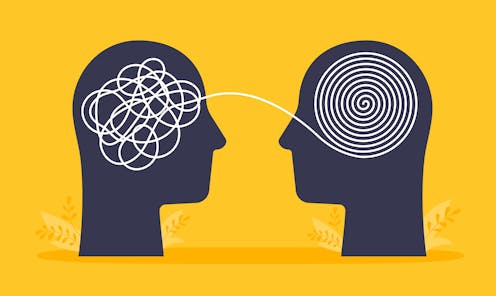
The relationship between insomnia and mental disorders is complex. It’s not just a case of “which comes first, the insomnia or the mental disorder?” Insomnia and mental disorders are interrelated in ways we don’t yet fully understand.
Read more: A short history of insomnia and how we became obsessed with sleep
What is insomnia? Is it a mental disorder?
Insomnia is, by far, the most common disorder of sleep. An estimated 12-15% of Australian adults at any one time meet criteria for insomnia.
People with insomnia have frequent and ongoing difficulties in falling and staying asleep, and/or going back to sleep after early waking. Insomnia not only affects people’s quality of sleep, but how they function the next day.
Many of the factors that trigger insomnia and help maintain its negative long-term effects are psychological or behavioural. These include:
psychosocial stressors (such as money, work or family problems)
attentional bias and worry about sleep (the more we think and worry about sleep, the worse it gets)
poor sleep habits (such as irregular sleep and wake times).
Insomnia is not a mental disorder in the same way that, say, depression and anxiety are mental disorders. Insomnia is a recognised sleep disorder that nonetheless has close links to a wide variety of mental disorders.
Read more: What's insomnia like for most people who can't sleep? You'd never know from the movies
Many people have both insomnia and a mental disorder
Around half of all people diagnosed with insomnia also have an associated mental disorder. The most common ones associated with insomnia are depression, anxiety, bipolar disorder, post-traumatic stress disorder, and substance-related disorders.
We don’t (yet) know why we see such high levels of mental disorders in people with insomnia. But there are several leading theories, including:
a shared genetic risk for insomnia and a mental disorder. In other words, some people’s genes may predispose them to both conditions
a shared neurobiological response. How the brain responds to sleep loss may be connected to how systems in the brain control cognition, emotion and reward. Disturbances of these brain functions are implicated in a range of mental disorders
inflammation and/or dysfunction of the immune system may underlie both insomnia and mental disorders.
Read more: How dangerous is insomnia? How fear of what it's doing to your body can wreck your sleep
Which comes first?
Further complicating the picture is evidence showing insomnia can occur before someone develops a mental disorder, or afterwards. Researchers call this a “bidirectional” relationship.
We can’t say one causes the other. We can only say there is a clear link between them.
This link means diagnosis and treatment of one can have implications for diagnosis and treatment of the other. For instance, if you don’t adequately treat insomnia, this can worsen symptoms of someone’s mental disorder, increasing both the severity and risk of relapse.
A type of talking therapy known as cognitive behavioural therapy for insomnia (CBTi) aims to change the unhelpful thoughts, feelings, emotions and behaviours that contribute to insomnia. And, in many cases, successful treatment of insomnia with CBTi can also treat someone’s mental disorder (and vice versa).
CBTi is particularly effective at treating insomnia plus depression, substance use or post-traumatic stress disorder. But it is less effective at treating insomnia plus psychosis or bipolar disorder.

Filling the gaps
There’s much we don’t know about the link between insomnia and mental disorders. Last year an international panel of experts outlined the research needed to plug the knowledge gaps. Recommendations included:
longer-term studies starting in childhood and adolescence that collect data on sleep and mental health using wearable or smartphone technologies. The aim is to provide more objective measurement of insomnia and mental health in these younger age groups, and to intervene early if needed
more studies involving people from diverse social and cultural backgrounds. Sleep practices are often culturally-determined. So researching diverse populations would provide a more comprehensive picture of insomnia and mental disorders
a greater recognition of people’s daytime behaviours and environmental exposures, and their contribution to insomnia and poorer mental health. This includes, eating fast food, having disrupted sleep routines (for example, shift work) and using technology excessively.
Results of this research will have profound implications for accurate diagnosis of both insomnia and mental disorders, and their treatment. The aim is to reduce the burden when these conditions occur together, both for individuals and society more broadly.
If this article has raised issues for you, or if you’re concerned about someone you know, call Lifeline on 13 11 14. Free information about insomnia and mental health is available from the Sleep Health Foundation.
Authors: Ben Bullock, Senior Lecturer, Psychology, Swinburne University of Technology


















