

Why do I bruise so easily? Could it be something serious?
- Written by: Sant-Rayn Pasricha, Division Head, Population Health and Immunity, Walter and Eliza Hall Institute
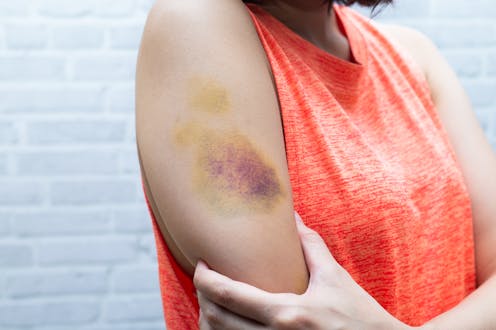
After a bump, we can expect a bruise. But what if we find ourselves bruising without any noticeable cause? What might be behind it? Should we worry?
Around 18% of adults report easy bruising. As haematologists (blood doctors), we are often asked for advice when people are worried they might bruise too easily.
Here is how we think about the problem.
What the blood does
Firstly, it helps to understand the complex, carefully balanced systems in our body that protect us from bleeding.
Blood flows as a liquid through our blood vessels, carrying red cells with their cargo of oxygen and immune cells to defend us from infections, to our brain, muscles and internal organs. Blood contains ingredients that are carefully balanced to protect us from bleeding if we are injured, while simultaneously minimising the risk of dangerous blood clot formation.
If a “puncture” occurs in a blood vessel, blood can rapidly thicken to form a jellylike clot, to minimise blood loss until the vessel repairs itself. To achieve this, tiny cell fragments called platelets that circulate in the blood bind to the damaged blood vessel wall.
A host of proteins (clotting factors), attracted by the platelets and damaged vessel wall, then combine to thicken the blood at the site and form a blood clot. Like all blood cells, platelets are made in the bone marrow, while clotting factors are mostly made in the liver.
So what can go wrong? If we have a problem affecting either our clotting factors, our platelets, or our blood vessel walls, we can find ourselves developing easy bruising or even problematic bleeding.
Read more: Hot pack or cold pack: which one to reach for when you're injured or in pain
Could it be a problem?
In many patients who report easy bruising, haematologists can’t find any particular cause.
Blood doctors are usually more cautious when a person has a constellation of problems related to bleeding. For example, a disorder is more likely if the bruising is widespread with large bruises, is accompanied by frequent nosebleeds, heavy periods, problems with bleeding after major dental work, surgery or childbirth – or even spontaneous serious bleeding into joints or into the brain.
A few simple tests can help us figure out if there is likely to be a serious problem.
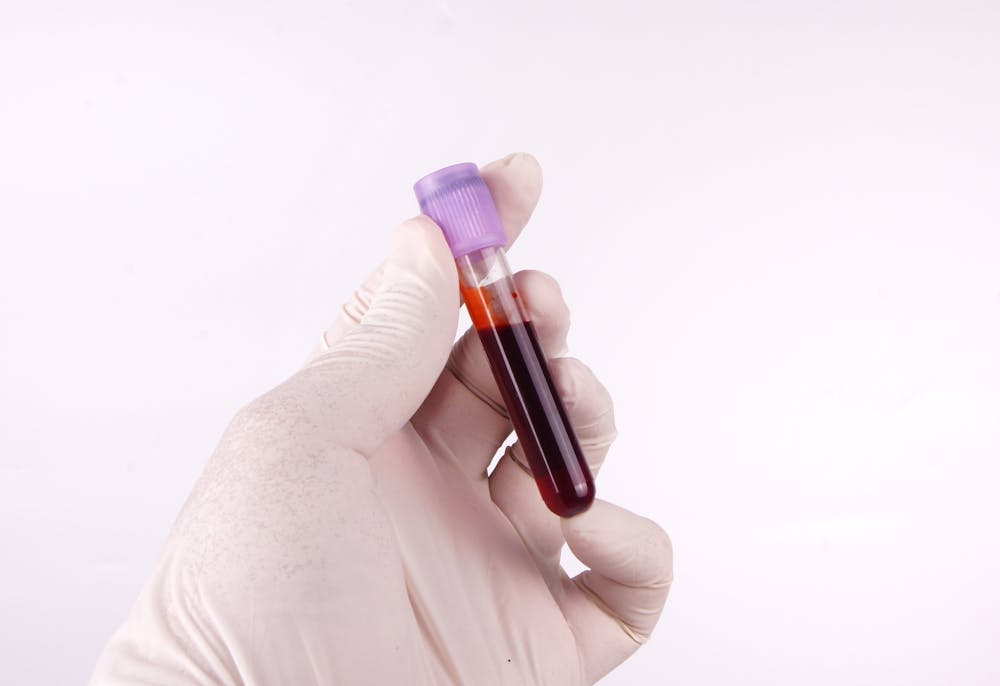
The first we would perform for any person reporting easy bruising is a full blood count. This will include a measurement of the platelet count and reliably show if the platelet numbers are normal.
Our platelets can be reduced for a number of reasons – either because they are not being produced in the bone marrow appropriately or in sufficient quantity, or because they are being removed from the circulation too quickly.
The latter scenario happens in a common condition called immune thrombocytopenic purpura. This condition can affect children or adults out of the blue or following a viral infection. Patients can develop severe reductions in their platelet count and come out in a fine rash, which is actually small bruises.
In children, it is usually a short-term condition that recovers by itself. In adults, severe cases may need treatment with medicines that suppress the immune system or boost platelet production. Sometimes adults need surgery to remove the spleen.
Problems with clotting proteins and diseases
Clotting factors – the proteins mentioned earlier – can be affected by a range of inherited or acquired causes.
Some people are born with low levels of important factors that help the blood clot when it needs to control bleeding.
Haemophilia A is seen almost exclusively in men and is caused by a genetic reduction in Factor VIII (a key clotting factor). Both men and women can have von Willebrand Disease, which involves reduced production or function of another key clotting factor.
Liver disease can also cause clotting problems. That’s why the second test we perform in any person reporting easy bruising is to measure clotting function. If we find an abnormality, we’ll follow up by testing the levels of key clotting factors.
Problems with blood vessels
Though rare today, severe vitamin C deficiency used to more commonly cause easy bruising and gum bleeding (“scurvy”) and deficiencies can still cause bruising.
Several diseases can cause blood vessel thinning or inflammation, including Henoch-Schonlein purpura – an autoimmune condition that results in leg and thigh bruising.
Older people can have fragile skin and blood vessels, making bruising more likely.
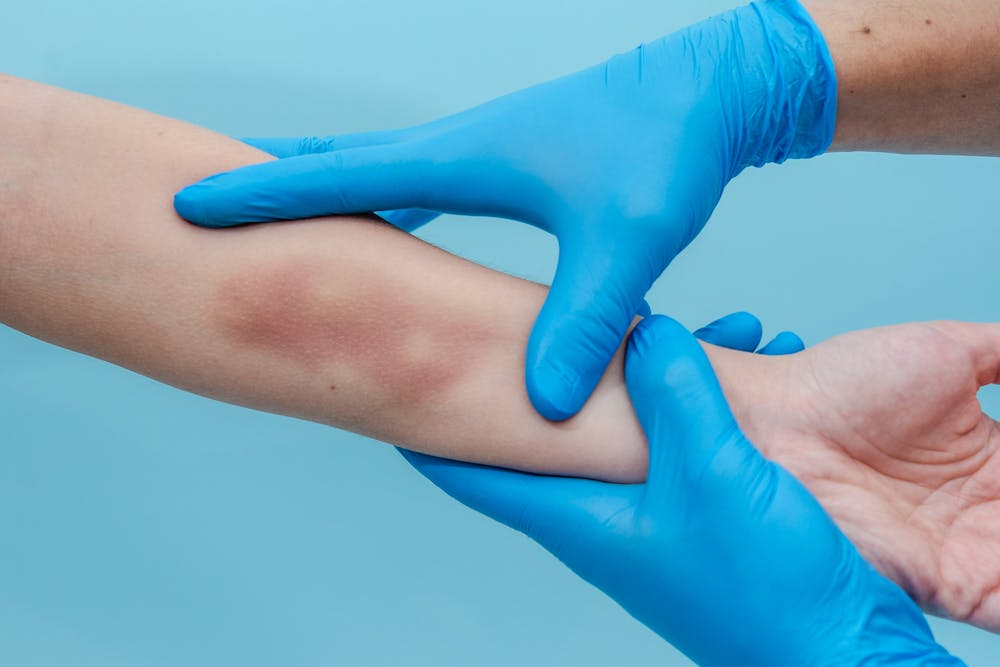 Doctors may do blood tests to rule out some causes of bruising.
Shutterstock
Doctors may do blood tests to rule out some causes of bruising.
Shutterstock
Read more: Why do we bleed? A hematologist explains how the body prevents blood loss after injury
Medicines and supplements
We always ask patients about their medication and alternative medicine use.
Aspirin – often prescribed to prevent platelets from worsening the risk of cardiac disease or stroke – can also reduce platelet function.
Medications like clopidogrel (to stop problem clotting) and non steroidal anti-inflammatory drugs (like ibuprofen or others taken for pain and inflammation) can reduce platelet function. Blood thinners such as warfarin, apixaban and rivaroxaban, prescribed to people with a higher risk of clots leading to stroke, can affect bruising.
People using oral or inhaled corticosteroids for a prolonged period (such as for chronic illnesses) may notice increased bruising because of thinning of the skin and weakened blood vessel walls.
Over-the-counter supplements including gingko and vitamin E can also promote easy bruising, as can some antidepressant medications.
Read more: A history of blood clots is not usually any reason to avoid the AstraZeneca vaccine
Questions of abuse and trauma
Finally, blood vessels can be damaged by trauma. Clinicians should carefully ask if the person has experienced any injuries, including a sensitive consideration of child abuse or intimate partner violence.
While there are many medical conditions that can cause easy bruising, if you don’t have a strong history of other forms of excessive bleeding, and your blood counts and clotting function tests are normal, it shouldn’t be a cause for concern.
Authors: Sant-Rayn Pasricha, Division Head, Population Health and Immunity, Walter and Eliza Hall Institute
Read more https://theconversation.com/why-do-i-bruise-so-easily-could-it-be-something-serious-207736


















