

7,000-year-old shark-tooth knives discovered in Indonesia
- Written by: Michelle Langley, Associate Professor of Archaeology, Griffith University
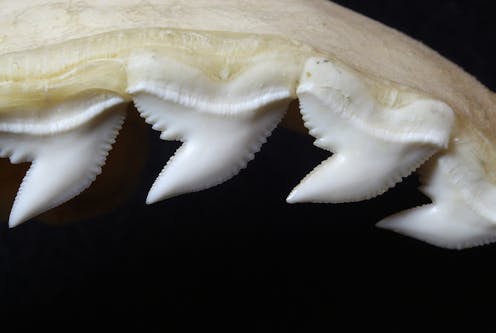
Excavations on the Indonesian island of Sulawesi have uncovered two unique and deadly artefacts dating back some 7,000 years – tiger shark teeth that were used as blades.
These finds, reported in the journal Antiquity, are some of the earliest archaeological evidence globally for the use of shark teeth in composite weapons – weapons made with multiple parts. Until now, the oldest such shark-tooth blades found were less than 5,000 years old.

Our international team used a combination of scientific analysis, experimental reproduction and observations of recent human communities to determine that the two modified shark teeth had once been attached to handles as blades. They were most likely used in ritual or warfare.
7,000-year-old teeth
The two shark teeth were recovered during excavations as part of a joint Indonesian-Australian archaeological research program. Both specimens were found in archaeological contexts attributed to the Toalean culture – an enigmatic foraging society that lived in southwestern Sulawesi from around 8,000 years ago until an unknown period in the recent past.
The shark teeth are of a similar size and came from tiger sharks (Galeocerda cuvier) that were approximately two metres long. Both teeth are perforated.
A complete tooth, found at the cave site of Leang Panninge, has two holes drilled through the root. The other – found at a cave called Leang Bulu’ Sipong 1 – has one hole, though is broken and likely originally also had two holes.
Microscopic examination of the teeth found they had once been tightly fixed to a handle using plant-based threads and a glue-like substance. The adhesive used was a combination of mineral, plant and animal materials.
The same method of attachment is seen on modern shark-tooth blades used by cultures throughout the Pacific.
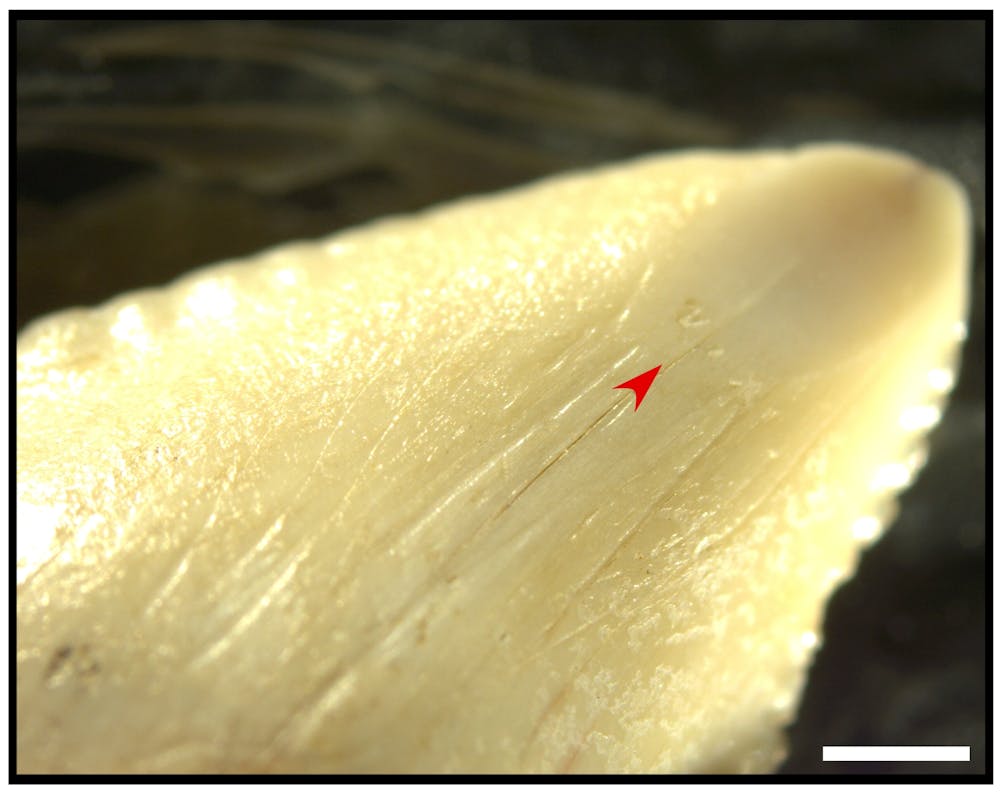 Scratches and a ground section on the tip of the Leang Panninge shark tooth indicate its use by people 7,000 years ago.
M.C. Langley
Scratches and a ground section on the tip of the Leang Panninge shark tooth indicate its use by people 7,000 years ago.
M.C. Langley
Examination of the edges of each tooth found they had been used to pierce, cut and scrape flesh and bone. However, far more damage was present than a shark would naturally accrue during feeding.
While these residues superficially suggest Toalean people were using shark-tooth knives as everyday cutting implements, ethnographic (observations of recent communities), archaeological and experimental data suggest otherwise.
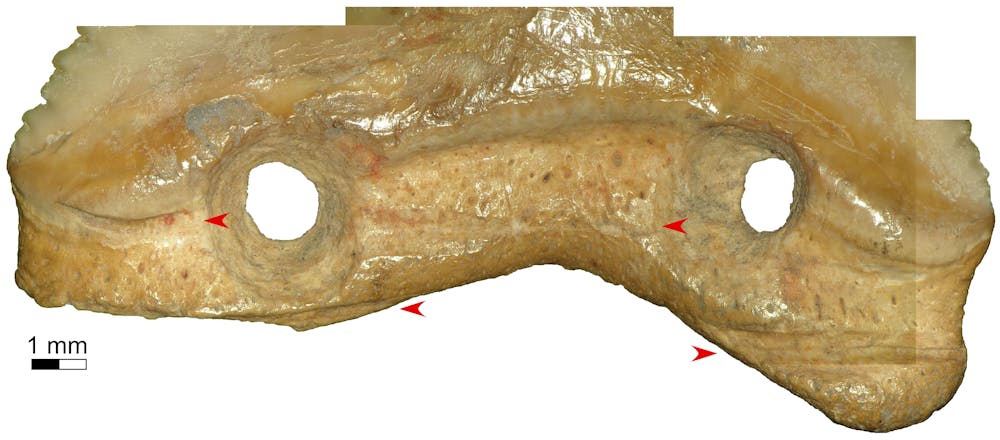 Grooves and traces of red resin along the base of the Leang Panninge tooth show how the teeth were attached using threads.
M.C. Langley
Grooves and traces of red resin along the base of the Leang Panninge tooth show how the teeth were attached using threads.
M.C. Langley
Why use shark teeth?
Not surprisingly, our experiments found tiger shark-tooth knives were equally effective in creating long, deep gashes in the skin when used to strike (as in fighting) as when butchering a leg of fresh pork.
Indeed, the only negative aspect is that the teeth blunt relatively quickly – too quickly to make their use as an everyday knife practical.
This fact, as well as the fact shark teeth can inflict deep lacerations, probably explains why shark-tooth blades were restricted to weapons for conflict and ritual activities in the present and recent past.
Read more: Evolution of a smile: 400 million year old spiny fish overturns shark theory of tooth origins
Shark-tooth blades in recent times
Numerous societies across the globe have integrated shark teeth into their material culture. In particular, peoples living on coastlines (and actively fishing for sharks) are more likely to incorporate greater numbers of teeth into a wider range of tools.
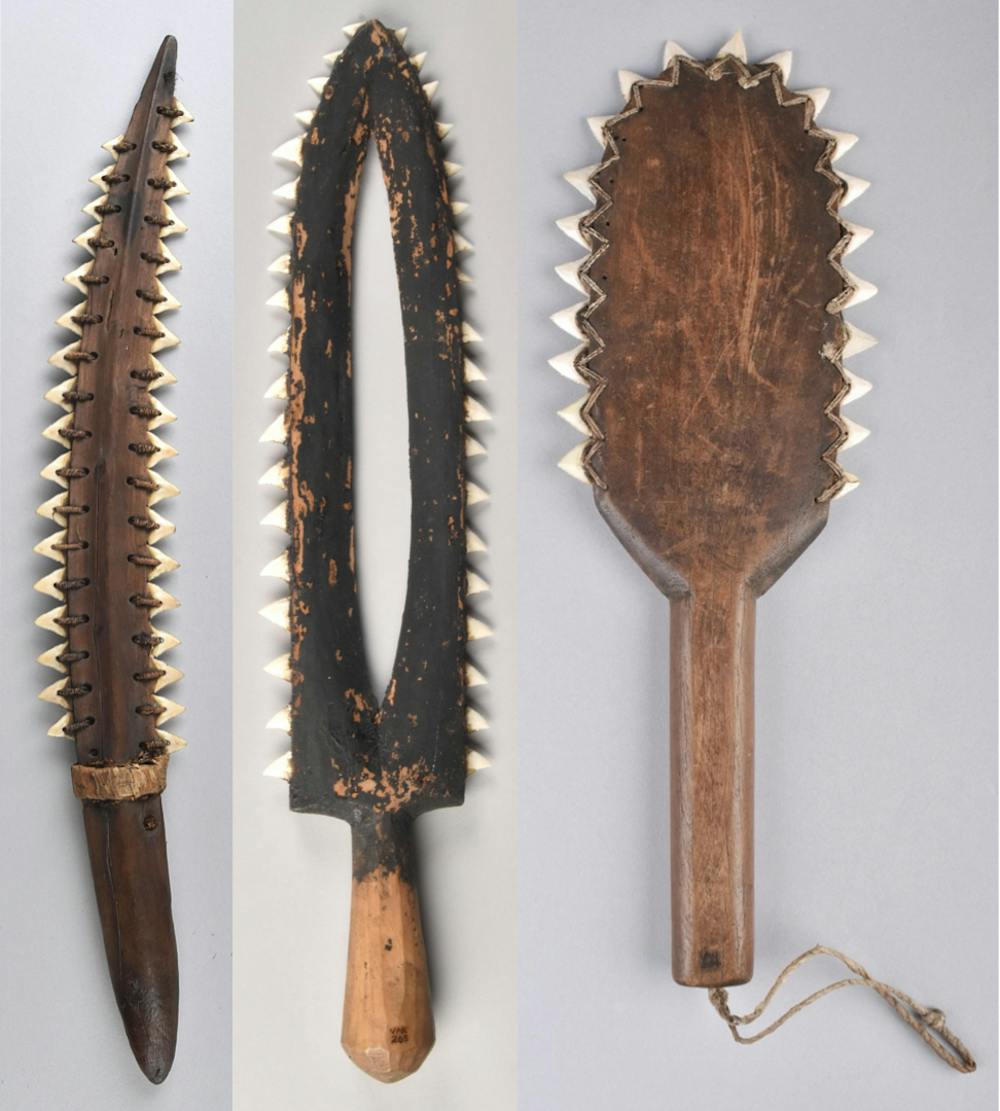 Shark teeth are widely used to edge deadly combat weapons or powerful ritual blades in the Pacific. Left: a knife from Kiribati; centre and right: weapons from Hawai'i.
The Trustees of The British Museum, CC BY-NC-SA
Shark teeth are widely used to edge deadly combat weapons or powerful ritual blades in the Pacific. Left: a knife from Kiribati; centre and right: weapons from Hawai'i.
The Trustees of The British Museum, CC BY-NC-SA
Observations of present-day communities indicate that, when not used to adorn the human body, shark teeth were almost universally used to create blades for conflict or ritual – including ritualised combat.
For example, a fighting knife found throughout north Queensland has a single long blade made from approximately 15 shark teeth placed one after the other down a hardwood shaft shaped like an oval, and is used to strike the flank or buttocks of an adversary.
Weapons, including lances, knives and clubs armed with shark teeth are known from mainland New Guinea and Micronesia, while lances form part of the mourning costume in Tahiti.
Farther east, the peoples of Kiribati are renowned for their shark-tooth daggers, swords, spears and lances, which are recorded as having been used in highly ritualised and often fatal conflicts.
Shark teeth found in Maya and Mexican archaeological contexts are widely thought to have been used for ritualised bloodletting, and shark teeth are known to have been used as tattooing blades in Tonga, Aotearoa New Zealand, and Kiribati.
In Hawai‘i, so-called “shark-tooth cutters” were used as concealed weapons and for “cutting up dead chiefs and cleaning their bones preparatory to the customary burials”.
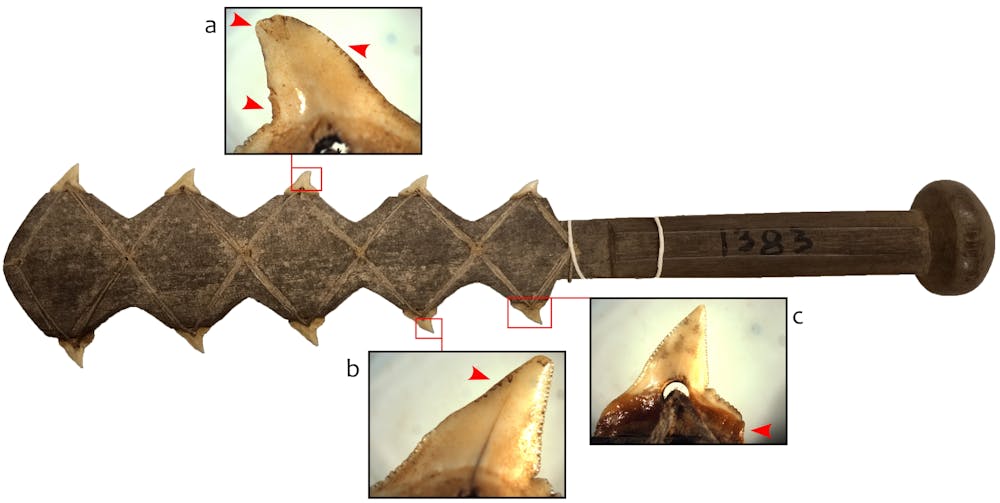 A shark-tooth knife from Aua Island, Papua New Guinea. Red arrows highlight wear and damage caused by fighting.
M. Langley and The University of Queensland Anthropology Museum
A shark-tooth knife from Aua Island, Papua New Guinea. Red arrows highlight wear and damage caused by fighting.
M. Langley and The University of Queensland Anthropology Museum
Other shark tooth archaeological finds
Almost all shark-tooth artefacts recovered globally have been identified as adornments, or interpreted as such.
Indeed, modified shark teeth have been recovered from older contexts. A solitary tiger shark tooth with a single perforation from Buang Merabak (New Ireland, Papua New Guinea) is dated to around 39,500–28,000 years ago. Eleven teeth with single perforations from Kilu (Buka Island, Papua New Guinea) are dated to around 9,000–5,000 years ago. And an unspecified number of teeth from Garivaldino (Brazil) is dated to around 9,400–7,200 years ago.
However, in each of these cases the teeth were likely personal ornaments, not weapons.
Our newly described Indonesian shark tooth artefacts, with their combination of modifications and microscopic traces, instead indicate they were not only attached to knives, but very likely linked to ritual or conflict.
Whether they cut human or animal flesh, these shark teeth from Sulawesi could provide the first evidence that a distinctive class of weaponry in the Asia-Pacific region has been around much longer than we thought.
Authors: Michelle Langley, Associate Professor of Archaeology, Griffith University


















