

Jesmyn Ward's Let Us Descend confronts a history beyond the ken of storytelling
- Written by: Julian Murphet, Jury Professor of English and Language and Literature, University of Adelaide
It is worth asking whether there are topics beyond the capacity of the novel. Are there subjects so immense in historical scope and in depths of human suffering that a form engineered to tackle but a bare handful of lives in sufficient detail cannot possibly accommodate them?
Warfare, with its punctual campaigns and political manoeuvrings, may indeed prove the limit beyond which the novel capitulates and the older form of the epic resurfaces.
And beyond that?
Review: Let Us Descend – Jesmyn Ward (Scribner)
New World slavery is beyond the ken of storytelling. As a direct corollary of that most unconscionable human catastrophe – the genocide of the Amerindians (130 million killed in 200 years) – the Atlantic slave trade is a critical component of the most important, most untellable story in the history of our species: the “conquest of the New World” by European powers.
Over 400 years, almost 13 million people were sold, shipped and bred so they could work to death on colonial plantations in South, Central and North America.
Such numbers stagger and incapacitate the imagination. Narrative, without which we fail to integrate our collective experience, is disabled by evil on this systematic scale. Slavery, as poet M. NourbeSe Philip writes, is “the story that simultaneously cannot be told, must be told, and will never be told.”
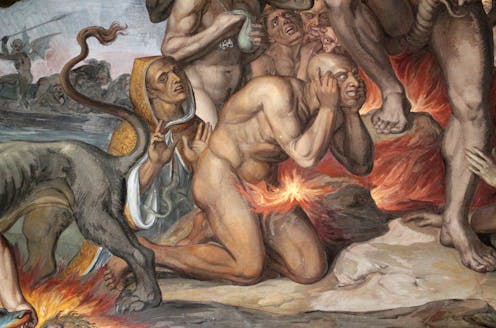
Even Dante, the greatest imagination ever to dedicate itself to the analysis and evaluation of human depravity, had no room in his packed inferno for the architects, agents and profiteers of modern chattel slavery. It is doubtful whether he could have contemplated this army of slobbering devils without immediately dropping dead in horror.
And yet they laid the foundations for our world; their legacy most powerfully shapes the present and threatens to determine the future. With no circle in hell reserved for them, their statues and namesakes are everywhere around us. They are legion.
Read more: Jean Toomer’s Cane at 100: the 'everlasting song' that defined the Harlem Renaissance
Sink to rise

 The Slave Trade – Auguste Francois Biard c.1833.
Public domain, via Wikimedia Commons
Read more:
A must-read list: The enduring contributions of African American women writers
Neglected lives
Like all Ward’s work, Let Us Descend is concerned with the neglected lives of the “other America”: the poor, the despised, the dark, those barely scraping a living on the periphery of the superstate – or in this case, the superstate’s nascent phase of accumulation.
Into her finely etched young protagonists and their blasted families, Ward breathes a tenderness that is never maudlin. She exudes a capacity for unconventional moral judgement. But now, rather than writing what she knows at first hand – present-day rural Mississippi Black folk, prey to the informal economy – Ward has projected her immense empathy onto historical material to which neither her nor her small-scale art is equal. The effects are often jarring.
Consider the enormous erudition and formal self-discipline on show in those precious few masterpieces of “slave literature” in the novel form: Toni Morrison’s Beloved and A Mercy, William Styron’s masterful ventriloquism in Confessions of Nat Turner, and Octavia E. Butler’s time-bending Kindred.
There is a discreet refusal to depict the existential inferno of day-to-day slavery directly in these works. Beloved is set slightly after the Civil War, A Mercy before the full-scale industrialisation of slavery under King Cotton. Nat Turner concerns itself with that rarest of phenomena, a full-scale slave uprising. Kindred occupies two disparate time-zones.
This discretion is matched by the rigour and authenticity of the period language, the painstaking effort to bear witness to what none of these authors (or any individual) could have seen in the round.
But the language of Let Us Descend – which, like all Ward’s novels, is narrated in the voice of a young adult – feels unmoored from history. Apart from the most obvious material referents (hatchet, lace, machete, pitchfork), it subsists in a belles-lettristic zone fenced off from socio-linguistic development.
Here, for example, is the putative voice of a pubescent, uneducated slave girl, circa early-1800s, describing her owners:
The husband’s cheeks wax round as corn cakes, red-washed with fat. He curls over her and engulfs her, eating up any shadow left in the glowing room, with his gold-threaded vest, his hair springing out over his head in big blond curls. The round pork of his shoulders fills the space. He is as showy as a robin. His wife, the small bird, flutters around him.
Who is speaking this? The first-person voice has no moral purpose if it does not make a stringent effort, in every sentence, to find the adequate linguistic material of its character’s actual situation. Instead, the voice Ward cultivates for Annis drifts off into a mellifluous if insipid drone of “style”, supplied by the author, as if to offset the character’s inadequacy as a literary instrument.
The Slave Trade – Auguste Francois Biard c.1833.
Public domain, via Wikimedia Commons
Read more:
A must-read list: The enduring contributions of African American women writers
Neglected lives
Like all Ward’s work, Let Us Descend is concerned with the neglected lives of the “other America”: the poor, the despised, the dark, those barely scraping a living on the periphery of the superstate – or in this case, the superstate’s nascent phase of accumulation.
Into her finely etched young protagonists and their blasted families, Ward breathes a tenderness that is never maudlin. She exudes a capacity for unconventional moral judgement. But now, rather than writing what she knows at first hand – present-day rural Mississippi Black folk, prey to the informal economy – Ward has projected her immense empathy onto historical material to which neither her nor her small-scale art is equal. The effects are often jarring.
Consider the enormous erudition and formal self-discipline on show in those precious few masterpieces of “slave literature” in the novel form: Toni Morrison’s Beloved and A Mercy, William Styron’s masterful ventriloquism in Confessions of Nat Turner, and Octavia E. Butler’s time-bending Kindred.
There is a discreet refusal to depict the existential inferno of day-to-day slavery directly in these works. Beloved is set slightly after the Civil War, A Mercy before the full-scale industrialisation of slavery under King Cotton. Nat Turner concerns itself with that rarest of phenomena, a full-scale slave uprising. Kindred occupies two disparate time-zones.
This discretion is matched by the rigour and authenticity of the period language, the painstaking effort to bear witness to what none of these authors (or any individual) could have seen in the round.
But the language of Let Us Descend – which, like all Ward’s novels, is narrated in the voice of a young adult – feels unmoored from history. Apart from the most obvious material referents (hatchet, lace, machete, pitchfork), it subsists in a belles-lettristic zone fenced off from socio-linguistic development.
Here, for example, is the putative voice of a pubescent, uneducated slave girl, circa early-1800s, describing her owners:
The husband’s cheeks wax round as corn cakes, red-washed with fat. He curls over her and engulfs her, eating up any shadow left in the glowing room, with his gold-threaded vest, his hair springing out over his head in big blond curls. The round pork of his shoulders fills the space. He is as showy as a robin. His wife, the small bird, flutters around him.
Who is speaking this? The first-person voice has no moral purpose if it does not make a stringent effort, in every sentence, to find the adequate linguistic material of its character’s actual situation. Instead, the voice Ward cultivates for Annis drifts off into a mellifluous if insipid drone of “style”, supplied by the author, as if to offset the character’s inadequacy as a literary instrument.



















