

We can still prevent the collapse of the West Antarctic ice sheet – if we act fast to keep future warming in check
- Written by: Richard Levy, Principal Scientist/Environment and Climate Research Leader, GNS Science
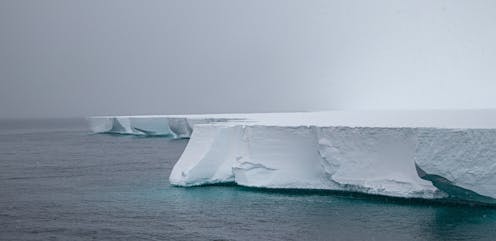
Projecting when and how fast the West Antarctic Ice Sheet will lose mass due to current and future global ocean warming – and the likely impact on sea level rise and coastal communities – is a priority for climate science.
We know deep water flowing towards and around Antarctica is warming, and the fringes of the West Antarctic Ice Sheet (WAIS) are increasingly vulnerable to ocean-driven melting.
Submerged continental shelves along large portions of West Antarctica, including offshore Pine Island and Thwaites glaciers in the Amundsen Sea, are already bathed by upwelling arms of this relatively warm water.
Ice shelves in this region – massive floating slabs of ice that flow out from the coast – are already losing mass. Because ice shelves float, their melting doesn’t affect sea levels. But they hold back land-based ice, which does.
Recent research suggests increasing flow of warm deep water in this area will speed up the melting of the WAIS over the coming decades, regardless of future anthropogenic greenhouse gas emissions.
This would mean global net-zero emissions targets cannot limit the amount of future sea-level rise caused by the melting of the WAIS. This poses significant challenges for coastal communities in low-lying regions as they plan for and adapt to unavoidable change.
Our project, an ambitious international collaboration known as the “Sensitivity of the WAIS to 2°C” (SWAIS2C), aims to retrieve sediments from the seafloor beneath the Ross Ice Shelf to explore how West Antarctica responded to warmer periods in Earth’s past – and what might happen in a warming future.
Read more: Increasing melting of West Antarctic ice shelves may be unavoidable – new research
We may have (some) time
While it may appear too late to slow or stop the retreat of the WAIS in areas where the ocean cavities beneath ice shelves are already “warm”, the inevitable demise of the entire WAIS is not so certain. There are also regions where ice shelf cavities are currently “cold”.
The Ross and Ronne-Filchner are Earth’s largest ice shelves and currently buttress and stabilise large regions of ice in the West Antarctic interior. The ocean cavity that lies beneath the Ross Ice Shelf is cold, generally characterised by temperatures at or below minus 1.8°C.
A recent ice sheet modelling study shows these large ice shelves and the WAIS will remain largely intact under low-emissions pathways which aim to keep warming close to or below 2°C above pre-industrial values.
Read more: Widespread collapse of West Antarctica's ice sheet is avoidable if we keep global warming below 2℃
Modelling experiments indicate an emissions pathway in line with the goals of the Paris agreement can still limit the total contribution to sea level rise coming from the Antarctic ice sheet to 0.12–0.44 metres by 2100 (0.45–1.57 metres by 2300).
Importantly, these experiments also show that spatial patterns of ice thinning and retreat in the Amundsen Sea region are similar for 2100 compared to 2015 (see figure below) under both low and high emissions.
The clearest contrasts between the scenarios occur in the Ross Sea sector, where the grounding line of the ice shelf advances in low-emissions (“sustainable”) scenarios but the shelf ice thins or even collapses in high-emissions (“fossil fuel intensive”) scenarios.
Observation gaps from key Antarctic regions
Global surface temperature is likely to exceed 1.5°C above pre-industrial values by the early 2030s. It may warm by as much as 4.4°C by the end of this century.
Our current global policy and action trajectory will yield 2.7°C of warming by the end of century, but more ambitious pledges and targets could keep global warming to 2.0°C. We need to know how sensitive the large, cold-cavity ice shelves are to these increases in global temperature.
Ice sheet modelling suggests rapid cuts in emissions can still limit WAIS melt, but we lack direct observations to support these findings. Collecting new data from locations around the WAIS margin will offer insights into present-day changes and a possible future response to warming.
Significant effort to address data gaps has been made in the Amundsen Sea around the Thwaites Glacier region, but observations beneath the Ross Ice Shelf, especially near the point where the WAIS begins to float, are limited. The SWAIS2C project aims to address this knowledge gap.
Tapping the geological record
SWAIS2C is an international collaboration involving scientists, drillers, engineers and science communicators. Our team will travel to the Siple coast, close to the centre of West Antarctica, to melt holes through the ice shelf at two sites.
Oceanographic measurements and geophysical observations at each site will improve our understanding of current ocean mechanics and ice sheet dynamics. But to understand the potential future contribution to sea-level rise from melting of the WAIS, we will need to turn to the geological record.
Seafloor sediments from beneath the Ross Ice Shelf represent an archive of climate information from warmer periods in Earth’s history and offer a means to “see” how the ice shelf and ice sheet responded to past warmth.
We will drill up to 200 metres below the seafloor to recover a geological record of changing rock types that reflect environmental conditions at the time they formed.
These data will allow us to identify previous episodes when the ice shelf thinned and disintegrated, driving retreat of the WAIS interior. Environmental data from these intervals will identify the regional climatic conditions that drove this retreat and help determine the sensitivity of the system to increases in global mean temperature.
SWAIS2C builds on other successful international scientific drilling programmes in the Ross Sea region, including ANDRILL and IODP and is supported by ICDP.
Authors: Richard Levy, Principal Scientist/Environment and Climate Research Leader, GNS Science


















