

What is a sonar pulse and how can it injure humans under water?
- Written by: Christine Erbe, Director, Centre for Marine Science & Technology, Curtin University
Over the weekend, the Australian government revealed that last Tuesday its navy divers had sustained “minor injuries”, likely due to sonar pulses from a Chinese navy vessel.
The divers had been clearing fishing nets from the propellers of HMAS Toowoomba while in international waters off the coast of Japan. According to a statement from deputy prime minister Richard Marles, despite HMAS Toowoomba communicating with internationally recognised signals, the Chinese vessel approached the Australian ship and turned on its sonar, forcing the Australian divers to exit the water.
The incident prompted a response from the Australian government, who labelled the incident “unsafe and unprofessional”. But what exactly is a sonar pulse, and what kinds of injuries can sonar cause to divers?
What is sonar?
Light doesn’t travel well under water – even in clear waters, you can see perhaps some tens of metres. Sound, however, travels very well and far under water. This is because water is much denser than air, and so can respond faster and better to acoustic pressure waves – sound waves.
Because of these properties, ships use sonar to navigate through the ocean and to “see” under water. The word “sonar” stands for sound navigation and ranging.
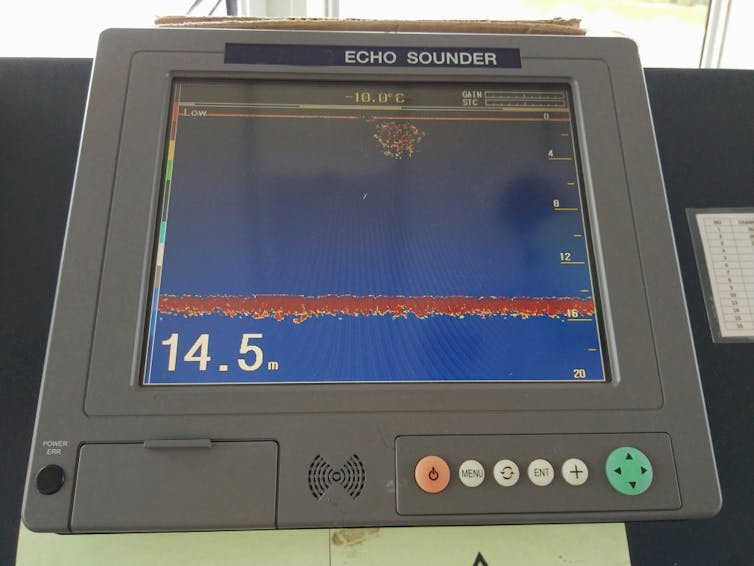
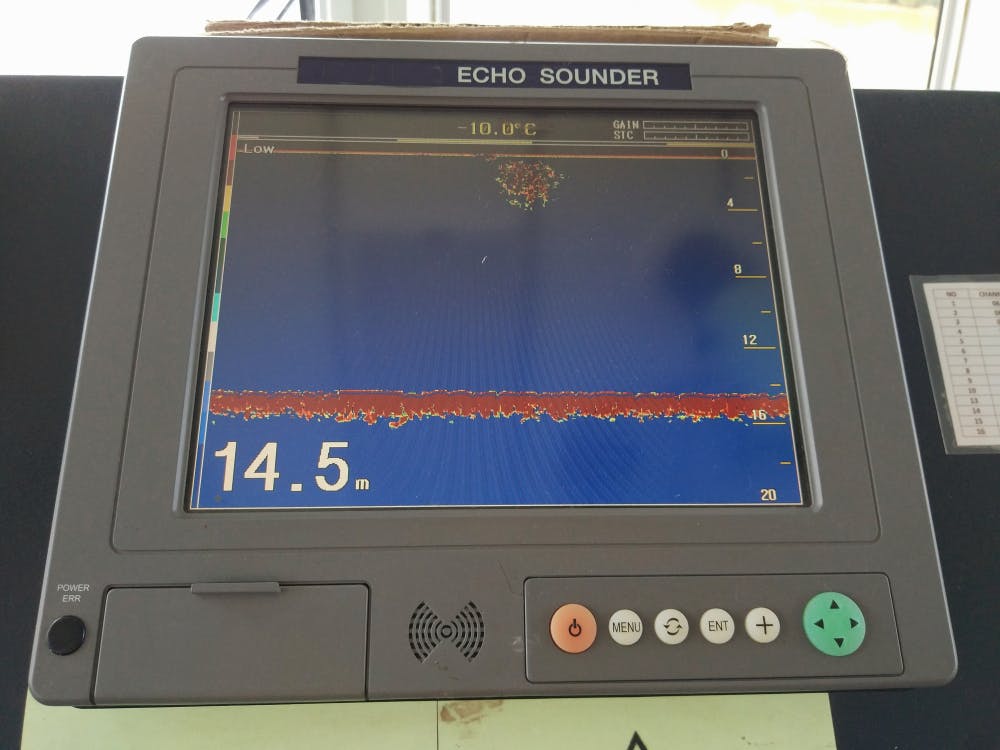
Sonar equipment sends out short acoustic (sound) pulses or pings, and then analyses the echoes. Depending on the timing, amplitude, phase and direction of the echoes the equipment receives, you can tell what’s under water – the seafloor, canyon walls, coral, fishes, and of course ships and submarines.
Most vessels – from small, private boats to large commercial tankers – use sonar. However, compared to your off-the-shelf sonar used for finding fish, navy sonars are stronger.
What are the effects of sonar on divers?
This is a difficult topic to study, because you don’t want to deliberately expose humans to harmful levels of sound. There are, however, anecdotes from various navies and accidental exposures. There have also been studies on what humans can hear under water, with or without neoprene suits, hoods, or helmets.
We don’t hear well under water – no surprise, since we’ve evolved to live on land. Having said that, you would hear a sonar sound under water (a mid-to-high pitch noise) and would know you’ve been exposed.
When it comes to naval sonars, human divers have rated the sound as “unpleasant to severe” at levels of roughly 150dB re 1 µPa (decibel relative to a reference pressure of one micropascal, the standard reference for underwater sound). This would be perhaps, very roughly, 10km away from a military sonar. Note that we can’t compare sound exposure under water to what we’d receive through the air, because there are too many physical differences between the two.
Human tolerance limits are roughly 180dB re 1 µPa, which would be around 500m from military sonar. At such levels, humans might experience dizziness, disorientation, temporary memory and concentration impacts, or temporary hearing loss. We don’t have information on what levels the Australian divers were exposed to, but their injuries were described as minor.
At higher received levels, closer ranges, or longer exposures, you might see more severe physiological or health impacts. In extreme cases, in particular for impulsive, sudden sound (which sonar is not), sound can cause damage to tissues and organs.
Read more: Mosquito devices may be used to disperse Australian delinquents – but how do they work?
What does sonar do to marine animals?
Some of the information on what noise might do to humans under water comes from studies and observations of animals.
While they typically don’t have outer ears (except for sea lions), marine mammals have inner ears that function similarly to ours. They can receive hearing damage from noise, just like we do. This might be temporary, like the ringing ears or reduced sensitivity you might experience after a loud concert, or it can be permanent.
Marine mammals living in a dark ocean rely on sound and hearing to a greater extent than your average human. They use sound to navigate, hunt, communicate with each other and to find mates. Toothed whales and dolphins have evolved a biological echo sounder or biosonar, which sends out series of clicks and listens for echoes. So, interfering with their sounds or impacting their hearing can disrupt critical behaviours.
Finally, sound may also impact non-mammalian fauna, such as fishes, which rely on acoustics rather than vision for many of their life functions.
Read more: Loud sounds at movies and concerts can cause hearing loss, but there are ways to protect your ears
Authors: Christine Erbe, Director, Centre for Marine Science & Technology, Curtin University
Read more https://theconversation.com/what-is-a-sonar-pulse-and-how-can-it-injure-humans-under-water-218116


















