

The Walkley awards were begun by a prominent oil baron. How do we reconcile their history and future?
- Written by: Denis Muller, Senior Research Fellow, Centre for Advancing Journalism, The University of Melbourne
In May this year, Belinda Noble, former journalist and the founder of Comms Declare, an organisation representing media professionals who won’t promote the expansion of fossil fuels, wrote on Ampol’s sponsorship of the nation’s premier journalism prizes, the Walkley Awards.
Three months later, Walkley Award-winning cartoonist Jon Kudelka announced he would boycott the 2023 Walkleys because of this sponsorship. He was soon joined by scores of other cartoonists, who linked the issue to the omission of a dedicated award for climate-focused journalism.
The controversies for the 2023 awards didn’t end there. On September 2, journalist Osman Faruqi wrote about the racist views expressed by the founder of the awards, oil baron Sir William (Bill) Walkley. The Walkley Foundation issued an apology for these views that day.
This week, the winners of the 67th Walkleys will be announced, so it is timely to discuss how we reconcile our present attitudes and knowledge with historical realities – and how resistant is our media to being seduced by powerful interests.
A murky history
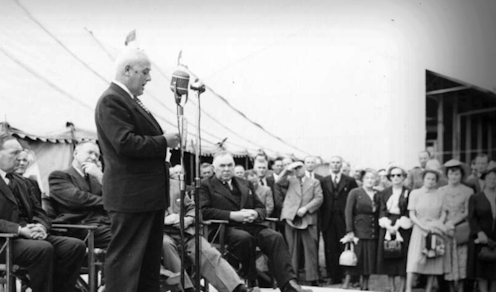
The first Walkleys were awarded in 1956, but Bill Walkley’s seduction of the media began a few years beforehand. As managing director of Ampol, in 1953 he chartered a plane to take reporters to Rough Range in Western Australia to witness the spudding of Australia’s first oil well.
Staff writers published in The Age:
The prospects for Australia – if the strike proves part of a big field – are limitless. The discovery of oil could mean as much to 20th century Australians as the introduction of Merino sheep meant to our great-grandparents.
Historian and former journalist John Hurst wrote of the trip:
the food was first class, there was plenty of grog […] and Walkley was his usual affable self and always accessible.
Reporters described the land in the language of the settler as “a lonely expanse carpeted with spiky spinifex, salt-bush and stunted scrub”:
Kangaroos, emus, flocks of goats and a few wandering, scraggy sheep are the only audience of man’s activity.
The First Australians were invisible. Respect for their ownership of the land, even for their very existence, was entirely absent.
This kind of duchessing of the media by the oil industry lasted for years. From the 1950s to the 1980s, among the most sought-after junkets in Australian journalism were the Shell Tours, conducted in association with the Royal Agricultural Societies in NSW and Victoria to brief journalists on rural affairs.

Some reporting got done and some evocative photographs taken, but the companies that sponsored these trips and the journalists who went on them did so in a cultural climate where certain values were dominant and others were entirely absent.
In this climate, figures like Walkley were lionised as people whose views about the nation’s future should be heard. In 1961, Walkley and six other leaders of business, commerce and industry were invited by the Sydney Morning Herald to write on the theme “if I ran this country”.
Walkley argued Australia was underpopulated and underdeveloped. In accord with the conventional attitudes (and the White Australia Policy) prevailing in 1961, Walkley declared:
Today Australians are but a drop of white in a sea of colour that teems with more than 1,200 million land-hungry Asiatics.
This language, just as the invisibility of the Aboriginal people at Rough Ridge, is repugnant to us though unremarkable at the time.
Added to those considerations now is the impact on the climate of our use of fossil fuels – ignored at the time, despite prophetic scientific warnings.
Read more: A question of ethics: journalists and climate change
Facing history and future
So how do we reconcile our present attitudes and knowledge with these historical realities?
Concerning Walkley’s racist attitudes, we may begin with the moral absolute that racism is always wrong, and condemn him on that ground. But his culpability, although not absolved, is mitigated by the cultural climate in which he wrote.
Removing his name from the awards would leave existing recipients in possession of awards devalued by association, which would be ahistorical and grossly unfair. Frank disclosure, faithful recording of history, and the apology made by the Walkley Foundation are sufficient.
 West Australia News journalist Steve Pennells at the 2012 Walkley awards.
AAP Image/Alan Porritt
West Australia News journalist Steve Pennells at the 2012 Walkley awards.
AAP Image/Alan Porritt
But climate change is a contemporary, not historical, problem to which Ampol contributes.
Typically under sponsorship arrangements, corporations are purchasing the goodwill of the media so if the need arises they will get the benefit of any doubt. This transactional element is harder to ignore.
The junket to Rough Ridge resulted in highly positive publicity for Ampol and Walkley. Certainly it reported an important development in Australia’s history – but the enthusiastic tone of celebration was generated by the goodwill resulting from the treatment the journalists received. Today there is a greater awareness among journalists of these dynamics but it is still hard to bite the hand that feeds.
There is a precedent for disconnecting journalism from fossil fuel revenue. Guardian Australia, whose journalists qualify for Walkley awards, has made a policy decision not to accept fossil fuel advertising.
Weakened by the impact of the internet on advertising revenue and of social media on information dissemination, the media and the profession of journalism on which they rely are not in a strong financial position to resist sponsorship. The ethical question for the Walkley Foundation is whether it is prepared to allow Ampol to get whatever benefit the company perceives comes its way from this sponsorship.
It comes down to principle, as Guardian Australia has demonstrated.
And if the Walkley Foundation were to introduce an award for climate-focused journalism, how would that sit with sponsorship from an oil company?
Read more: Global journalism needs global ethics
Authors: Denis Muller, Senior Research Fellow, Centre for Advancing Journalism, The University of Melbourne


















