

Controversial claims about extinct humans are stirring up evolution research. Here's how the mess could have been avoided
- Written by: Mike W. Morley, Associate Professor and Director, Flinders Microarchaeology Laboratory, Flinders University
In June, researchers led by palaeoanthropologist Lee Berger published sensational claims about an extinct human species called Homo naledi online and in the Netflix documentary Unknown: Cave of Bones. They argued the small-brained H. naledi buried their dead in Rising Star Cave in South Africa more than 240,000 years ago, and may also have decorated the cave walls with engravings.
If true, this would be an astonishing new entry in the annals of human evolution. But many scientists – including ourselves (the authors of this article, along with Ian Moffat at Flinders University in Australia, Andrea Zerboni at the University of Milan in Italy, and Kira Westaway at Macquarie University in Australia) – are not convinced by the evidence in the three online articles.
The peer reviewers of these articles and the journal editor found that the evidence was “inadequate” and suggested a comprehensive list of changes that would be needed to make the articles’ argument convincing. More recently, a strongly worded, peer-reviewed critique by one of us (Herries) concluded there was not enough evidence to support the hypothesis that H. naledi carried out intentional burials.
The need for an analytical revolution
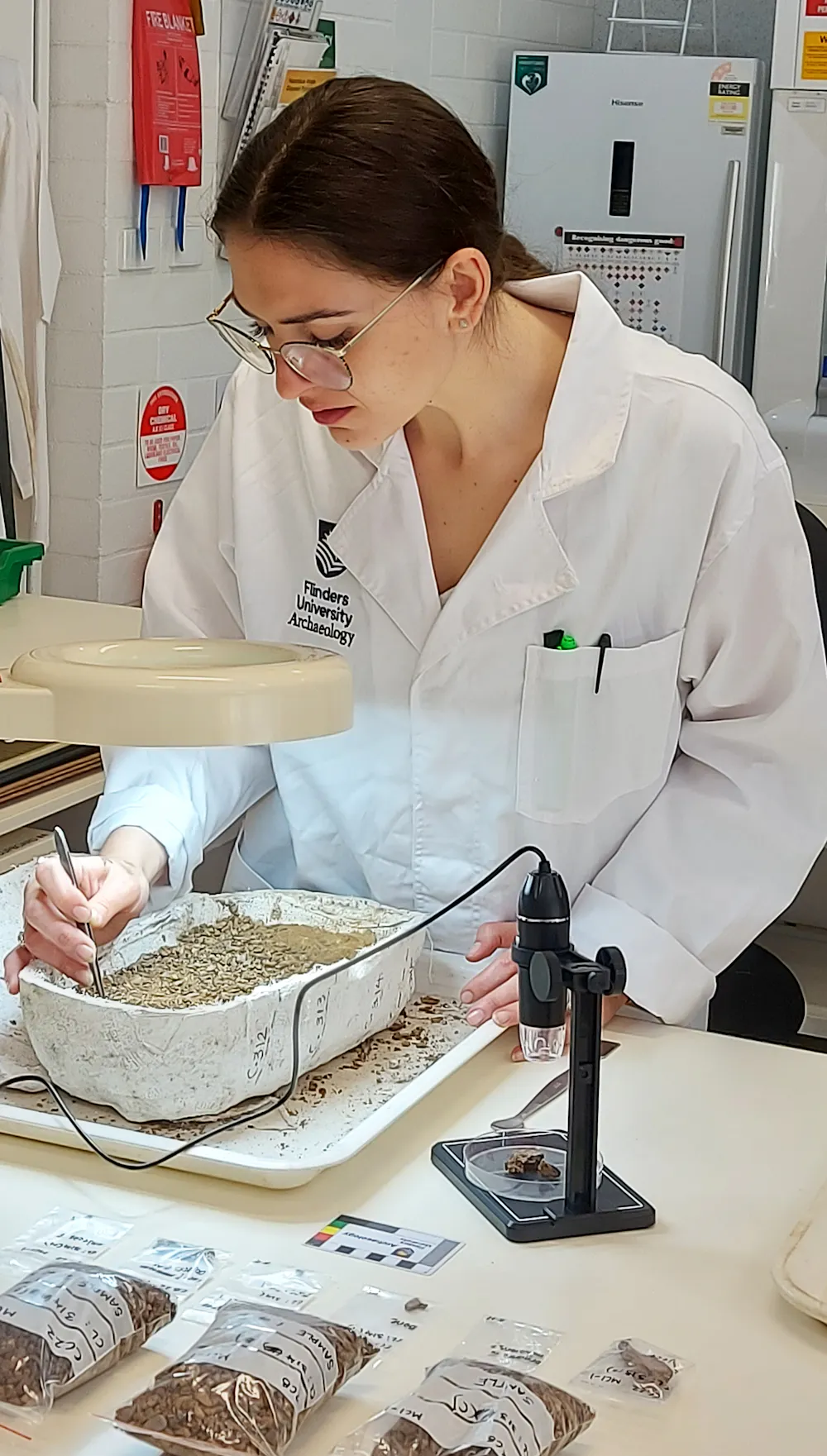
What would “enough evidence” for such claims look like? As we argue in a new comment piece in Nature Ecology and Evolution, there are modern scientific techniques that could provide it.
There are many kinds of evidence for human evolution, such as fossils and artefacts, and the sediment (or dirt) from which they are recovered. There are also many new and creative ways we can use to study this evidence.
We argue that the routine use of these techniques to generate supporting data will help avoid future controversies and increase public confidence in such claims.
Scientific collaborations
Human evolution researchers deal with very long timescales, often measured in hundreds of thousands – or even millions – of years. Because of this, we often work with geologists and other Earth scientists, and use their ideas and tools to analyse traces of ancient humans.
The analytical techniques of the Earth sciences can provide extremely useful information about the context of fossils and archaeological material.
These techniques are commonly used to study the sediments that the archaeology and fossils are recovered from. These kinds of analyses can be carried out at the microscopic level, which means we can find information about the collected remains that would otherwise be impossible to obtain.
Answers in the dirt
Better instruments and ways to study dirt means that archaeological science can be used to understand the processes that form archaeological sites and preserve fossils and artefacts in incredibly detailed ways. We can even study evidence at the scale of molecules and elements.
One way of studying dirt that is gaining traction in the field is known as micromorphology. This method involves the microscopic analysis of sediment that surrounds fossils or archaeology.
Read more: Dishing the dirt: sediments reveal a famous early human cave site was also home to hyenas and wolves
By studying intact blocks of sediment removed from archaeological trenches, microscopic clues can be pieced together to reconstruct the past environments present at the site and in the local environment.
What’s more, the same blocks of sediment can be used for other analyses, such as refining the ages of the dirt and to better understand how archaeological sites form and preserve up until the point of discovery.
What’s in the dirt? Science can tell us
Micromorphology has proven to be a powerful tool for analysing ancient human remains and burial practices. In 2021, scientists who studied the oldest known human burial (78,000 years ago) used micromorphology to help identify the burial and publish the work in Nature.
Earlier, in 2017, the technique was used to identify hearth features at Liang Bua cave (Indonesia). These small fireplaces were not obvious to the naked eye but under the microscope showed all of the characteristics of burning, including micro-traces of charcoal and ash.
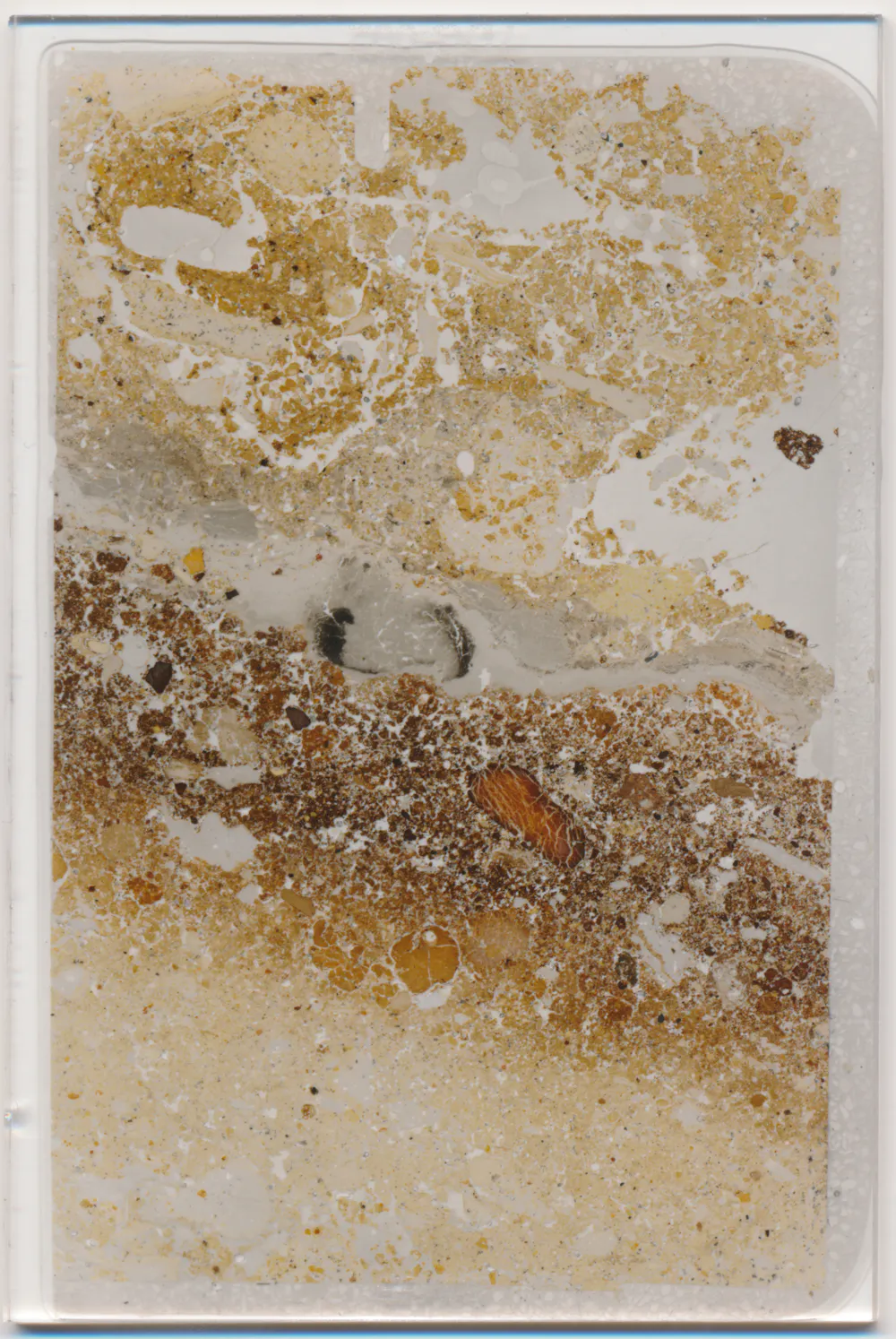 A microscope slide showing traces of an ancient fireplace at Liang Bua cave.
Mike Morley
A microscope slide showing traces of an ancient fireplace at Liang Bua cave.
Mike Morley
Fossils of H. floresiensis (dubbed “hobbits”) were also found in this cave. However, it turned out the hearths were made by H. sapiens 46,000 years ago, after the last appearance of the hobbits (around 60,000–50,000 years ago).
In the case of H. naledi, micromorphology could have provided evidence for, or against, the idea that the remains were deliberately buried. It might have found traces of a grave cut or subtle differences in the sediment used to cover the body that might not have been obvious during excavation.
In fact, three of the four peer reviewers of the original burial paper suggested micromorphology could have been used to interpret the sediments of the possible grave fill.
What next?
As scientists working in the field of human evolution, we are thrilled about the Rising Star Cave fossils and the recognition of H. naledi as a new member of our genus, Homo. We trust the team working at the site will soon present new data that convinces us all one way or the other about the question of intentional burial.
On the weight of the currently available evidence we agree with others that there is no compelling case for that particular mortuary practice at the site. However, there are a raft of scientific techniques that could help end the controversy.
It can be incredibly difficult for the public to disentangle facts from fiction. We believe scientists need to be extremely careful about how they communicate their findings to avoid an increase in scepticism towards scientists that can have a major impact across all aspects of modern life.
Aside from the H. naledi burial debate, we would like to see a future where all investigations into human evolution use these scientific techniques from the outset. This might avoid future controversy and find clues that strongly support hypotheses. This would also allow for greater confidence in findings presented to the scientific community and public alike.
Authors: Mike W. Morley, Associate Professor and Director, Flinders Microarchaeology Laboratory, Flinders University

















