

We thought we’d find 200 species living in our house and yard. We were very wrong
- Written by: Matthew H. Holden, Lecturer, School of Mathematics and Physics, The University of Queensland
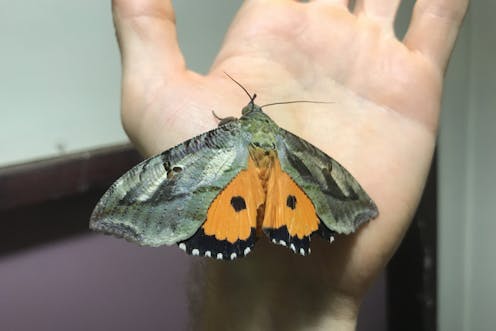
We are biodiversity researchers – an ecologist, a mathematician and a taxonomist – who were locked down together during the COVID pandemic. Being restricted to the house, it didn’t take long before we began to wonder how many species of plants and animals we were sharing the space with. So we set to work counting them all.
We guessed we would find around 200–300, and many of our colleagues guessed the same.
There was nothing extraordinary about our 400 square metre block of land in Annerley, a suburb of Brisbane in Queensland, Australia. Roughly half the block was occupied by a three-bedroom house.
What was extraordinary was the number of species we discovered there. As revealed in our just-published study, starting on the first day of lockdown and continuing over the course of a year, we catalogued 1,150 species on our inner-city property.
Familiar faces and rare recluses
Many of the species were what any east coast suburban Australian would expect: ibises, brush turkeys, kookaburras, possums and flying foxes. But, surprisingly, others had rarely been recorded.
In fact, three of the 1,150 species had never been documented in Australia’s leading biodiversity database at that point. This included a rare mosquito, a sandfly and an invasive flatworm that can cause populations of native snails to decline.
Read more: The 39 endangered species in Melbourne, Sydney, Adelaide and other Australian cities
We found common foes, but also many friends. That rare mosquito was just one of 13 mosquito species we found. The cupboards accommodated pantry moths and grain weevils, but also spiders to prey on them (we recorded 56 species).
Our lack of assiduous garden-tending meant weeds were prolific; of the 103 plant species we documented on the property, 100 were non-native.
Apart from weeds, however, the vast majority of species were actually native. Our two massive lilly-pilly trees provided shade, shelter and food, magnets for numerous pollinators and other species.
Bees and butterflies

The yard was filled with pollinators. For example, there were hoverflies which, at a quick glance, you’d think were wasps. We had ten species of those, a fraction of the more than 109 species of flies we found.
Native blue-banded bees and fluffy teddybear bees roosted in the hedges under our windows at night. They were just two of more than 70 bee and wasp species we observed.
We also counted a mindblowing 436 species of butterflies and moths. A few were as large as a human hand, but most were tiny and barely noticeable. Some were brightly coloured, while others – like the vampire moth Calyptra minuticornis – seemed boring until we began to study their behaviour.
The moth Scatochresis innumera is another interesting one: as a caterpillar, it lives inside a single possum poop before emerging as an adult.
The caterpillars of Parilyrgis concolor, yet another moth, live in spiderwebs, surviving on the spider’s food waste, while the adults can be found hanging bat-like from the spiderwebs. It is not known how they avoid getting eaten by the spiders.
Wasps and beetles
We recorded ten species of lycaenid “blue” butterflies, many of which use ants to protect their caterpillars from predators, including certain wasp species which would lay eggs in them if they got a chance.
These wasps are called parasitoids – meaning their young develop in other organisms, eventually killing them. Some of these wasps even parasitise other parasitoid wasps. Our urban homes are clearly complex ecosystems.
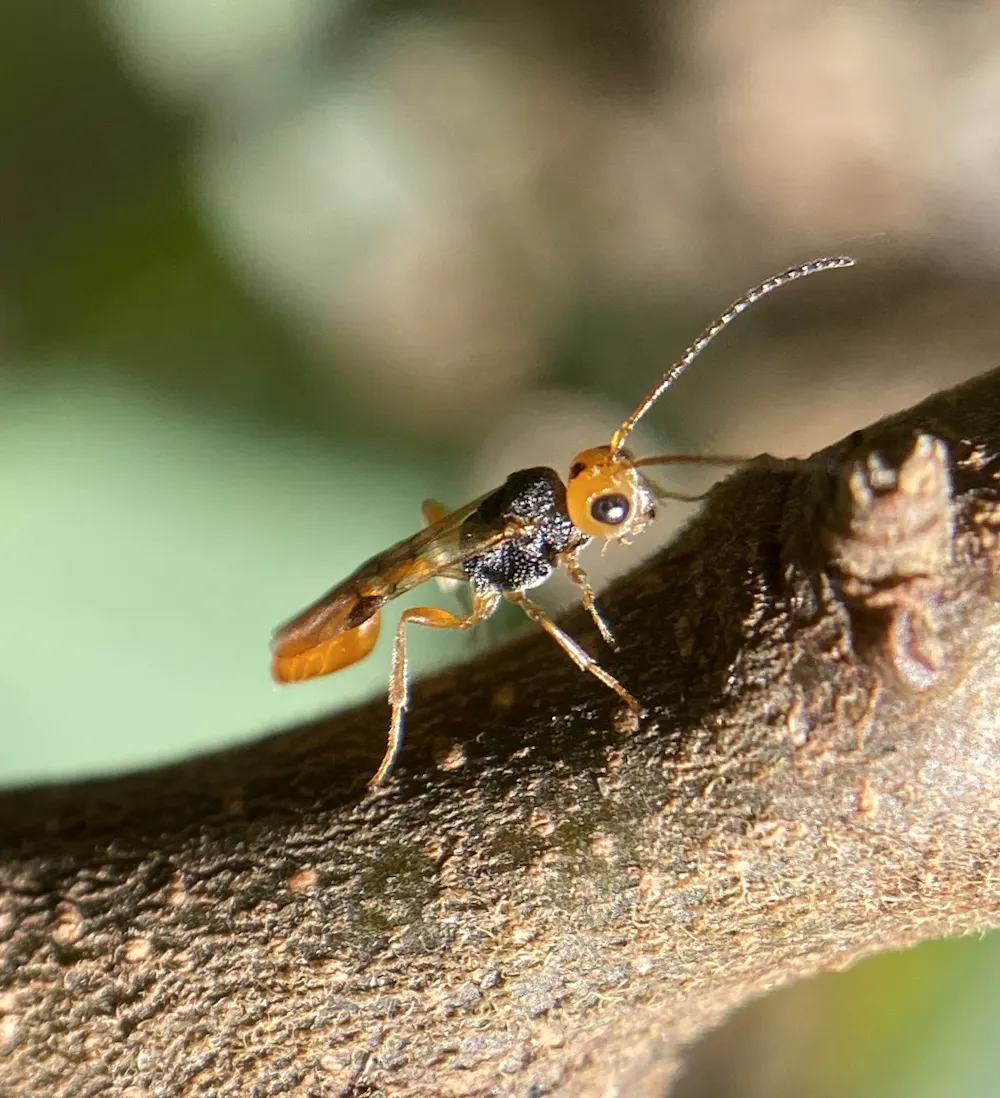 A tiny Braconid wasp that parasitises other insects.
Matthew Holden
A tiny Braconid wasp that parasitises other insects.
Matthew Holden
We were surprised to only find just under 100 beetle species (the fourth most common group of organisms in our study). Beetles are widely believed to be the most diverse order of insects on the planet.
Our finding may be a sign of declining beetle populations, which has been observed around the world. On the other hand, it may just have been a bad year for beetles in our neighbourhood.
An urban environment teeming with life
Overall, we found far more species than we expected, and we showed that even urban environments can be teeming with wildlife.
A big reason for that was surely the vegetation: the shrubs, trees and weeds in the yard. The monotony of perfectly tended lawn and heavily sprayed and manicured flowerbeds may be nice to look at and for the kids to play on but, as habitat for urban wildlife, it is lacking.
Read more: Here's how to design cities where people and nature can both flourish
Our own laziness meant we did little work in the garden. However, by giving the mower and pesticides a break, and by sacrificing some lawn for native trees, shrubs and flowering weeds, we ended up with something much more valuable.
But no matter what you do to maintain your home, definitely check your porch or balcony light tonight, and keep your eye out for urban wildlife around your home. You too can experience some pretty amazing nature, no matter how urban the environment you live in.
Authors: Matthew H. Holden, Lecturer, School of Mathematics and Physics, The University of Queensland


















