

If you've got solar, can you run aircon without worrying about cost? Not quite
- Written by: Wasim Saman, Emeritus Professor of Sustainable Energy Engineering, University of South Australia
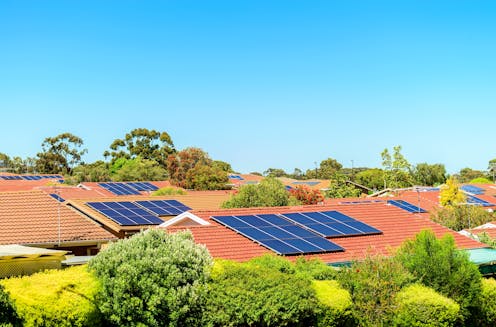
You’re inside on a scorching 40°C day, running your air conditioner on full for extended hours. Normally, you might worry about cost – or even the impact on the grid or the environment. But you’ve got solar on your roof, so you should be producing plenty of power to offset your aircon.
This line of thinking is common. Is it correct? Not quite. While it’s true that solar on your roof usually performs well over summer, there is an issue here for you and the grid.
Your solar performs at its best when the sun is high. But the hottest part of the day is actually in the late afternoon. As heat builds up and up, you often need cooling late into the evening even as output from your solar array starts to drop.
That’s not to say solar isn’t worth it – it will cut your cooling bill substantially. Here’s what this phenomenon means for you – and for the grid.
Hot and hotter
Australia has heated up by 1.47°C since 1910. Globally, this year is breaking all records, with temperatures briefly passing 2°C above the pre-industrial period.
Heatwaves have already started and we’re likely to see many more in Australia this summer. A heatwave is three or more days when daytime and night-time temperatures are unusually high. They’re often worse in cities, where black surfaces such as roads and roofs trap heat, and as air conditioners dump heat out to the outside air. This, in turn, means more demand for electricity to cool houses. Australia’s energy market operator forecasts electricity demand will hit a one in ten-year high this summer.
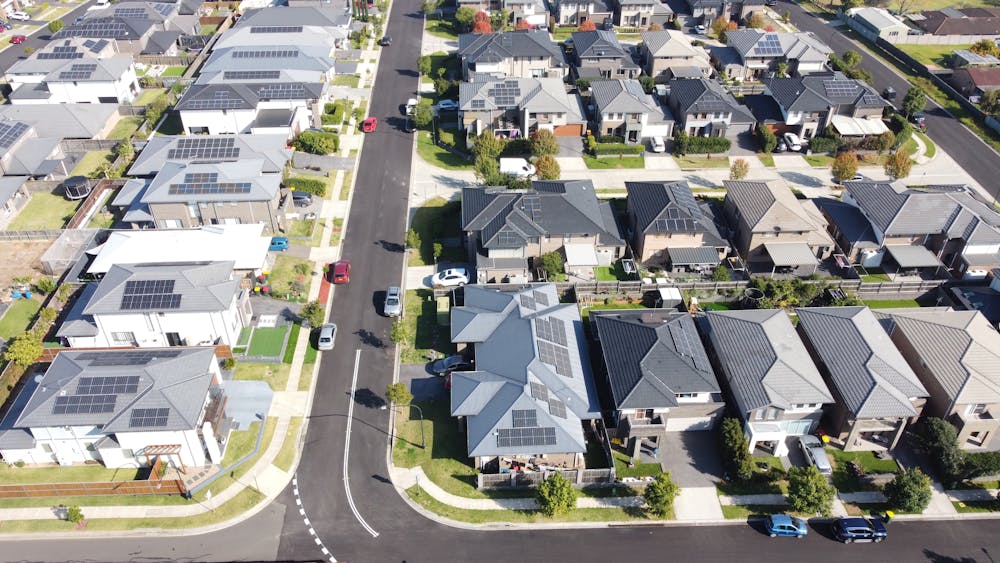
As electricity prices rise, many of us have responded by going solar. One in three Australian households – 3.6 million homes – now generate electricity domestically. In South Australia the proportion is nearly 50%.
As Australia gets hotter, aircon use will drive more electricity demand in all mainland cities. We estimate the extra demand for cooling will drive up demand in Sydney and Brisbane 20% and 49% respectively by 2050.
Heat – especially sustained heat – is dangerous. During the last northern summer, North America, Europe and China experienced record heatwaves. Deaths linked to this year’s heatwaves reached 62,000 in Europe.
Staying cool is a health issue. We do not want to advise people to turn off their aircon when they need it most – especially for people with health concerns or older people.
 Staying cool matters for your health.
Shutterstock
Staying cool matters for your health.
Shutterstock
Solar and heatwaves
During hot periods, residential demand accounts for 50% or more of the peak demand in many parts of Australia. Before the age of solar, peak power demand in South Australia more than doubled during a heatwave and the peak demand on the grid occurred close to midday.
Now that solar is common, this midday peak has been cancelled out. But we now must cope with a smaller late-evening peak during heat events, as the sun sets but the air is still hot.
When we drill down to individual homes, we can clearly see domestic air conditioning is the major driver behind peak power demand.
Our research in homes shows air conditioning accounts for 72% (Adelaide) and 90% (Brisbane) of household electricity usage during peak times. This is true even of low-energy use houses. When we monitored 60 low energy homes in Adelaide’s Lochiel Park Green Village over a year, we found that while these homes used considerably less electricity overall, aircon was still a major draw.
The longer the heatwave, the higher the peak electricity demand. This is likely due to buildings struggling to shed excess heat overnight and households becoming less tolerant of the conditions. As heatwaves go on, the demand for power overnight gradually increases.
Most Australian homes have lower energy-efficiency ratings than these homes, and will need more electricity for cooling. But the average rooftop solar array in Australia is around 6 kilowatts, while the average for new solar is now almost 10kW. These larger arrays will cope with higher air conditioning demand during the day, but will not tackle the night peak.
Read more: How to make homes cooler without cranking up the air conditioning
What can you do to cut aircon bills?
Choosing the right size air conditioner for your space with a high energy efficiency (6 star rating) is essential at the outset. If your aircon is more than ten years old, replacing it by a more efficient one will save money.
If you already have aircon, you can reduce its thirst for power. We know well-insulated houses with light-coloured roofs are more resistant to heatwaves, are more thermally comfortable to live in, and need less air conditioning.
If you’re renting, you have limited ability to control these factors. One option to weather heatwaves without huge energy bills is to create a “cool retreat” – cooling one room rather than the whole house.
You can also cut energy bills and emissions by:
- turning the air conditioner on earlier in the day while the sun is shining
- setting it to a slightly higher temperature
- using external blinds or shutters to reduce direct sun heat from windows
- reducing other electricity use in late afternoon and evenings.
Looking to the future
At grid scale, the ever-growing number of residential arrays and grid-scale solar farms with batteries will help reduce the risk of blackouts this summer.
Home batteries can store excess electricity from solar for use in the evening peak. Thermal batteries are an emerging technology which store heat or cold for later use. When vehicle-to-grid technology gets cheaper and more widely used, you will be able to use your electric car as a much larger home battery and use your own stored solar when the sun is not shining, rather than paying top dollar for grid power.
Acknowledgements: The author would like to thank many colleagues, particularly Stephen Berry and David Whaley for contributing to the research behind this article.
Read more: How to maximise savings from your home solar system and slash your power bills
Authors: Wasim Saman, Emeritus Professor of Sustainable Energy Engineering, University of South Australia


















