

What are ‘decodable readers’ and do they work?
- Written by: Misty Adoniou, Associate Professor in Language, Literacy and TESL, University of Canberra
The Victorian Coalition has promised $2.8 million for “decodable readers” for schools if they win the upcoming election.
Money for books must surely be a good thing. But what exactly is a “decodable reader”? After all, surely all books are decodable. If they weren’t decodable they would be unreadable.
Read more: Lost for words: why the best literacy approaches are not reaching the classroom
What is decoding?
The Australian curriculum provides a clear definition of decoding:
A process of working out the meaning of words in a text. In decoding, readers draw on contextual, vocabulary, grammatical and phonic knowledge.
However the Victorian Coalition is defining decoding as “sounding out letters”. As their policy platform states:
Decodable books are designed to align with explicit, systematic phonics instruction. They are simple stories constructed using almost exclusively words that are phonetically decodable, using letters and letter-groups that children have learned in phonics lessons.
The “decodable readers” they are funding are books that are contrived to help children practise a particular letter-sound pattern taught as part of a synthetic phonics program.
For example, the following sentences are from a decodable reader designed to focus on the consonants “N” and “P” and short vowel /a/
Nan and a pan.
Pap and a pan.
Nan and Pap can nap.
 Decodable readers don’t have a narrative.
Reading a-z.com
Decodable readers don’t have a narrative.
Reading a-z.com
Books like this have no storyline; they are equally nonsensical whether you start on the first page, or begin on the last page and read backwards.
While they may teach the phonics skills “N” and “P”, they don’t teach children the other important decoding skills of grammar and vocabulary.
And as many a parent will testify, they don’t teach the joy of reading.
Read more: The way we teach most children to read sets them up to fail
What about the children’s vocabulary development?
Meaning and vocabulary development are not the focus of decodable readers. Yet, research shows the importance of vocabulary for successful reading.
Students need to add 3,000 words a year to their vocabulary to be able to read and write successfully at their year level.
Limited vocabulary in books translates to lack of vocabulary growth.
What is the alternative to ‘decodable readers’?
Supporters of decodable readers are hopeful these books will support students with reading difficulties, by focusing closely on the sounds in words. However, focusing on sounds alone is not sufficient to support a struggling reader.
The reality is all children learning to read need to listen to, and read books that are written with rich vocabulary, varied sentence structures and interesting content knowledge that encourages them to use their imagination.
Compare the text about Pan and Nap with the opening lines of Pamela Allen’s very popular story Who Sank the Boat?:
Beside the sea, on Mr Peffer’s place, there lived a cow, a donkey, a sheep, a pig, and a tiny little mouse. They were good friends and one sunny morning, for no particular reason, they decided to go for a row on the bay. Do you know who sank the boat?
This book immediately engages children and asks them to question, imagine and help solve a problem. Children always ask for this book to be read again and again and they enjoy joining in. They learn new vocabulary and incidentally learn about complex sentence structures, which they emulate in their oral language and story writing.
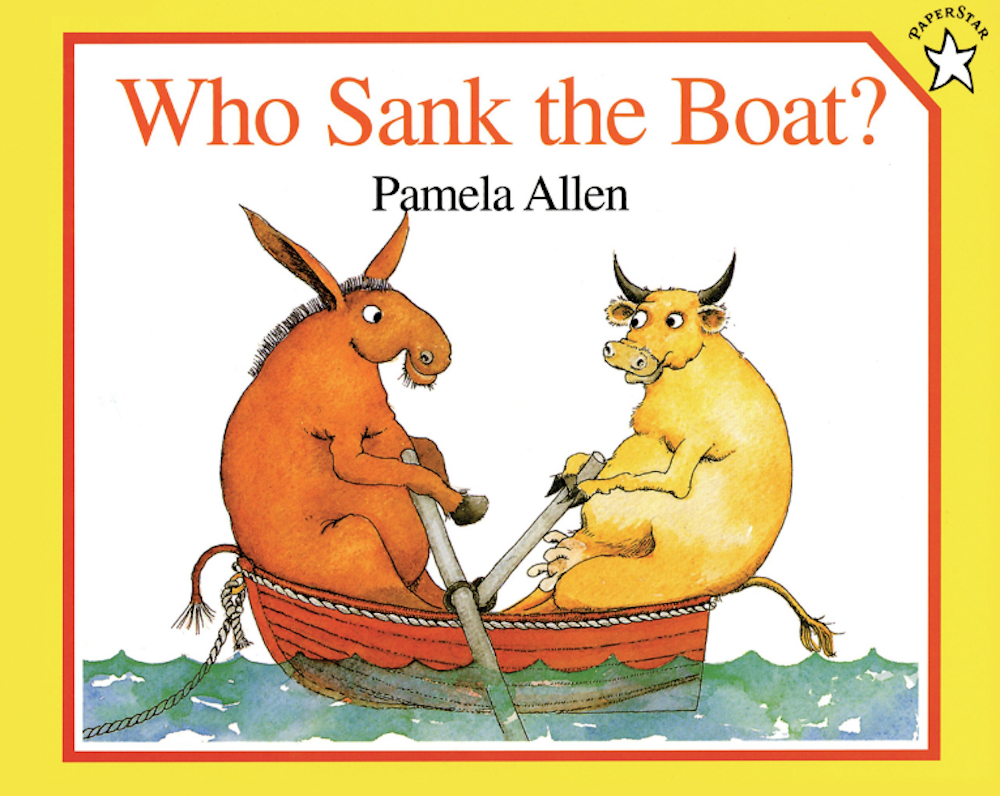 Kids want to unveil the mystery of who sank the boat – and they learn in the process.
Amazon.com
Kids want to unveil the mystery of who sank the boat – and they learn in the process.
Amazon.com
Read more: A balanced approach is best for teaching kids how to read
Using books to teach all the decoding skills
Using rich authentic texts supports all the decoding skills described in the Australian curriculum – phonics, vocabulary and grammar.
In Pamela Allen’s story above, we can look at the word “bay” and notice the parts /b/ - /ay/, which help us to say and spell the word. What happens if we change the beginning – how many other words could we write and read? For example, day, say, play, and so on.
We can look at the “frequent” words. These are the words that we can’t always “sound out” but which make up the 100 most frequent words in English. For example, do, you, they, were, the.
These words are very important to teach children, as these 100 words make up 50% of all written language.
We can develop their vocabularies with words and phrases such as “for no particular reason”, “decided” and “beside” .
We can introduce them to beautifully literate sentence structures, for example, “Beside the sea, on Mr Peffer’s place, there lived a cow, a donkey, a sheep, a pig, and a tiny little mouse”.
Decodable readers can only do the phonics part of the reading puzzle. They are a very inefficient way to teach reading.
So what do we want for all children learning to read?
When teaching children to read, we hope they will learn reading is pleasurable and can help them to make sense of their lives and those around them.
The strategies children are taught to use when first learning to read greatly influence what strategies they use in later years. When children are taught to focus solely on letter-sound matching to read the words of decodable readers, they often continue in later years to over-rely on this strategy, even with other kinds of texts. This causes inaccurate, slow, laborious reading, which leads to frustration and a lack of motivation for reading.
A book must be worth reading and give children the opportunity to learn the full range of strategies needed to read any text.
Children who grow up with real books, with rich vocabularies, beautiful prose and genuine storylines reach a higher level of education than those who do not have such access, regardless of nationality, parents’ level of education or socioeconomic status.
And yet it’s children from disadvantaged backgrounds who are less likely to have access to these books in their homes. It’s crucial schools fill the gap.
A$2.8 million spent on beautifully written books to fill Victorian classroom libraries would be a far more effective use of the education budget.
Authors: Misty Adoniou, Associate Professor in Language, Literacy and TESL, University of Canberra
Read more http://theconversation.com/what-are-decodable-readers-and-do-they-work-106067


















