

Climate change and nature loss are our biggest environmental problems
- Written by: Patrick O'Connor, Associate Professor, University of Adelaide
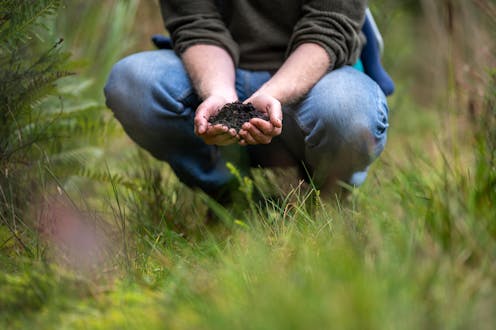
Climate change and biodiversity loss are arguably the greatest environmental challenges the world faces. The way we use land is crucial in finding solutions to these problems. In theory, actions such as revegetation and avoiding land clearing can tackle both problems at once – for example, by simultaneously storing carbon in plants and providing habitat for animals.
Sometimes when taking these actions, however, carbon storage is prioritised at the expense of biodiversity. But that need not be the case. Our new research suggests we can act to boost the climate and nature at the same time.
We examined a financial incentive scheme in South Australia’s Mount Lofty Ranges. We found action by farmers to restore native woodlands on their properties also stored carbon in the vegetation. This carbon abatement, if converted into carbon credits, could have paid the farmers for their restoration activities. It suggests existing carbon markets can pay for biodiversity conservation.
To date, few market-based biodiversity schemes in Australia have been designed to reward farmers for delivering these twin benefits – and the same is true for carbon markets. This is a huge missed opportunity for both the climate and nature.
Carbon markets don’t always help nature
Carbon markets encourage farmers and other land managers to help mitigate climate change, through activities such as planting trees or avoiding land clearing. These activities are rewarded with “credits” which can then be sold to buyers wanting to reduce their carbon footprint, such as a polluting company. Similar schemes are emerging for biodiversity conservation.
Efforts to tackle climate change through land-based activities are welcome. But these interventions do not always lead to good biodiversity outcomes. For example, a particular tree species planted to store carbon may not be useful to animals in the area. It may even cause problems such as spreading weeds, which can add to biodiversity decline.
In Australia, the decline of native species and ecosystems is well-documented. The decline is marked in the eastern Mount Lofty Ranges where native vegetation – mostly eucalypt forests and woodlands – has been reduced to about 10% of its former extent.
It means many animal species in the Mount Lofty Ranges are falling in numbers. They include birds such as the diamond firetail, superb fairy-wren and purple-crowned lorikeet.
Reversing this decline requires restoring and protecting the native vegetation that feeds and homes these animals. We wanted to know if carbon markets could pay for such work.
What we found
We examined a payment scheme, known as BushBids, for farmers who manage the region’s degraded woodlands. It was funded by the federal government and administered by the state government.
The scheme, which began in 2006, invited private landholders to tender for ten-year contracts to undertake certain restoration activities. These included retaining fallen logs (instead of collecting them for firewood), limiting stock grazing, controlling weeds, and reducing grazing by both feral animals and overabundant native animals such as kangaroos. Such activities can lead to more carbon being stored in vegetation, debris and soils.
Monitoring showed the activities restored some components of the woodland systems – most notably the diversity of native plant species.
The activities also led to additional carbon being stored in the woodlands. Australia’s carbon market does not currently recognise this type of carbon gain.
But what if it did? We calculated how much carbon was stored by the restoration of degraded native vegetation across 12 sites. We then calculated how much of the cost of this work would have been covered by payments for that carbon storage.
We found the additional carbon stored in the woodlands could pay all, or a substantial proportion, of the price of restoring degraded native vegetation. The exact proportion covered depends on factors such as the carbon price, rainfall and rate of vegetation recovery.
A video explaining the authors’ findings.Implications for Australia
Our study shows how the price of restoring native vegetation for biodiversity conservation could be covered by trading carbon credits created at the same time. This could be achieved either with separate markets, or markets that include both biodiversity and carbon.
But using markets for both nature repair and carbon storage will only work if the markets are designed well.
That means changes to Australia’s existing carbon market may be required. Research has cast doubt over the integrity of more than half the credits generated in that market. It found under one particular method – regrowing native forests to store carbon from the atmosphere – most carbon storage for which credits were issued either had not occurred, or would have occurred anyway.
Separately, the federal government has recently passed legislation to establish a biodiversity scheme known as the Nature Repair Market. For this scheme to avoid making the same mistakes as the carbon scheme, it should involve methods and standards that lead to the right kinds of biodiversity restoration in the right places.
This means focusing on which species and ecosystems need protection. For example, it should include not just those species listed as threatened with extinction, but species declining in their strongholds, and where the decline of a species would have broader impacts such as damage to agriculture.
Australian farmers have demonstrated that they can restore degraded ecosystems in a cost-effective way – and they should have better access to carbon funding to do it. Done right, this can be a huge win-win for both nature and the climate.
Read more: 'Untenable': even companies profiting from Australia's carbon market say the system must change
Authors: Patrick O'Connor, Associate Professor, University of Adelaide


















