

Stringybark is tough as boots (and gave us the word 'Eucalyptus')
- Written by: Gregory Moore, Doctor of Botany, University of Melbourne
Few eucalypts are as versatile, varied and valuable as messmate stringybark. It was the first eucalypt to be scientifically named, and in fact gives us the name “Eucalyptus”.
Gum trees had been seen and collected on earlier expeditions, but a specimen collected on James Cook’s third expedition to Bruny Island off the Tasmanian coast was sent to the British Museum, where the French botanist Charles Louis L’Heritier de Brutelle named it and then published it in 1788.
Read more: Where the old things are: Australia's most ancient trees
L’Heritier named the specimen Eucalyptus obliqua, and so messmate stringybark is the first named and now type specimen for all Eucalyptus species. Because of the little caps covering the buds of this specimen, the name eucalypt was derived from the Greek eu, meaning “well”, and calyptos, meaning “covered”. Meanwhile, the asymmetrical or oblique leaf base gave us the description obliqua.
The name stringybark comes from the fibrous stringy bark that grows on the trunk of the tree, but no one knows the origins of the name messmate, which is also applied to several other eucalypt species.
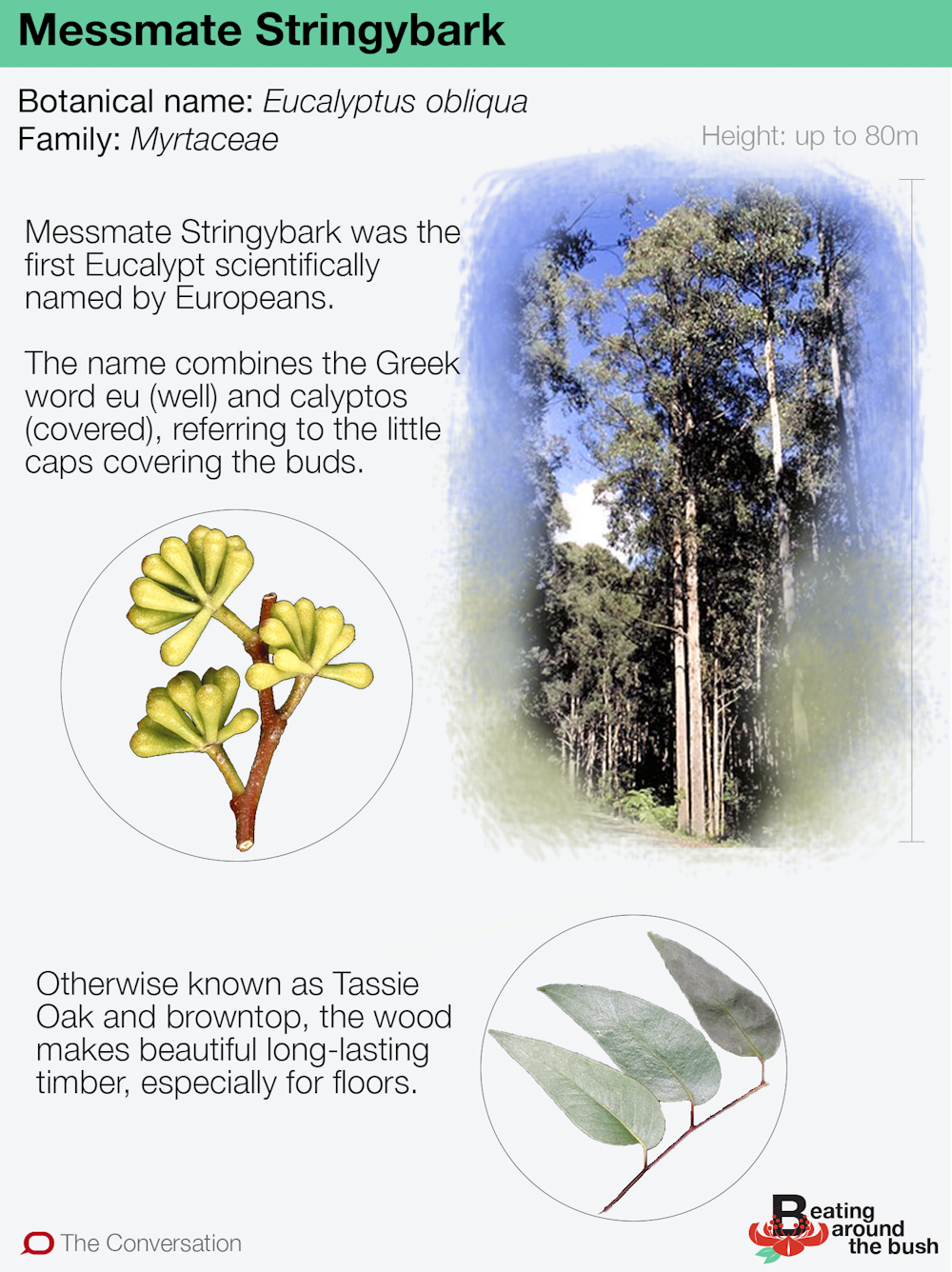 The Conversation, CC BY
Humming with bees
The flowers are small and white and often go unnoticed – but not by bees, which are often attracted to the trees in such large numbers that the trees seem to be humming. The fruits, or gum nuts, are also small at about 8mm across and usually occur in clusters of three, four or five. The juvenile leaves are quite large, almost heart-shaped, and up to 70mm wide and 100mm long, but the adult leaves are about 50mm wide and up to 200mm long with a sharply acute base on one side.
E. obliqua is also commonly known as messmate, stringybark, browntop, Tasmanian or Tassie oak, or browntop stringybark. It is widely distributed through southeastern Australia, growing in Tasmania, Victoria, South Australia and much of New South Wales, almost to the Queensland border.
It is usually a tall straight forest tree that can reach heights of 80m or more, and girths in excess of 10m. It grows in higher and wetter habitats and often grows around other eucalypts such as E. regnans, E. delegatensis, E. viminalis or E. radiata.
Read more:
Mountain ash has a regal presence: the tallest flowering plant in the world
The specimens that Cook’s expedition encountered on Bruny Island were huge forest trees, and there are still such specimens growing on the island today. They are well worth a visit along easily accessible tracks. Such giant specimens can also be found on the mainland in places such as the Otway Ranges. However, you can also find examples of E. obliqua growing in the coastal heaths of Victoria that are no more than a metre high and will maintain their short stature regardless of where they are grown.
The Conversation, CC BY
Humming with bees
The flowers are small and white and often go unnoticed – but not by bees, which are often attracted to the trees in such large numbers that the trees seem to be humming. The fruits, or gum nuts, are also small at about 8mm across and usually occur in clusters of three, four or five. The juvenile leaves are quite large, almost heart-shaped, and up to 70mm wide and 100mm long, but the adult leaves are about 50mm wide and up to 200mm long with a sharply acute base on one side.
E. obliqua is also commonly known as messmate, stringybark, browntop, Tasmanian or Tassie oak, or browntop stringybark. It is widely distributed through southeastern Australia, growing in Tasmania, Victoria, South Australia and much of New South Wales, almost to the Queensland border.
It is usually a tall straight forest tree that can reach heights of 80m or more, and girths in excess of 10m. It grows in higher and wetter habitats and often grows around other eucalypts such as E. regnans, E. delegatensis, E. viminalis or E. radiata.
Read more:
Mountain ash has a regal presence: the tallest flowering plant in the world
The specimens that Cook’s expedition encountered on Bruny Island were huge forest trees, and there are still such specimens growing on the island today. They are well worth a visit along easily accessible tracks. Such giant specimens can also be found on the mainland in places such as the Otway Ranges. However, you can also find examples of E. obliqua growing in the coastal heaths of Victoria that are no more than a metre high and will maintain their short stature regardless of where they are grown.
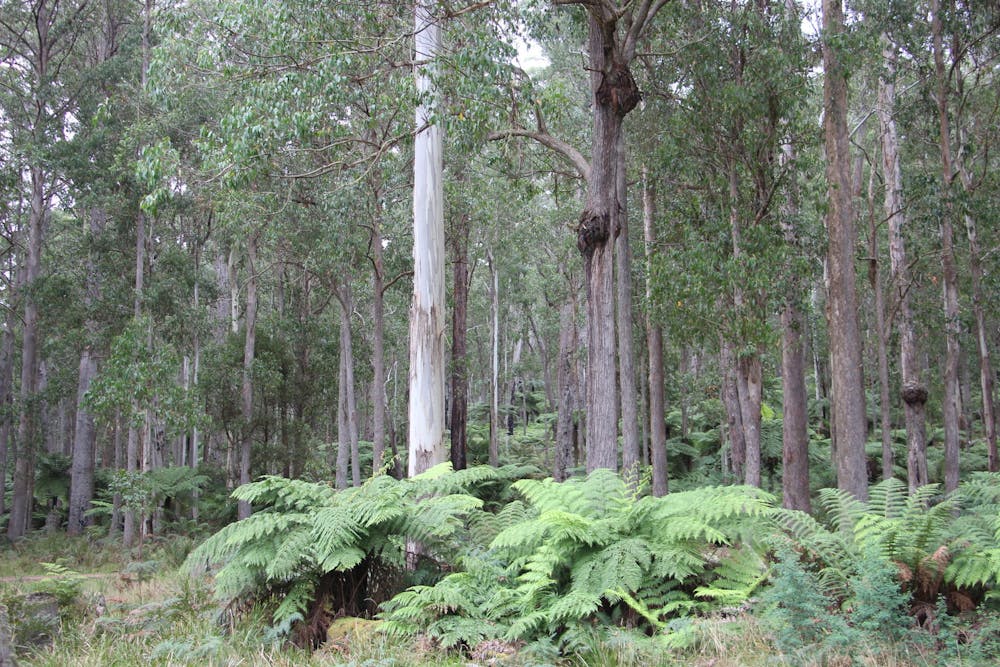 Stringybark near Mountain Ash, with a canopy height of around 40m.
Pete The Poet/Flickr, CC BY-NC
A tough customer
One of the great things about messmate stringybark is its environmental resilience. The species is renowned for its adaptations to stress, particularly fire. Its thick stringy bark protects the trunk during bushfires, and under the bark are dormant (or “epicormic”) buds that allow the rapid establishment of a leafy canopy after fire or other stresses such as grazing. These buds often sprout very soon after a fire and are the first sign the forest is beginning to regenerate.
Many of these new shoots will not last very long, but usually enough will survive to reconstitute the tree’s canopy. If all the shoots fail, most specimens have a lignotuber (like a mallee root) that allows new stems and trunks to develop after very severe stress. So E. obliqua is truly a tough customer.
During the most recent ice age, Tasmania and the mainland were connected by a land bridge that subsequently disappeared under Bass Strait. The populations of E. obliqua in Victoria and Tasmania were then connected but in the 10,000 years since they have been separated by the strait, the individual trees growing on the mainland have retained a lignotuber, while those in Tasmania did not. This reflects the better growing conditions in Tasmania for messmate stringybark, and less need or stress adaptations.
Read more:
A fresh perspective on Tasmania, a terrible and beautiful place
Good wood
The timber of E. obliqua is highly prized. It was used by Indigenous communities, as scars on some surviving trees indicate, and its fibrous bark could be used for making fibre and in fires. Today, it is a fine quality hardwood that can be used for building house frames, furniture making or, of course, for wonderful Tassie oak wooden floors.
It is not the densest or hardest eucalypt timber, but is hard enough to make beautiful and durable flooring that polishes to a rich honey or golden colour. Properly installed and maintained, these floors can remain in good condition for well over a century and many Australians will have fond memories of dancing on them.
Read more:
Unravelling the mystery of eucalypt scribbles
Messmate stringybark is one of the great trees of Australia for a variety of reasons. It has links to Captain Cook, is an economically important timber species, and is a great survivor in the harsh Australian environment. With its wide distribution and adaptations to fire and other stresses, it is a species likely to cope well with climate change. After all, it is as tough as boots.
Stringybark near Mountain Ash, with a canopy height of around 40m.
Pete The Poet/Flickr, CC BY-NC
A tough customer
One of the great things about messmate stringybark is its environmental resilience. The species is renowned for its adaptations to stress, particularly fire. Its thick stringy bark protects the trunk during bushfires, and under the bark are dormant (or “epicormic”) buds that allow the rapid establishment of a leafy canopy after fire or other stresses such as grazing. These buds often sprout very soon after a fire and are the first sign the forest is beginning to regenerate.
Many of these new shoots will not last very long, but usually enough will survive to reconstitute the tree’s canopy. If all the shoots fail, most specimens have a lignotuber (like a mallee root) that allows new stems and trunks to develop after very severe stress. So E. obliqua is truly a tough customer.
During the most recent ice age, Tasmania and the mainland were connected by a land bridge that subsequently disappeared under Bass Strait. The populations of E. obliqua in Victoria and Tasmania were then connected but in the 10,000 years since they have been separated by the strait, the individual trees growing on the mainland have retained a lignotuber, while those in Tasmania did not. This reflects the better growing conditions in Tasmania for messmate stringybark, and less need or stress adaptations.
Read more:
A fresh perspective on Tasmania, a terrible and beautiful place
Good wood
The timber of E. obliqua is highly prized. It was used by Indigenous communities, as scars on some surviving trees indicate, and its fibrous bark could be used for making fibre and in fires. Today, it is a fine quality hardwood that can be used for building house frames, furniture making or, of course, for wonderful Tassie oak wooden floors.
It is not the densest or hardest eucalypt timber, but is hard enough to make beautiful and durable flooring that polishes to a rich honey or golden colour. Properly installed and maintained, these floors can remain in good condition for well over a century and many Australians will have fond memories of dancing on them.
Read more:
Unravelling the mystery of eucalypt scribbles
Messmate stringybark is one of the great trees of Australia for a variety of reasons. It has links to Captain Cook, is an economically important timber species, and is a great survivor in the harsh Australian environment. With its wide distribution and adaptations to fire and other stresses, it is a species likely to cope well with climate change. After all, it is as tough as boots.
 Sign up to Beating Around the Bush, a series that profiles native plants: part gardening column, part dispatches from country, entirely Australian.
Authors: Gregory Moore, Doctor of Botany, University of Melbourne
Read more http://theconversation.com/stringybark-is-tough-as-boots-and-gave-us-the-word-eucalyptus-100528
&media=https://www.modernaustralian.com/https://images.theconversation.com/files/243630/original/file-20181102-83626-frpdtn.png?ixlib=rb-1.1.0&q=45&auto=format&w=754&fit=clip&description=Stringybark%20is%20tough%20as%20boots%20(and%20gave%20us%20the%20word%20'Eucalyptus') "Pin It")

















